
 AI Governance
 Data Centers
 Drones
 Climate
 Privacy
 2026 Maine Senate
 Bob Dylan
Wildfire Smoke Reaches Climate Havens
Coverage from The Conversation, The Detroit News, and others
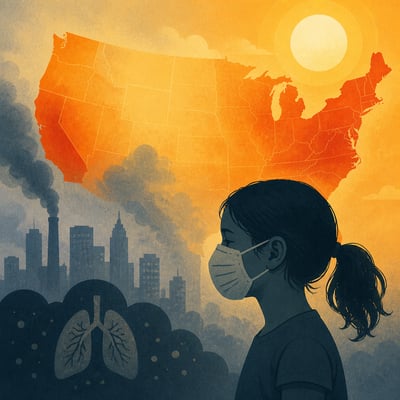
Hotter, drier conditions are contributing to severe Canadian and North American wildfires whose smoke is reaching cities far from the fire zones, including Toronto, Detroit, New York, and other Great Lakes communities.
Episodes of hazardous air are increasing respiratory risks, disrupting outdoor activities, schools, work, and local businesses, and challenging the idea that the Midwest is insulated from major climate impacts. The material points toward stronger indoor filtration, clean-air spaces, public-health warnings, and building protections, while indicating that emissions reductions could limit longer-term deterioration in air quality.
If you read one thing
It provides the clearest broad overview of the cross-border smoke episode, its climate drivers, and its health and disruption risks.
Best explainer
It explains how wildfire smoke travels from Ontario to distant U.S. cities while connecting transport risks to climate-driven fire conditions.
The counter-case
It represents the contested view that Canadian forest and fuel management bears primary responsibility for the smoke crisis.
The evidence
It adds quantified evidence of the substantial health and economic costs imposed by recurring wildfire smoke.
The evidence
It provides forward-looking projections showing how warming could make unhealthy summer air alerts increasingly routine.
Climate-driven wildfire escalation
Hotter, drier conditions and human-caused warming are increasing the likelihood and severity of major Canadian wildfire seasons. The evidence supports emissions reductions alongside forest management, preparedness, and response capacity.
Cross-border exposure erodes climate-refuge assumptions
Smoke from Canadian fires is transported into Ontario, the Great Lakes, and the U.S. Midwest and Northeast, making air-quality risk regional rather than confined to fire zones. This undermines the assumption that Great Lakes and Upper Midwest communities can reliably serve as climate refuges.
Air-quality harms are a recurring health and economic burden
Fine-particle smoke, ozone, and heat are driving respiratory and cardiovascular risks, disrupting outdoor activity and work, and imposing substantial economic costs. Research projects that unhealthy summer-air alerts could become routine for large populations without stronger climate action, while stay-inside guidance alone offers limited protection.
Response requires adaptation, mitigation, and coordination
The response is centered on cleaner indoor air, filtration, preparedness, targeted forest management, and emergency guidance, but these measures do not address the warming driver without emissions cuts. Political efforts to blame Canada or rely on tariffs conflict with expert calls for combined mitigation, adaptation, and cross-border coordination.
$11 billion to $20 billion USD per year
health-related damages from short-term wildfire-smoke exposure
“A study published in Science of the Total Environment estimated that short-term exposure to wildfire smoke costs Americans $11 billion to $20 billion per year, while long-term exposure costs $76 billion to $130 billion per year in health-related damages, in 2010 dollars.”
billions of dollars USD
local economic costs of wildfire-related air pollution
“On days with peak air pollution, people tend to stay inside rather than shop, dine out, or spend time outdoors. Businesses that rely on foot traffic receive fewer customers, while festivals, races, and sporting events may be canceled. Air pollution can therefore cost local economies billions of dollars.”
about a quarter
share of prior air-quality progress erased by wildfire smoke
“Recent research suggests wildfire smoke has erased about a quarter of the progress made over previous decades, and more than half in many western states.”
Contested Issue
Is the primary explanation and policy responsibility for cross-border wildfire smoke Canadian forest and fuel management, or climate-driven fire conditions and atmospheric transport?
The corpus contains materially different explanations and policy emphases. Some coverage treats Canadian forest management, fuel reduction, prescribed fire, and wildfire-response capacity as central causes and remedies, while other sources attribute escalating fire risk primarily to human-caused warming and identify atmospheric transport as the mechanism carrying smoke across borders.
Forest-management responsibility
Canadian forest and fuel management, prescribed fire, and wildfire-response capacity are presented as central explanations of the smoke crisis and as key policy levers.
Climate-and-transport explanation
Human-caused warming intensifies wildfire conditions, while atmospheric transport carries smoke across the border; emissions reduction and adaptation are therefore emphasized over assigning primary responsibility to Canada alone.
The newly added articles reinforce the already documented health, economic, and equity impacts of wildfire smoke but do not establish a material change beyond the prior state.
Previously
Climate-fueled wildfires in Canada are sending hazardous smoke across the U.S.-Canada border, while hotter summers and other pollution sources add to worsening air-quality risks. The impacts include dangerous PM2.5 exposure, increased respiratory and cardiovascular concerns, disrupted outdoor activities, and pressure on governments to provide clean indoor air and emergency guidance. The material points toward a combined response of emissions reductions, wildfire preparedness, filtration, and cross-border coordination rather than relying on forest management alone.
The story is reinforced with more concrete evidence of recurring smoke episodes disrupting municipal operations and healthcare, while the Great Lakes and Midwest framing becomes more prominent. New institutional attribution includes reported emergency-department increases during a severe episode.
The story now places greater emphasis on wildfire smoke’s broader socioeconomic and equity impacts, not just acute health risks, while documenting more concrete institutional responses.