Drought Extends the Wildfire SeasonDrought Extends the Wildfire SeasonCoverage from Hagadone News Network, Colorado School of Mines Newsroom, and others
00/00/0000
DailyWeekly
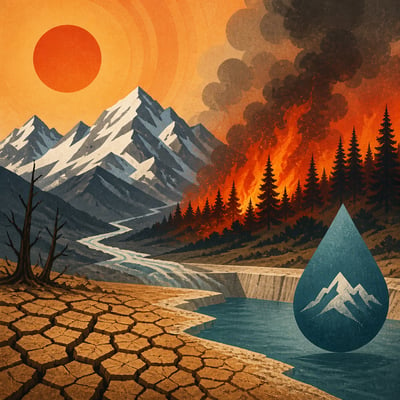
The topic centers on how warmer, drier conditions are deepening drought and reducing snowpack, leaving landscapes more vulnerable to larger and longer-lasting wildfires.
Across the western United States, low snow storage, earlier melt, high evaporative demand, and heat are affecting water supplies while increasing fire danger; smoke is also creating health impacts far from burn areas. Prevention measures such as prescribed fire, fuel treatments, defensible space, and emergency planning remain relevant, but researchers and officials indicate that climate-driven weather increasingly constrains their effectiveness.
It adds a distinct public-health dimension by documenting how wildfire smoke travels far beyond burn areas and increases health risks.
The Guardian / Ajit Niranjan
Key Issues
01
Warming is destabilizing the West’s snow system
Human-caused warming has sharply increased the likelihood and recurrence of extreme Western snow droughts. Warmer conditions are shifting precipitation from snow to rain and accelerating melt, with especially pronounced effects in the Upper Colorado River Basin.
Drawn from 5 articles
02
Snow loss is tightening water and allocation constraints
Reduced snowpack and earlier melt are cutting expected runoff, reservoir inflows, and hydropower reliability while increasing pressure on groundwater and agriculture. The Colorado River’s over-allocation makes the hydrologic shortfall an increasingly consequential allocation and governance problem.
Drawn from 5 articles
03
Fire seasons are longer and harder to suppress
Heat, drought, dry fuels, and reduced snowpack are increasing fire potential across the West and broader North America. Warmer, drier nights and more fire-favorable hours are extending daily burning windows and reducing the nighttime relief available for suppression.
Drawn from 6 articles
04
Smoke has become a continental public-health exposure
Climate-amplified fires in western North America and Canada are transporting fine-particle pollution far beyond burn areas, exposing urban and cross-border populations. Smoke exposure is creating recurring health and preparedness demands for outdoor workers and other vulnerable groups.
Drawn from 6 articles
Looking Back
1926 Day Timeline
Articles published over time. Hover any bar for the period and its article count.
May '21
Mar '22
Jan '23
Jan '24
Nov '24
Sep '25
Jul '26
The Story So Far
No material change
The supplied articles add no materially new development beyond the existing account of climate-driven drying, wildfire risk, and human exposure.
Previously
A combination of warmer conditions, prolonged drought, and historically low mountain snowpack is intensifying wildfire risk across the western United States and Canada while reducing the reliability of seasonal water supplies. Attribution studies find that human-caused warming substantially increased the likelihood of the discussed Western snow drought, with especially large effects in the Upper Colorado River Basin. The resulting fires, smoke, ecosystem damage, and water stress are increasing demands for improved land management, public-health protection, conservation, and emergency preparedness.
History
09/01/2026
The story now shifts from primarily projected and attributed risk toward documented 2026 wildfire activity exceeding seasonal averages, including major fires damaging homes. It also adds official agencies and researchers emphasizing that California's fire season is becoming less seasonal and that climate-driven conditions increasingly limit prevention effectiveness.
Researchers from Colorado and Wyoming found that human-caused climate change increased the likelihood of the West's severe snow drought across the Mountain West.
Colorado School of Mines researchers reported human-caused warming increased the 2026 Western snow drought odds, especially in the Upper Colorado River Basin.
Researchers reported attribution results in the Proceedings of the National Academy of Sciences linking industrial warming to substantially higher likelihood of extreme snow droughts in the American West.
Climate change intensified a Western US snow drought during the discussed year, reducing summer water supplies and increasing groundwater use, wildfire risk, and agricultural stress across major basins.
Scientists report climate change likely worsened Canadian wildfire heat and dryness, contributing to PM2.5 smoke episodes across New England and potential increased recurrence.
Climate risks from drought are expected to intensify during a strong El Nino period, amplifying heat, wildfire, and food and water insecurity in multiple regions.
Scientists and water managers in the American West report record-warm winter and March heat reduced snowpack, shrinking Colorado River runoff and raising drought, wildfire risk, and water restriction planning.
Climate Central-linked record warmth and a March 2026 heat wave in the western U.S. produced record-low April 1 snowpack, raising water and wildfire risks.
Researchers and Western lawmakers assessed Utah wildfire damage in late June, finding that climate-driven heat and drought increasingly overwhelm conventional forest management and threaten forest ecosystems.
Wildfires after heatwaves displaced tens of thousands in southern Europe and generated smoke over Canada and the United States as warming increases fire-weather risk.
Wildfire smoke risk increased in 2023-2026 due to drought, reduced snowpack, and regional fire regime changes, with health impacts amplified by uncertain smoke transport.
In July 2026, wildfire smoke from United States fires affected East Coast air quality, while fires in Spain and France underscored climate risks and a projected El Nino threatened hotter records worldwide.
Scientists report that record-low snowpack and record warm winter temperatures across the Western United States in early 2026 are endangering regional water supplies and increasing wildfire risk.
Climate change intensified wildfire conditions across the United States, Canada, and Europe in 2026, while wildland-urban development worsened destruction and evacuation risks.
Climate-amplified heat and dryness drove widespread 2026 wildfires across North America, Europe, and North Africa, causing evacuations, smoke pollution, deaths, and extensive ecological damage.
Over 800 wildfires in Canada during mid-July are sending smoke into Toronto, Boston, and New York City, escalating evacuations in Ontario and health risks in the U.S.
University of Michigan experts attribute worsening wildfire conditions in Canada, the United States, and Europe to human-caused warming and drying and stress smoke-related health risks.
In the Denver-to-Rocky-Mountains region and across the Great Lakes, warming has reduced snowpack and lake ice, shrinking reservoir and ecosystem stability.
Cal Fire, NOAA, and academic experts connect early-2026 U.S. wildfire growth to hotter, drier, and windier conditions expected to worsen under climate change.
Kaiwei Luo and coauthors report in Science Advances (2020s) that climate change has increased wildfire burning hours, especially across the American West.
Experts attribute Georgia wildfire growth to drought and climate change-driven atmospheric drying, with nationwide early-season fire acreage far above the 10-year average.
Russ Schumacher and Daniel Swain report record-low mountain snowpack across the American West after historically warm winter and extreme March heat, increasing dry-season water and fire risks.
Bill McKibben describes 2025 Canadian wildfires and cross-border wildfire smoke impacts, including Namaygoosisagagun First Nation evacuation in northern Ontario, with climate-linked warming cited as a driver.
Warm snow drought conditions in California and the Sierra Nevada are accelerating snowmelt, shrinking snowpack, and increasing wildfire and water-supply risks in 2026.
In August, more than 7,000 fire personnel fought 16 uncontained wildfires across Washington State as climate-amplified fire risk strained insurance, worker protections, and water management.
8/10/2026 • Policy, Politics & Governance • General
Canadian and Minnesota wildfires caused hazardous smoke across the United States in July 2026, while experts linked warming conditions to rising wildfire and infectious-disease risks.
Chicago Park District canceled outdoor activities in response to extremely hazardous air quality from Canadian wildfire smoke, which experts linked to climate change.
Canadian wildfire smoke during midweek caused unhealthy air in New Hampshire, attributed by state and meteorology officials to climate-amplified drought and wildfire spread risk.
Climate Central reported that exceptional heat and rain-dominated winter conditions across the western United States reduced mountain snowpack, increasing water shortages and wildfire risk.
Climate scientists in the western US report warm March conditions that melted depleted snowpack, advancing melt schedules and increasing April water and wildfire risk.
In the US West, record-low snowpack during a historic snow drought is increasing water shortage and wildfire risks as unusual warmth linked to climate change accelerates snowmelt.
Water managers and researchers report record-low Mountain West snowpack in March, raising Colorado River Basin water-supply, hydropower, and wildfire risks.
Daniel Swain and federal water managers warn record-warm conditions are shrinking Colorado River snowpack, increasing Lake Powell and hydropower risk as interstate water allocation talks stall.
Climate change and suburban expansion intensified wildfires near Reno, Nevada, in 2025, destroying homes, threatening residents, and complicating evacuations through constrained road networks.
Wildfire smoke from northern Minnesota and Canada triggered air-quality alerts for New York, Chicago, and Toronto during ongoing fire conditions, worsening health risks.
The National Interagency Coordination Center projects above-normal wildfire threat across the western U.S. this summer, citing snow drought, early snowmelt, and extreme heat.
March heat across nine U.S. states coincides with critically low western snowpack as Tropical Cyclone Maila and Asia heat-stress risks threaten multiple regions.
The National Interagency Coordination Center projected an above-normal wildfire threat across the Western United States for the upcoming summer season based on snow drought, earlier snowmelt, and an extreme heat wave.
Experts warn that historic snowpack decline and a mid-March heat wave across the Colorado River Basin and nearby states will raise summer risks to water supply, Lake Powell power generation, and wildfire conditions.
U.S. wildfire totals through March 27, 2026 exceed the 10-year average as drought, poor snowpack, and unseasonable heat increase risk across the Western United States and Great Plains.
World Weather Attribution analysis links record-setting early-spring heat in the US west to climate change, raising drought, water-supply, and wildfire risks.
Canada and the United States experienced severe wildfire seasons by late July 2024, as heat and drought increased fire spread and shifted management toward controlled burns and resilience planning.
In the United States, record-low western snowpack is cutting runoff and accelerating drought-driven wildfire risk while federal and city agencies pursue water conservation and alternative supplies.
Robinson Meyer reports that recurrent wildfire-smoke events in Chicago and the eastern United States are exposing more than 100 million people, shifting smoke risk from exceptional to planning-relevant.
A US wildfire risk outlook forecasts above-normal wildfire conditions through April as hot temperatures and drought expand, straining insurance systems and federal wildfire capacity.
Recent wildfire investigations in Reno, Nevada, and Spokane, Washington, show that human ignitions are widespread while climate-driven drying increases potential fire severity.
Ontario and northern Minnesota wildfires produced hazardous smoke and air-quality alerts across the Great Lakes, New England, and Maryland as heat and drought intensified through the weekend.
Washington state officials warn that as summers grow hotter, climate driven drought could trigger the next megafire in the Olympic and Cascade forest regions of Washington.
National Interagency Fire Center raised US wildfire preparedness to level 3 in response to multi-state June fires, linking climate-driven dryness to longer wildfire-favorable weather.
6/18/2026 • Policy, Politics & Governance • General
Bernie Sanders visited Michigan in 2026 to address wildfire smoke health risks and climate links during campaign stops in Detroit, Lansing, and Grand Rapids.
7/16/2026 • Policy, Politics & Governance • General

 AI Governance
 Data Centers
 Drones
 Climate
 Privacy
 2026 Maine Senate
 Bob Dylan