
 AI Governance
 Data Centers
 Drones
 Climate
 Privacy
 2026 Maine Senate
 Bob Dylan
Wildfire Smoke Reaches Climate Havens
Coverage from The Conversation, The Detroit News, and others
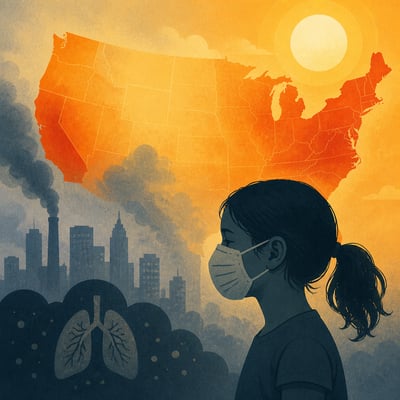
Hotter, drier conditions are contributing to severe Canadian and North American wildfires whose smoke is reaching cities far from the fire zones, including Toronto, Detroit, New York, and other Great Lakes communities.
Episodes of hazardous air are increasing respiratory risks, disrupting outdoor activities, schools, work, and local businesses, and challenging the idea that the Midwest is insulated from major climate impacts. The material points toward stronger indoor filtration, clean-air spaces, public-health warnings, and building protections, while indicating that emissions reductions could limit longer-term deterioration in air quality.
The story is reinforced with more concrete evidence of recurring smoke episodes disrupting municipal operations and healthcare, while the Great Lakes and Midwest framing becomes more prominent. New institutional attribution includes reported emergency-department increases during a severe episode.
The story now places greater emphasis on wildfire smoke’s broader socioeconomic and equity impacts, not just acute health risks, while documenting more concrete institutional responses.
The story now includes a political backlash, with U.S. figures advocating compensation or sanctions against Canada over smoke. Its interpretation also shifts toward coordinated cross-border adaptation and emissions cuts, rather than treating forest management as sufficient.
The story shifts from a cross-border smoke crisis plus political blame to a more climate-framed public-health narrative. The updated version drops the dispute angle and emphasizes warming-driven wildfire risk, climate-haven vulnerability, and preparedness measures.
The story has shifted from a broad cross-border smoke crisis to a more specific account of July 2026 wildfire impacts, with stronger emphasis on air-quality severity, public-health responses, and the constraints on suppression. It also adds a sharper political and policy dimension, including proposed accountability measures and updated climate projections.
- Toronto and the Great Lakes are newly highlighted as major smoke-affected areas.
- Hazardous-to-extreme air-quality readings are now explicitly reported.
- Health agencies recommended N95s, filtration, and cleaner-air spaces.
- Lawmakers proposed tariffs, sanctions, or regulatory action against Canada.
- Suppression limits from remote terrain and staffing constraints are newly emphasized.
The story adds a sharper political and scientific framing: U.S. leaders are now explicitly floating tariffs or sanctions against Canada, while researchers more directly tie the worsening fires to climate change and shared responsibility. The smoke episode itself remains the same, but the policy dispute and mitigation guidance are more developed.
The story broadened from a Canada-driven smoke episode into a cross-border wildfire and air-quality crisis affecting both Canada and the northern U.S., with a stronger emphasis on heat-driven fire behavior and political blame over responsibility. It also adds a new local pollution example from Washington, D.C., to show how non-wildfire sources can worsen air-quality problems.
- Wildfires in the northern United States are now part of the smoke event.
- Heat domes are described as trapping pollution near the ground.
- Donald Trump is blaming Canada and raising tariffs or sanctions.
- Mark Carney is now named in the cross-border dispute.
- Washington, D.C. fireworks are cited as compounding air-quality problems.
The story shifts from a broad pattern of recurring Canadian smoke events to a more specific mid-July 2026 outbreak tied to hundreds of fires, with clearer operational response and localized severity. The current version also adds more concrete evidence of weather-driven smoke dispersion and names additional actors involved in monitoring and event disruption.
- Hundreds of Canadian wildfires are driving the smoke episode.
- AQI was exceptionally hazardous in parts of Michigan, Ohio, Minnesota and Wisconsin.
- Officials closed or postponed outdoor activities and distributed masks.
- U.S. and Canadian authorities are coordinating firefighting and monitoring.
- Longer fire seasons and drier vegetation are increasing wildfire risk.
The story has broadened from a recurring smoke-and-health disruption into a more structural North American climate-risk narrative, adding modeling that projects worsening summer air quality through 2100 and a stronger emphasis on adaptation. Political blame over Canada is now present, but it is secondary to the expanding evidence that wildfire smoke is becoming a persistent cross-border exposure problem.
- Summer air quality is projected to worsen further by 2100.
- Adaptation measures now include stronger building filtration and fire-hardened standards.
- Trump and Republican lawmakers are discussing tariffs or sanctions over the smoke.
- Pollution is now framed as moving freely across national boundaries.
- Some wildfire smoke now originates from parts of the northern United States.
The story shifts from a broad smoke emergency centered on the U.S. Midwest and Northeast to a more Canada-centered event, with Ontario and Manitoba now emphasized as the main wildfire sources. It also adds new operational impacts, including cleaner indoor spaces and broader public-health and event-management responses.
The story now includes Minnesota wildfires as part of the smoke source, widening the event beyond Canadian fires alone. It also adds more concrete public-health and response details, including specific vulnerable groups and New York distributing over 100,000 masks.
The story has shifted from a broad climate-and-air-quality pattern to a more immediate cross-border wildfire-smoke crisis affecting the Midwest, Northeast, and Mid-Atlantic, with concrete event disruptions and political fallout. The new version also adds a sharper U.S.-Canada dispute over responsibility for wildfire prevention and climate action.
- Hundreds of Canadian wildfires produced widespread hazardous smoke impacts.
- Outdoor activities and sporting events were disrupted by air-quality conditions.
- Officials distributed masks and urged residents to use N-95 respirators.
- Donald Trump and Mark Carney entered the story's political dispute.
- Smoke uncertainty affected World Cup final preparations in New Jersey.
The story has broadened from a mainly forward-looking projection about worsening U.S. summer air quality into one that also captures active wildfire-smoke episodes already disrupting air across the U.S. and Canada. That shifts the emphasis from a long-range risk pattern to a combined picture of structural climate-driven pollution and immediate hazardous events.
- Canadian wildfire smoke is already causing hazardous air alerts in U.S. cities.
- Current coverage includes July 2026 smoke episodes.
- Ontario and Canadian public-health contexts now appear in the story.
- Attribution is complicated by overlapping sources beyond climate alone.
- Heat and stagnant air are described as reinforcing wildfire-smoke impacts.
The story is largely stable, but the framing has been tightened: the current version emphasizes a broader U.S. sensitive-group impact while adding wildfire smoke and indoor adaptation as part of the health response. It also softens the absolute tone slightly by stressing partial protection rather than a broader escalation in scope.
Recent coverage consistently points to climate change worsening U.S. air quality, with more summer ozone and PM2.5 alerts expected for sensitive groups by 2100. The strongest signal is a modeling-based health risk story tied to California and the eastern United States, where warming raises exposure, indoor avoidance needs, and economic costs. A second, reinforcing strand from public-health reporting shows that children already face widespread unhealthy air and that climate conditions intensify pollution burdens.