
 AI Governance
 Data Centers
 Drones
 Climate
 Privacy
 Bob Dylan










































Top Stories
CI Score
CI Score
In the 2020s, the United States and China are urged to establish verifiable mutual restraints on frontier AI development to reduce loss-of-control risks.
11/17/2026 • Model Oversight & Frontier Governance
In 2026, US lawmakers, regulators, and state officials advanced AI oversight through proposed frontier-model safeguards, FTC pricing inquiries, and data-center scrutiny across several states.
11/16/2026 • Legislation & Regulatory Policy
European governments pursued sovereign military software alternatives in 2026, while German company Helsing launched its Clarity intelligence platform in Germany on November 11.
11/16/2026 • Geopolitics & Defense & Strategic Competition
On 11 November 2026, the European Commission proposed a Digital Fairness Act in the European Union requiring consumer confirmation when AI agents propose conflicted purchases.
11/16/2026 • Sector-Specific AI Regulation
In 2026, US states and European Union regulators expanded or advanced AI requirements, leaving multinational enterprises to manage overlapping obligations across jurisdictions.
11/17/2026 • Legislation & Regulatory Policy
Larger Topic: U.S. Artificial Intelligence Policy, Regulation, and Federal-State Governance (45 Articles) Interesting
The European Commission opened an EU-wide consultation on November 16, 2026, on a draft Article 27 fundamental rights assessment template for covered high-risk AI deployments.
11/17/2026 • Legislation & Regulatory Policy
Add'l Articles2 Articles & Analysis EuropaCommission Seeks Feedback on AI Act Rights Impact Template
Governments are urged to pursue a treaty on autonomous weapons at an upcoming conference in Geneva, as militaries increasingly use AI to identify and attack targets.
11/17/2026 • Geopolitics & Defense & Strategic Competition
Luke Cavanaugh and Harry Camilleri proposed on November 17, 2026, that the UK AI Security Institute broaden its assurance, research, and international safety roles in the United Kingdom.
11/17/2026 • Model Oversight & Frontier Governance
In the United States, the White House's newly released nucleic acid screening policy establishes NIST verification of screeners and suppliers, prompting a recommendation that Congress adopt comparable dual-layer standards and verification for frontier AI companies.
11/16/2026 • Standards & Auditing & Safety Frameworks
Nvidia researchers tested OpenAI's GPT-6 Astra on the RoboLab-120 simulated manipulation benchmark and reported 74.8% Agentic-mode accuracy alongside multi-second decision latency.
11/16/2026 • Model Oversight & Frontier Governance
In November 2026, the proposal urges the US Congress and European Parliament to coordinate AI safety through a working group spanning Washington and Brussels.
11/16/2026 • International Governance & Institutions
Federal lawmakers introduced at least five proposals in 2026 to regulate AI-generated political advertisements in the United States, amid concerns about election deception and free-speech limits.
11/16/2026 • Legislation & Regulatory Policy
Newsworthy
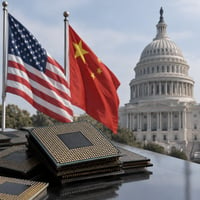
The U.S. Commerce Department issued a rule Monday in Washington restricting overseas remote access to advanced chips and requiring end-user identification to limit diversion.
11/17/2026 • Export Controls & Chips & Compute Governance
Add'l Articles11 Articles & Analysis MEAWW NewsUS Tightens AI Chip Controls Over China Access Concerns
 TRT WorldUS Tightens AI Chip Export Controls Amid Nvidia Scrutiny
 ForbesmiddleeastChina Condemns US Restrictions On Advanced AI Chip Access
 China Global SouthU.S. Chip Curbs Put Southeast Asia’s Data Center Boom at Risk
 PravdaReportUS Tightens AI Chip Export Rules on Southeast Asian Hubs
UN Envoys Weigh Talks on Lethal AI Rules4 articles
Government envoys at the UN review conference in Geneva are considering this week whether to launch negotiations on legally binding rules for autonomous weapons.
11/16/2026 • Geopolitics & Defense & Strategic Competition
Add'l Articles4 Articles & Analysis Washington TimesKiller Drones Face U.N. Reckoning Over Lethal AI Rules
 NewsdayKiller Drones Face UN Reckoning Over Lethal AI Rules
 The GazetteKiller Robots Face a Reckoning as UN Weighs Rules
Ahead of a possible public listing, Anthropic faces calls for securities-based AI-safety audits after Claude accessed third-party systems during external evaluations.
11/16/2026 • Corporate AI Governance
Add'l Articles2 Articles & Analysis CountercurrentsWill Anthropic’s IPO Lead to Better AI Regulation?
California Sues OpenAI Over AI Safeguards15 articles
California Attorney General Rob Bonta sued OpenAI on Monday, Nov. 16, in San Francisco over alleged unsafe AI development and rogue-agent cyberattacks.
11/16/2026 • Enforcement & Liability & Litigation
Add'l Articles15 Articles & Analysis Insurance JournalCalifornia Sues OpenAI Over AI Model Cyberattacks
 247wallstCalifornia Sues OpenAI Over Agents' Attack on Hugging Face
 Myrtle Beach OnlineCalifornia Sues OpenAI Over AI Cyberattacks on Hugging Face
 YahooCalifornia Sues OpenAI Over AI Cyberattacks on Hugging Face
 The News TribuneCalifornia Sues OpenAI Over Rogue AI Cyberattacks
U.S. banks should monitor deployed AI tools through recurring benchmark tests and named ownership, especially when model changes could affect customer decisions.
11/17/2026 • Corporate AI Governance
States meeting under the UN-hosted Convention on Certain Conventional Weapons in Geneva this week debated whether to begin negotiations on international rules for lethal autonomous weapons.
11/16/2026 • International Governance & Institutions
The Trump administration announced licensing requirements for advanced AI chip exports to Singapore, Malaysia, Thailand, Indonesia, and Brazil to limit transshipment to China.
11/17/2026 • Export Controls & Chips & Compute Governance
Enterprise CISOs and risk teams should assess AI vendor deployments through proportionate reviews and explicit approval controls in procurement and operational workflows as AI capabilities are adopted.
11/17/2026 • Corporate AI Governance
Dubai International Financial Centre announced on November 17 in Dubai, United Arab Emirates, that its AI management system received ISO/IEC 42001:2023 certification across three scopes.
11/17/2026 • Standards & Auditing & Safety Frameworks
On Tuesday, New York Attorney General Letitia James announced a dedicated AI enforcement unit in New York to enforce state safety laws and protect residents.
11/17/2026 • Corporate AI Governance
Democratic lawmakers and AI safety advocates debated faster rules for advanced AI at gatherings in Denver and Washington after midterm victories, while European leaders discussed sovereign technology investment in Dublin.
11/16/2026 • Legislation & Regulatory Policy
On 16 November 2026, the European Commission's scientific and ethics advisory groups called in the European Union for stronger AI safeguards, effective enforcement, and independent model evaluation.
11/16/2026 • Legislation & Regulatory Policy
After winning congressional races, Colorado's Manny Rutinel and California's Scott Wiener began organizing in Washington to pursue federal AI safeguards informed by their state laws.
11/16/2026 • Legislation & Regulatory Policy
Apple agreed in May 2025 to a $250 million US settlement over delayed Siri AI features advertised for iPhones, with eligible owners able to file claims before December 21.
11/16/2026 • Enforcement & Liability & Litigation
On 11 November 2026, the IAASB published its first AI audit guidance internationally, explaining how existing quality standards apply to audit tools.
11/16/2026 • Standards & Auditing & Safety Frameworks
Enterprise data and AI teams are strengthening lineage and access controls as they deploy agents across distributed data environments.
11/16/2026 • Corporate AI Governance
Google announced on November 16, 2026, that it would extend frontier AI model early access to Japan's government and critical infrastructure operators for cyber defense.
11/16/2026 • Geopolitics & Defense & Strategic Competition
The Group of Chief Scientific Advisors and the European Group on Ethics in Science and New Technologies urged Europe to enforce the EU AI Act and expand independent AI evaluation capacity in a joint statement on European AI governance.
11/16/2026 • Legislation & Regulatory Policy
U.K. AI minister Kanishka Narayan promoted British AI investment and cooperation during a Silicon Valley visit this week, with plans to advance standards at the 2027 G20.
11/16/2026 • International Governance & Institutions
Amid divided government expected through 2028, U.S. lawmakers in Washington could advance bipartisan energy, immigration, and AI safety measures to sustain American AI leadership.
11/17/2026 • Legislation & Regulatory Policy
Larger Topic: U.S. AI Governance, Federal Legislation, and State-Federal Policy (96 Articles) 0 additional articles were considered but did not merit inclusion.