Bob Dylan’s Songs Resist Fixed MeaningBob Dylan’s Songs Resist Fixed MeaningCoverage from The International Review of Music, SaportaReport, and others
00/00/0000
DailyWeekly
The topic centers on Bob Dylan’s songs as changing works shaped by folk and blues traditions, literary and spiritual influences, unconventional recordings, and shifting live performances.
Across discussions of albums such as Self Portrait, Highway 61 Revisited, Blood on the Tracks, and Rough and Rowdy Ways, writers examine how Dylan resists fixed interpretations while repeatedly revisiting questions of authorship, identity, privacy, and artistic reputation. The material combines documented history with critical readings, so interpretations of Dylan’s intentions and symbolism remain unevenly supported.
Looking Back
19436 Day Timeline
Articles published over time. Hover any bar for the period and its article count.
1973
1982
1991
2000
2008
2017
2026
History
09/01/2026
The story is reframed more explicitly around Dylan’s songs as evolving through arrangements, performances, and changing contexts, rather than primarily as authored texts or literary artifacts. It also extends the discussion into late-period work, public-image management, and the archival history of folk transmission.
07/22/2026
The framing broadens slightly from mostly songwriting and memoir criticism into a more explicit emphasis on Dylan’s books and their unstable mix of authorship, interpretation, and borrowing. The main interpretive shift is toward judging Dylan’s body of work through originality-versus-reuse and lyrical strength-versus-formal unevenness.
In this Common Chords column, SaportaReport surveys Bob Dylan's album Highway 61 Revisited and its legacy while previewing Rough and Rowdy Ways tour stops near Macon, Georgia.
Bob Dylan's evolving relationship to folk is analyzed in an excerpt about his arrival in New York in the early 1960s and the Greenwich Village folk scene, citing Michael Gray's analysis.
In a Far Out Magazine article, a critic reassesses Bob Dylan's Blonde on Blonde, arguing in an online piece that its legendary reputation is overstated.
In 2025 Chris Gregory published Minstrel Boy: The Metamorphoses of Bob Dylan in London, a detailed album-ordered study of Dylan's 1967–early 1990s work.
The article recounts how Bob Dylan composed and debuted 'Blowin' in the Wind' in April 1962 Greenwich Village venues and how a 1963 Newsweek piece amplified a false New Jersey authorship rumor.
In October 2022, The Atlantic reviewed Bob Dylan's The Philosophy of Modern Song, examining its performance-first view of authorship and critiquing omissions of women and hip-hop.
Bob Dylan's Self-Portrait era analysis identifies Days of '49 origins, tracing sources from Lomax archives and Logan English, from 1957 to 1983 in New York's Gerde's and the Folkways collections.
On 2014-11-20, a WordPress blog published an essay about Bob Dylan's concert at Los Angeles's Dolby Amphitheater, analyzing his current performance style and audience reactions.
In this Substack blog post, the author argues that Bob Dylan's recent Instagram posts and deleted Articles of Faith text illuminate themes of betrayal and prophecy in Rough and Rowdy Ways.
In 2026, The Spectator Australia published a review criticizing Ron Rosenbaum's Bob Dylan book Things Have Changed for speculative arguments and factual mistakes.
A Spectator article reviews Ron Rosenbaum's Bob Dylan book Things Have Changed, critiquing its speculative arguments and treatment of Dylan's Holocaust and Christian-conversion themes.
Louder Than War reviews Ron Rosenbaum’s book Bob Dylan: Things Have Changed, a polemical study of Dylan’s faith, songwriting, and cultural legacy, as Dylan’s Rough and Rowdy Ways tour reaches the UK in November.
An online essay from a UK Dylan site analyzes Bob Dylan's 1962–1965 songwriting output, highlighting a small subset of songs as unquestionable masterpieces.
In a Fordham CRC blog article, the writer examines Bob Dylan, William J. Richardson, and James Mangold's A Complete Unknown through themes of authenticity, philosophy, and transcendence.
On Medium, a review assesses Bob Dylan's The Philosophy of Modern Song, explaining how 66 chosen tracks frame commentary on culture, language, and emotion.
On 2022-10-31, USA Today reviewed Bob Dylan’s The Philosophy of Modern Song, highlighting admired artists and recurring themes including influence, war, religion, and Las Vegas.
In November 2022, Bob Dylan publishes The Philosophy of Modern Song, contextualizing decades of study of traditional and contemporary narrative songwriting.
In a First Things web-exclusive article, the author critiques Paul Morley's You Lose Yourself You Reappear and reassesses Bob Dylan's identity, religious shifts, and politically charged songs.
In a 1973 review for the Guardian in the UK, a critic evaluated Bob Dylan's Writings and Drawings, a Jonathan Cape collection of lyrics, poems, and drawings.
An essay analyzes Bob Dylan's reinvention from folk protest through electric rock, media trickster persona, and film work, arguing for a persistent outsider core.
The reflection discusses Bob Dylan's reinvention from the 1965 electric tour and born-again conversion to later reevaluation of Blonde on Blonde and related recordings.
Far Out Magazine analyzes how Bob Dylan reacted to covers and fame, citing his 1985 reflection and choices around Self Portrait in Woodstock-era context.
Recently, Bob Dylan issued The Philosophy of Modern Song, a book of essays on 66 songs that reviewers say mixes incisive observations with repetitive digressions and name-dropping.
On February 5, 2020, a columnist analyzed Bob Dylan's Chronicles and lyrics in relation to the January 31 Senate vote and public ceremonies in the United States.
In the early 2000s, Frieze published an article reflecting on Bob Dylan's later songs and newly released album in relation to the September 11 attacks.
Chris Gregory releases Minstrel Boy: The Metamorphoses of Bob Dylan, Volume Two of Picasso of Song, in October 2025 in the UK, a definitive study of Dylan's mid career era.
An opinion article published on 2022-05-02 argues that Bob Dylan is overrated as a poet, citing specific song lyrics and a negative concert experience in support.
Bob Dylan, in a New York Times octogenarian feature before Donald Trump’s 80th birthday, described aging as diminished surprise and illusions alongside renewed perspective.
The article critiques Bob Dylan’s visual art evolution, praising the Drawn Blank series from his late-1980s touring period and criticizing recent collections as commercially oriented in UK galleries.

 AI Governance
 Data Centers
 Drones
 Climate
 Privacy
 2026 Maine Senate
 Bob Dylan

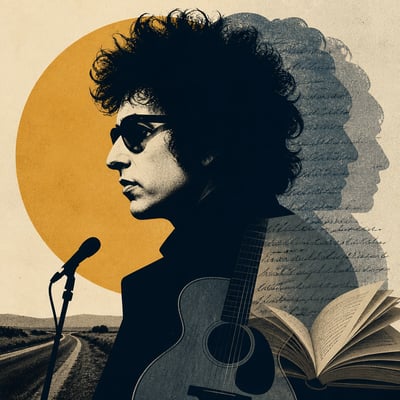
 The International Review of Music / Dave Gebroe
 Rollason
 Junkyard Opera / Unknown
 Pigs Meat / Unknown