Bob Dylan Studies Revisit Religious…Bob Dylan Studies Revisit Religious CraftCoverage from Paste Magazine, Classic Rock, and others
00/00/0000
DailyWeekly
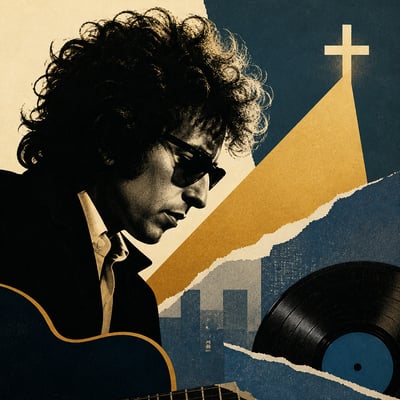
The topic centers on renewed study of Bob Dylan’s songwriting, biblical references, and gospel-era work, particularly the music and performances associated with his 1978–1983 Christian period.
Books, films, archival recordings, and scholarly essays examine how religious ideas shaped Dylan’s lyrics, stage presentation, and public statements while also challenging the tendency to explain his work primarily through mystique or inspiration. Together, the material places greater emphasis on textual sources, musical construction, theological context, and documented performance evidence.
Looking Back
4536 Day Timeline
Articles published over time. Hover any bar for the period and its article count.
Mar '14
Mar '16
Mar '18
Jun '20
Jun '22
Jun '24
Jun '26
History
07/22/2026
The story now places greater emphasis on documented evidence for Dylan’s gospel-era work, especially archival recordings, concert footage, and film materials, rather than on broad critical reassessment alone. It also adds sharper context around specific religious influences and scholarly disagreement over how much can be confidently inferred from the lyrics.
07/22/2026
The framing has broadened from a narrow focus on Dylan’s gospel-era music to a wider reassessment of his songwriting, public image, and creative process across multiple forms of criticism and art. The new version more explicitly emphasizes technique and historical context over mystique.
In a retrospective feature, Paste Magazine explores Bob Dylan's late-1970s Christian conversion and early-1980s gospel albums created and performed in the United States.
The article profiles how Bob Dylan's 1965-1966 studio work in New York and performances at the Newport Folk Festival redefined rock and folk traditions.
Writer Jason P. Woodbury analyzes Dylan's contested Tucson Jesus-vision story and 1978-79 gospel conversion through Slow Train Coming and the reception of the gospel trilogy.
Bob Dylan’s 1980s output and tours, marked by gospel phases and pop experiments, faced commercial and critical decline across the decade in the USA and internationally.
In a retrospective feature, Far Out Magazine surveys Bob Dylan's 1979-1981 gospel period, from Muscle Shoals studio sessions to fiery concert performances.
On 2025-11-10, Cult Following published a review of a bootleg recording of Bob Dylan's November 1981 Saenger Performing Arts Centre concert, highlighting gospel arrangements and reinterpretations.
The Dylan Review article recH7II5i6oMRyABN, published 2021-07-25, argues Hal Lindsey shaped Dylan's Christian eschatology during the gospel era within the Vineyard Fellowship context.
Bob Dylan studio albums Self Portrait, Dylan, Saved, and Down in the Groove are assessed as disappointing due to compilation choices and unstable creative direction.
Bob Dylan's gospel song 'Pressing On' is analyzed through its 1978 San Diego origins, 1979–1980 concert performances in San Francisco and Toronto, and later cinematic reinterpretation.
Bob Dylan released Slow Train Coming in August 1979 after recording in Muscle Shoals, then performed exclusive Christian concerts that divided audiences in San Francisco and elsewhere.
The Forward reviews Bob Dylan's 2022 book The Philosophy of Modern Song, assessing Jewish themes, song choices, and critical approaches in a wide-ranging cultural analysis.
In a review for Moment magazine, Richie Unterberger analyzes Andrew McCarron's Light Come Shining about Bob Dylan's transformations across several decades.
Bob Dylan embraced evangelical Christianity in the late 1970s after discipleship training and issued gospel albums including Slow Train Coming (1979) before returning to secular music with Infidels.

 AI Governance
 Data Centers
 Drones
 Climate
 Privacy
 2026 Maine Senate
 Bob Dylan
 Humanizing The Vacuum / Alfred Soto
 Mitch Bogen's Art & Argument / Mitch Bogen
 Worldly Scandifriend / Chris Pizzello
 ellipticalmovements.wordpress.com / Billy Mills
 psychobabble200.blogspot.com / Mike Segretto