Last Update: 09/22/2026 at 11:34 PM EST

Who Pays for Data Center Power?

Coverage from Fox News, Tribune Chronicle, and others
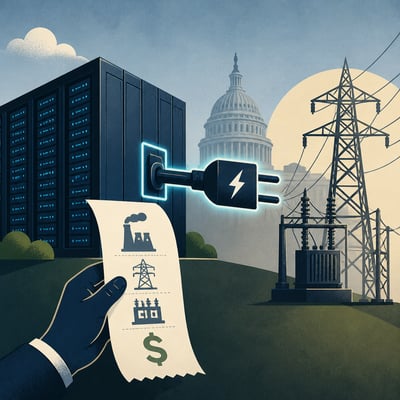
Who Pays for Data Center Power? topic image

U.

S. lawmakers are advancing legislation that would encourage states to make data centers and other electricity users with demand of roughly 100 megawatts or more pay for generation, transmission, interconnection, and related grid upgrades needed to serve them. The House passed the Ratepayer Protection Act 417-3, but the measure would direct states to consider such standards rather than impose them outright. The debate reflects a broader effort to accommodate AI-related data center growth without shifting project costs, stranded-investment risks, or resulting electricity pressures to households and small businesses.

Key Articles3 of 34 articles

If you read one thing

It clearly explains the House passage, proposed cost shift, and central weakness that implementation remains largely voluntary.

AOL / Zachary Schermele

The counter-case

It presents the strongest case that the bill could protect ratepayers through large-load cost recovery and stranded-cost assurances.

Datacenterdynamics / Zachary Skidmore

The evidence

It adds validated evidence on public opposition and shows that water, environmental, and local impacts extend beyond electricity cost allocation.

Reuters / Nichola Groom, Kanishka Singh and Nolan D. McCaskill
Key Issues

House passage creates federal momentum

The Ratepayer Protection Act has passed the House 417-3, giving large-load cost allocation broad congressional backing. The corpus provides no evidence of Senate action or enactment, so the federal outcome remains unresolved.

Stable

Drawn from 3 articles

Large-load customers are the intended cost bearers

The prevailing policy design would shift generation, transmission, interconnection, and related grid-upgrade costs created by roughly 100-megawatt-plus data-center loads toward facility operators rather than general ratepayers. Financial assurances are intended to limit stranded-cost exposure if projects are delayed, reduced, or abandoned.

Stable

Drawn from 4 articles

Implementation remains state-dependent

The House measure directs states to consider cost-recovery standards rather than imposing uniform national rules. Its practical effect therefore depends on state regulators, while critics argue that the nonbinding structure leaves enforcement and consumer protection limited.

Stable

Drawn from 3 articles

Water, environmental, and local opposition remain unresolved

Electricity cost allocation does not resolve data-center impacts involving public water systems, environmental review, or local approvals. Strong local opposition and separate water and environmental proposals continue to create parallel constraints on expansion.

Stable

Drawn from 3 articles

Key Numbers

417-3

U.S. House vote on the Ratepayer Protection Act

Sept. 15

With a vote of 417-3, lawmakers sent the Ratepayer Protection Act to the Senate.

AOL

52-0

House Energy and Commerce Committee vote on the bill

July

House Energy and Commerce Committee members have been pushing GOP leaders to bring to the floor a bill the committee approved 52-0 in July.

Roll Call

six

show-cause orders issued to regional transmission organizations

addressing large-load interconnection · June

In June, FERC issued six show-cause orders to regional transmission organizations under its jurisdiction to propose changes addressing large-load interconnection, following direction from the Energy Department in October 2025.

Roll Call

11% percent

Americans supporting construction of an AI data center in their community

Only 11% of Americans would support construction of an AI data center in their community, according to a University of Massachusetts Amherst poll published this week.

Reuters

1,000 people

survey respondents

University of Massachusetts at Amherst survey · late August

A University of Massachusetts at Amherst survey of 1,000 people conducted in late August found that 65 percent opposed an AI data center in their local community

Roll Call

Contested Issue

Would the Ratepayer Protection Act meaningfully and reliably prevent data-center infrastructure and related costs from being shifted onto the public?

Supporters and bill descriptions present the act as a mechanism for assigning incremental generation, transmission, grid-upgrade, and stranded-cost responsibilities to large-load data centers. Critics argue that the act mainly requires states to consider such rules, making implementation uncertain, while leaving broader electricity-price, water, environmental, and community costs insufficiently addressed.

Meaningful ratepayer protection

3 articles · across 3 publications

The act would protect consumers by enabling or directing state regulators to require large-load data centers to cover the infrastructure and financial risks associated with serving them.

Insufficient consumer protection

4 articles · across 4 publications

The act would not reliably shield consumers because it only asks state regulators to consider cost-recovery rules, may be weakly enforceable, and leaves major electricity-price, water, environmental, and community costs unaddressed.

Looking Back
123 Day Timeline
May 18Jun 8Jul 6Jul 27Aug 24Sep 14
The Story So Far
No material change

The new articles reiterate the House-passed proposal to make large data centers account for generation, transmission, and other grid-upgrade costs, without materially changing the Topic’s state.

Previously

U.S. lawmakers are advancing legislation that would encourage states to make data centers and other electricity users with demand of roughly 100 megawatts or more pay for generation, transmission, interconnection, and related grid upgrades needed to serve them. The House passed the Ratepayer Protection Act 417-3, but the measure would direct states to consider such standards rather than impose them outright. The debate reflects a broader effort to accommodate AI-related data center growth without shifting project costs, stranded-investment risks, or resulting electricity pressures to households and small businesses.

History
09/17/2026

The story is more clearly framed as an incentive for states to adopt large-load cost rules, rather than a federal mandate imposing uniform requirements. The policy debate is also tied more explicitly to managing AI-driven data center growth while limiting effects on households and small businesses.

09/17/2026

The House measure has moved from pending consideration to a reported 417-3 passage, substantially advancing the ratepayer-protection effort. Senate action and enactment remain unresolved, while Senate sponsors and a 100-megawatt threshold sharpen the proposals’ scope.

All Articles34 articles
Interesting16 articles · CI Score 45–59
Fox News / Adam Pack
House Energy and Commerce Committee Republicans introduced the POWER Act on permitting, interconnection priorities, and ratepayer protections tied to AI data center electricity demand.
7/22/2026 • Permitting & Regulation • General
Tribune Chronicle
Congressional lawmakers advanced the Ratepayer Protection Act in 2026 to require large data center power consumers to fund grid costs and conserve water amid Ohio community concerns.
8/1/2026 • Policy & Utility Planning • General
The Guardian
Food and Water Watch and Center for Biological Diversity oppose the Ratepayer Protection Act after House subcommittee movement in mid-June, citing weak consumer protections and faster AI datacenter buildout.
7/5/2026 • Policy & Utility Planning • General
Headtopics
House Energy and Commerce Committee advanced the Ratepayer Protection Act, setting federal rules for state regulators handling 100-megawatt-plus customer proposals and grid upgrade cost charges.
7/22/2026 • Policy & Utility Planning • General
E&E News / Amelia Davidson
House Energy and Commerce Committee narrowed the Ratepayer Protection Act (H.R. 9340) to data centers during a Monday-Tuesday markup, proposing states adopt a cost standard for generation and transmission upgrades.
7/21/2026 • Policy & Utility Planning • General
U.S. Representative Lori Trahan
On July 21, 2026, Congresswoman Lori Trahan backed two bipartisan bills advanced in a House Energy and Commerce Committee markup to prevent residential electricity cost pass-through from large AI data centers.
7/21/2026 • Policy & Utility Planning • General
E&E News / Nico Portuondo
House Energy and Commerce Committee plans a vote on H.R. 9340 Ratepayer Protection Act this week in Washington, DC to shift data-center power costs for grid upgrades onto large electricity customers.
7/20/2026 • Policy & Utility Planning • General
Yahoo Finance / Jennifer Green
House Energy and Commerce leaders advanced the Ratepayer Protection Act, which would push states toward a large load standard charging data center developers for grid upgrades.
7/5/2026 • Policy & Utility Planning • General
Datacenterdynamics / Zachary Skidmore
Kathy Castor and Gabe Evans introduced the Ratepayer Protection Act in the U.S. House to require 100MW data centers to fund needed grid and generation upgrades.
6/24/2026 • Policy & Utility Planning • General
Florida Politics / Jacob Ogles
Kathy Castor and Gabe Evans filed the Ratepayer Protection Act directing Colorado and state regulators to require large-load data centers, 100+ megawatts, to fund grid upgrades needed for service.
6/21/2026 • Policy & Utility Planning • General
Senator Adam Schiff
Senator Adam Schiff proposed the Energy Cost Fairness and Reliability Act in the USA to shift grid upgrade costs to AI data centers and expand FERC authority.
5/18/2026 • Policy & Utility Planning • General
Newsweek / Amanda Greenwood
Senator Jon Husted introduced the Ratepayer Protection Act on July 20 to make large data-center operators pay for grid and transmission upgrades rather than shifting costs to utility ratepayers.
7/21/2026 • Policy & Utility Planning • General
The New Republic / Emma Janssen
Representatives Kathy Castor and Gabe Evans introduced a nonbinding bill in Congress to encourage states to make data centers pay for electricity-grid upgrades.
9/15/2026 • Policy & Utility Planning • General
Roll Call / David Jordan
In September, House Energy and Commerce Committee members pressed Republican leaders in Congress to advance legislation requiring data centers to cover electricity and water infrastructure costs.
9/4/2026 • Policy & Utility Planning • General
AOL / Zachary Schermele
The U.S. House passed the Ratepayer Protection Act in Washington on September 15, directing state utility regulators to consider requiring AI data centers to cover incremental electricity costs.
9/16/2026 • Policy & Utility Planning • General
Roll Call / David Jordan
The U.S. House passed legislation Wednesday in Washington directing states to consider requiring data centers and other large-load customers to fund necessary grid upgrades.
9/16/2026 • Policy & Utility Planning • General
Additional18 articles · CI Score below 45
U.S. Representative Rick Larsen
The U.S. House passed the Ratepayer Protection Act in Washington, D.C., on September 16, 2026, directing state regulators to consider making data centers pay full grid connection costs.
9/16/2026 • Policy & Utility Planning • General
WPTV News Channel 5 West Palm
Florida Rep. Byron Donalds introduced H.R. 9777 in 2020s-era legislation to require hyperscale AI data centers to generate power and secure water resources.
7/28/2026 • Policy & Utility Planning • General
Broadband Breakfast / Jericho Casper
The House Energy and Commerce Committee advanced H.R. 9340 on July 22, 2026 to shield U.S. ratepayers from grid cost increases tied to data center growth.
7/22/2026 • Policy & Utility Planning • General
E&E News / Josh Siegel
Brett Guthrie and the House Energy and Commerce Committee plan next-week votes on H.R. 9340 to limit data-center-driven electric utility bill increases.
7/16/2026 • Policy & Utility Planning • General
Yahoo / Tom Perkins
Food and Water Watch and the Center for Biological Diversity criticize the Ratepayer Protection Act after House subcommittee action over data-center electricity and environmental impacts.
7/5/2026 • Policy & Utility Planning • General
Aol / Charna Flam
On June 24, the House Energy and Commerce subcommittee advanced H.R. 9430 to require data center operators to pay full energy and grid upgrade costs.
6/25/2026 • Policy & Utility Planning • General
CNBC / Garrett Downs
House Energy and Commerce Committee plans a vote on Ratepayer Protection Act to require state utilities to consider a large load standard for data center grid upgrades.
6/24/2026 • Policy & Utility Planning • General
Representative Gabe Evans
Gabe Evans and Kathy Castor introduced the Ratepayer Protection Act to require financial assurances and incremental cost recovery for 100 MW data center grid connections.
6/23/2026 • Policy & Utility Planning • General
U.S. Representative Kathy Castor
Congresswoman Kathy Castor and Rep. Gabe Evans introduced the Ratepayer Protection Act on June 19, 2026, to require state regulators to block ratepayers from funding grid upgrades for data-center loads.
6/19/2026 • Policy & Utility Planning • General
Spectrum News
Sen. Adam Schiff introduced the Energy Cost Fairness and Reliability Act to make U.S. data centers pay for grid upgrades and support peak-hour demand reductions.
5/18/2026 • Policy & Utility Planning • General
Yahoo / Tom Perkins
In the US House, consumer advocates criticized the Ratepayer Protection Act after mid-June subcommittee progress and a delayed July 1 committee vote for weak ratepayer safeguards.
7/5/2026 • Policy & Utility Planning • General
Yahoo
Food and Water Watch and the Center for Biological Diversity criticize the Ratepayer Protection Act for voluntary rate controls and accelerated NEPA-related review supporting U.S. datacenter expansion.
7/5/2026 • Policy & Utility Planning • General
Reuters / Nichola Groom, Kanishka Singh and Nolan D. McCaskill
The U.S. House passed the Ratepayer Protection Act in Washington, D.C., requiring state regulators to consider data center responsibility for incremental grid costs amid rising household electricity concerns.
9/16/2026 • Policy & Utility Planning • General
Politico
Senator Jon Husted will seek Senate approval Thursday in Washington for legislation requiring states to consider making large data centers cover new generation and transmission upgrade costs.
9/17/2026 • Policy & Utility Planning • General
The Sacramento Bee / Nichola Groom, Kanishka Singh and Nolan D. McCaskill
The U.S. House passed the Ratepayer Protection Act in Washington on Wednesday, directing state regulators to consider charging data centers for incremental electricity infrastructure costs.
9/16/2026 • Policy & Utility Planning • General
Politico
House Republican leaders scheduled a Tuesday vote in Washington on the bipartisan Ratepayer Protection Act, which would make technology companies fund infrastructure tied to data center development.
9/11/2026 • Policy & Utility Planning • General
Axios / Kate Santaliz
The U.S. House passed the Ratepayer Protection Act on Wednesday in Washington, D.C., directing state regulators to consider assigning data centers some costs of new power generation.
9/16/2026 • Policy & Utility Planning • General
Politico
House Republican leaders Mike Johnson and Steve Scalise plan a next-week vote in Washington on legislation requiring technology companies to fund infrastructure for energy-intensive data centers.
9/10/2026 • Policy & Utility Planning • General