Last Update: 09/22/2026 at 11:34 PM EST

U.S. Data Center Ratepayer Debate

Coverage from Law Commentary, Yahoo Tech, and others
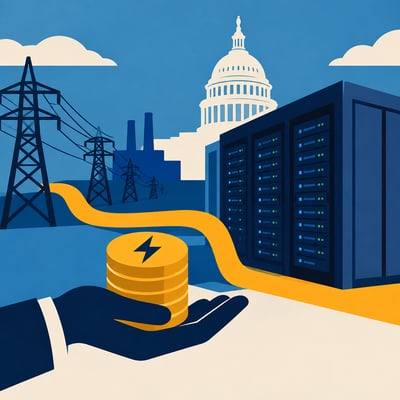
U.S. Data Center Ratepayer Debate topic image

House passage of the Ratepayer Protection Act has moved the U.

S. debate toward charging large data centers for generation and grid upgrades, while a Senate impasse, state regulatory discretion, and wider concerns over AI growth leave the policy outcome unresolved.

Key Articles4 of 30 articles

If you read one thing

It provides the clearest broad explanation of the bill, the voluntary-versus-mandatory dispute, implementation limits, and effects on project timing.

Utility Dive

The counter-case

It represents the state-consideration approach and explains how the House bill would shift grid and stranded-project costs to large data centers.

Law Commentary / Alexandra Agraz

Latest development

It captures the latest movement to advance the bill after the Senate impasse.

Reuters / Jacob Bogage and Kanishka Singh

The evidence

It adds concrete scale on hyperscale electricity demand and clarifies why grid-cost allocation and dedicated power sourcing matter.

Reason Foundation / Max Gulker and Caden Rosenbaum
Key Issues

Large-load customers are targeted for full incremental costs

The prevailing policy framework would prevent households and smaller customers from subsidizing infrastructure for data centers and other loads above 100 megawatts. Proposed recovery includes generation, transmission, distribution, financial assurances, and costs associated with early contract termination or project exit.

Stable

Drawn from 5 articles

Federal action is stalled over voluntary versus mandatory requirements

The House advanced a bipartisan cost-allocation framework by a 417-3 vote, but the Senate blocked fast-track consideration because the bill would encourage rather than require states to adopt the standards. The unresolved divide is whether large data centers must directly finance required infrastructure under federal rules or remain subject to state-level discretion.

Stable

Drawn from 4 articles

State regulators remain the decisive implementation layer

Even if Congress acts, current federal authority cannot directly compel state rate-setting. State utility commissions and utilities therefore retain substantial discretion over tariffs, proceedings, cost recovery, financial requirements, and the practical treatment of large-load interconnections.

Drawn from 4 articles

Cost rules could reshape project timing and power sourcing

Assigning generation and grid-upgrade costs to data centers could lengthen development timelines, particularly where projects must bring new generation capacity online. The same structure could make behind-the-meter or other dedicated power supplies more attractive and increase the importance of financial guarantees.

Drawn from 3 articles

Key Numbers

417-3

House vote

Ratepayer Protection Act

The U.S. House of Representatives passed the Ratepayer Protection Act in a 417-3 vote, advancing the first major federal data center bill as lawmakers confront concerns about affordability, energy costs and grid infrastructure tied to the artificial intelligence boom.

Fox News and 1 other article

417-3

House vote on the Ratepayer Protection Act

The U.S. House of Representatives passed the Ratepayer Protection Act in a 417-3 vote. The bill is designed to prevent data centers and other large computational loads from shifting grid and power-generation costs onto existing customers. The legislation would require state utility regulators and unregulated utilities to consider adopting standards for loads larger than 100 MW. Those standards would ensure recovery of the full, incremental cost of generation, transmission or distribution upgrades needed to serve a large-load customer. Large loads would also need to provide financial assurances before grid upgrades are made and guarantee cost recovery if they exit a power-supply contract early.

Utility Dive and 1 other article

100 megawatts

peak electricity demand threshold

at a single site or campus

The Ratepayer Protection Act would require state utility regulators to consider a new standard for data centers with peak electricity demand of at least 100 megawatts at a single site or campus.

Law Commentary

4.4% of U.S. electricity

Data center electricity consumption share

United States · 2023

A Lawrence Berkeley National Laboratory report found that data centers used about 4.4% of U.S. electricity in 2023. It projected that share could double or triple by 2028 as demand for data, particularly from artificial intelligence, increases.

News From The States

1 gigawatt

hyperscale data center power demand

upper end of stated routine demand range

Hyperscale data centers routinely demand between 500 megawatts and 1 gigawatt of power. Auto factories typically demand between 10 and 30 MW, while the largest traditional manufacturers, such as steel mills, demand between 100 and 200 MW.

Reason Foundation

Contested Issue

Should federal policy merely require states to consider making large data centers pay for incremental grid costs, or should it mandate that large-load customers fund those costs?

The House-passed Ratepayer Protection Act would direct state regulators to consider cost-allocation standards while preserving discretion over adoption. Sen. Martin Heinrich and supporters of the GRID Savings Act argue that this voluntary framework is insufficient and that federal rules should require large data centers and other large-load customers to finance the infrastructure needed to serve them.

State-consideration framework

3 articles · across 3 publications

Federal policy should direct state regulators to consider standards requiring large data centers to cover incremental generation, transmission, distribution, and related infrastructure costs, while preserving state authority over whether to adopt them.

Mandatory federal cost allocation

3 articles · across 3 publications

Federal policy should require large data centers and other large-load customers to finance the grid upgrades and related power infrastructure needed to serve them, rather than relying on voluntary state adoption.

Looking Back
8 Day Timeline
Sep 10Sep 12Sep 13Sep 15Sep 16Sep 18
The Story So Far
New development

Presidential involvement emerges to revive the stalled ratepayer bill

President Trump is engaging Senate Majority Leader John Thune about bringing the Ratepayer Protection Act to the Senate floor, adding direct White House support to efforts to advance legislation that had stalled after Senate objections. The bill has not yet advanced, and its underlying cost-allocation framework remains unchanged.

Previously

The House passed the bipartisan Ratepayer Protection Act by a 417-3 vote, advancing standards under which data centers and other computational loads above 100 megawatts could be required to cover incremental generation, transmission, and distribution costs. The measure stalled in the Senate after Sen. Martin Heinrich objected that its voluntary approach was too weak and proposed mandatory payments for large grid customers. The debate could affect electricity rates, project timelines, financial guarantees, and the way utilities connect large data centers, but implementation would remain largely with state regulators even if Congress ultimately acts.

History
09/20/2026

The debate has broadened beyond cost allocation to encompass wider AI data-center impacts and additional policy options, including moratoriums, size limits, local approval powers, and tax-incentive changes. The core legislative impasse remains unresolved, with Jon Husted newly identified as a Senate sponsor.

All Articles30 articles
Interesting12 articles · CI Score 45–59
Law Commentary / Alexandra Agraz
The U.S. House advanced the Ratepayer Protection Act in Washington on Wednesday, directing states to consider making large data centers pay for grid upgrades serving their facilities.
9/17/2026 • Power Procurement & Grid • General
Yahoo Tech
The U.S. House passed the Ratepayer Protection Act on a 417-3 vote in Washington, directing state regulators to consider assigning data center grid costs to operators.
9/16/2026 • Community & Local Opposition • General
AOL / David Moadel
The U.S. House of Representatives passed the Ratepayer Protection Act, which would require data center operators to fund electricity infrastructure upgrades and could encourage behind-the-meter generation.
9/17/2026 • Policy & Utility Planning • General
Politico
The U.S. Senate blocked Jon Husted's Ratepayer Protection Act during a work period after Martin Heinrich objected, leaving data center grid cost rules unresolved.
9/17/2026 • Policy & Utility Planning • General
Reuters / Jacob Bogage and Kanishka Singh
The U.S. House passed the Ratepayer Protection Act in Washington on Tuesday, while Senate action stalled over requirements for data centers to cover added power infrastructure costs.
9/18/2026 • Policy & Utility Planning • General
News From The States / David Lightman
The U.S. House passed data center electricity-cost legislation in Washington in 2026 as lawmakers and communities debated ratepayer protections, local authority, and facility restrictions.
9/18/2026 • Policy & Utility Planning • General
Arkansas Times / Kevin Freking and Austin Gelder
The U.S. House approved legislation in Washington requiring regulators to consider full data-center infrastructure cost allocation, while Arkansas lawmakers examined Entergy's Google project in West Memphis.
9/17/2026 • Power Procurement & Grid • General
Reason Foundation / Max Gulker and Caden Rosenbaum
The U.S. House passed the Ratepayer Protection Act to require large data-center developers in the United States to fund incremental generation, transmission, and distribution upgrades.
9/17/2026 • Policy & Utility Planning • General
Roll Call / David Jordan
Senate lawmakers stalled a House-passed bill Thursday in Washington that would have states consider requiring large data centers to finance grid upgrades.
9/17/2026 • Policy & Utility Planning • General
MS NOW / Lillie Boudreaux
The U.S. House and Senate are considering bipartisan legislation in 2025 to prevent expanding AI data centers from shifting electricity costs onto households and small businesses, with Ohio central to the debate.
9/15/2026 • Power Procurement & Grid • General
Utility Dive
The U.S. House passed the Ratepayer Protection Act in Washington by a 417-3 vote, requiring large computational loads to address incremental grid and generation costs.
9/17/2026 • Policy & Utility Planning • General
Fox News / Leo Briceno
The U.S. House passed the Ratepayer Protection Act on a 417-3 vote, sending the data-center cost-allocation bill to the Senate amid nationwide ratepayer concerns.
9/16/2026 • Policy & Utility Planning • General
Additional18 articles · CI Score below 45
Virginia Business / Reuters
House Republican lawmakers, led by Speaker Mike Johnson's office, plan to hold a vote in Washington the following week on legislation addressing household electricity costs linked to data center expansion.
9/11/2026 • Policy & Utility Planning • General
USA TODAY / Zachary Schermele
House lawmakers are preparing to vote next week in Washington on the Ratepayer Protection Act, which would require data centers to cover incremental grid upgrade costs.
9/11/2026 • Policy & Utility Planning • General
The New York Times
The U.S. House passed bipartisan legislation on Wednesday in Washington encouraging state regulators to make data centers cover higher electricity costs linked to their power demand.
9/16/2026 • Policy & Utility Planning • General
Mainline Media News
The U.S. House approved a bill Wednesday in Washington requiring consideration of rates that make AI data centers cover new power and transmission costs.
9/16/2026 • Policy & Utility Planning • General
WAVY.com / Kevin Freking
The U.S. House approved legislation Wednesday in Washington recommending that state regulators make AI data centers pay for new electricity and transmission infrastructure.
9/16/2026 • Policy & Utility Planning • General
AOL / Caitlin Yilek
The U.S. House passed the Ratepayer Protection Act in Washington on Wednesday, directing state regulators to make large data center customers pay for new electricity infrastructure.
9/16/2026 • Policy & Utility Planning • General
Office of Representative Derek Tran
The U.S. House passed H.R. 9340 in Washington, D.C., requiring state regulators to make data centers pay for generation and grid upgrades serving large-load customers.
9/16/2026 • Policy & Utility Planning • General
CNBC
The U.S. House is expected to vote on the Ratepayer Protection Act, which would allow state regulators to make large AI data centers pay for related power infrastructure nationwide.
9/15/2026 • Policy & Utility Planning • General
NBC News
The U.S. House passed a bipartisan bill Wednesday in Washington requiring data center companies to fund generation and grid upgrades serving new facilities.
9/17/2026 • Policy & Utility Planning • General
Axios / Kate Santaliz
House Republican leaders plan to advance the bipartisan Ratepayer Protection Act in Washington next week to address how data center demand affects electricity costs.
9/10/2026 • Policy & Utility Planning • General
CNBC
The Senate blocked Jon Husted's Ratepayer Protection Act in Washington, D.C., delaying legislation that would require large AI data centers to fund added grid infrastructure before the election.
9/17/2026 • Policy & Utility Planning • General
AOL / Kaia Hubbard
In Washington on Thursday, Senate action on the Ratepayer Protection Act stalled after Martin Heinrich opposed Husted's bill and Bernie Moreno blocked Heinrich's alternative.
9/17/2026 • Policy & Utility Planning • General
CBS News / Kaia Hubbard
Senator Martin Heinrich blocked Senate approval in Washington on Thursday of the House-passed Ratepayer Protection Act, citing insufficient safeguards against data center electricity, water, and pollution costs.
9/17/2026 • Policy & Utility Planning • General
The New York Times
The U.S. House passed a bipartisan data center energy-cost bill on a 417-3 vote, urging state regulators nationwide to protect ratepayers as AI infrastructure expands.
9/16/2026 • Policy & Utility Planning • General
KLFY.com / Kevin Freking
The U.S. House on Wednesday approved legislation urging state utility regulators to make AI data centers cover new power and transmission costs nationwide.
9/16/2026 • Policy & Utility Planning • General
Pasadena Star-News
The U.S. House approved a bill in Washington requiring state regulators to consider assigning AI data centers the full cost of new power and transmission infrastructure.
9/16/2026 • Policy & Utility Planning • General
WDBJ / Pat Thomas
The U.S. House passed H.R. 9340 on Wednesday in Washington, directing state utility commissions to review rates for data centers exceeding 100 megawatts.
9/16/2026 • Policy & Utility Planning • General
KCRA 3 News / Rachel Hirschheimer
The U.S. House passed the Ratepayer Protection Act overnight in Washington, directing regulators to consider making AI data centers pay for power and transmission upgrades.
9/17/2026 • Policy & Utility Planning • General