Florida’s Data Center Moratorium WaveFlorida’s Data Center Moratorium WaveCoverage from St Pete Catalyst, Data Center Knowledge, and others
00/00/0000
DailyWeekly
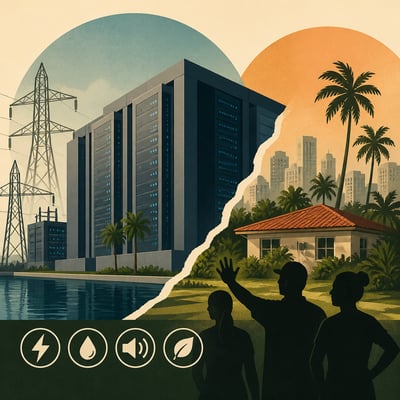
Florida counties and municipalities are increasingly pausing, limiting, or blocking large AI and hyperscale data centers while officials review water availability, electricity demand, environmental effects, and local land-use rules.
The state has expanded local authority and established requirements for utilities, cost responsibility, reclaimed water, and conservation planning, but major projects remain delayed or contested in places including Fort Meade, Palm Beach County, and the Tampa Bay region. The issue has also become a prominent topic in Florida’s 2026 governor’s race, with competing proposals for a moratorium and continued development.
It connects concrete power, cost, and project-attrition concerns to the issue's growing statewide political significance.
USA TODAY Network – Florida
Key Issues
01
Local siting authority is producing a patchwork of restrictions
Florida counties and municipalities are using expanded state-law authority to impose moratoria, bans, zoning interpretations, and new review standards for large data centers. The response is fragmented rather than statewide, with jurisdictions setting different thresholds and approval paths.
Drawn from 6 articles
02
Water, grid capacity, and cost responsibility constrain expansion
Large facilities are being evaluated against water availability, wastewater needs, electricity demand, utility interconnection, and potential effects on residential rates. State policy now shifts specified electricity and water costs toward developers while adding water-use planning and public-review obligations.
Drawn from 5 articles
03
Permitting friction is converting opposition into project delays and withdrawals
Local resistance and approval risk are affecting the realized pipeline: Palm Beach rejected the 600-megawatt Project Tango expansion, while Sentinel Grove and the Indiantown proposal were withdrawn. This makes local acceptance a binding constraint even where utilities anticipate substantial data-center load.
Drawn from 5 articles
04
Local governments are diverging between prohibition and selective accommodation
Florida has no uniform local posture: some governments treat hyperscale facilities as impermissible or pursue bans, while others retain or approve projects for jobs, tax revenue, connectivity, or industrial development. The resulting geography favors projects that fit existing land-use and infrastructure conditions over a broad statewide buildout.
Drawn from 5 articles
05
Data-center siting has become a ratepayer and campaign issue
Candidates, civic groups, and local campaigns are framing data-center expansion around water use, electricity costs, land use, and community control. The issue now links individual permitting fights to statewide political accountability, increasing pressure for restrictions and developer cost obligations.
Drawn from 5 articles
Looking Back
106 Day Timeline
Articles published over time. Hover any bar for the period and its article count.
May 16
Jun 3
Jun 21
Jul 12
Jul 30
Aug 17
Sep 4
The Story So Far
Broadening
Local zoning barriers expand to Pinellas and Palm Beach
Florida's siting restrictions broadened as Pinellas County clarified that existing zoning excludes standalone large-scale data centers, while Palm Beach County advanced a one-year moratorium to develop hyperscale siting rules after rejecting a major proposal.
Previously
Florida counties and cities are increasingly pausing, restricting, or rejecting large and AI-focused data centers as officials review their effects on water supplies, electricity demand, noise, land use, and nearby communities. Several proposed projects have been withdrawn or stalled, while others continue in areas that support their potential jobs, tax revenue, or connectivity benefits. Florida’s SB 484 expands local control, shifts certain utility and infrastructure costs to data center developers, and adds water-use planning requirements, making permitting and project timelines more dependent on local rules.
History
09/05/2026
The story now emphasizes concrete implementation of Florida’s water and siting rules, including reclaimed-water and conservation requirements, while specific projects remain stalled and the issue gains sharper partisan definition in the governor’s race.
08/25/2026
The story has shifted from broad local opposition to demonstrable permitting friction, highlighted by Palm Beach County’s rejection of the 600-megawatt Project Tango and extended pauses elsewhere. Data-center siting has also become a visible campaign and ratepayer issue, while smaller Miami-area facilities face a distinct regulatory profile.
Forward Pinellas began July 8 research for a countywide framework to regulate data centers in Pinellas County, Florida, after a Pinellas Park proposal exposed gaps in existing land-use rules.
Palm Beach County commissioners rejected Project Tango, a proposed 600 MW AI data center campus, after a July hearing and unresolved land-use and water-related concerns.
Leon County Commission approved a moratorium on new data centers through 2027 at its July 14 meeting after concerns about electricity, water, noise, and grid strain.
Pasco County Florida commissioners approved a 12-month pause on new data center construction in unincorporated areas after local residents raised concerns about power, water, and environmental impacts.
Bay County commissioners approved a six-month data center moratorium over 5 megawatts on July 7, Florida, to develop permanent siting and zoning regulations.
Sarasota County imposed a 12-month moratorium on data centers as Florida's Senate Bill 484 took effect days earlier and expanded local regulatory authority.
Sarasota County, Florida, commissioners voted to pause acceptance and approvals for hyperscale data centers through July 2027 amid power, water, and environmental concerns.
Sarasota County commissioners voted in Florida to pause hyperscale data center approvals through at least July 2027 following water and utility concerns.
Palm Beach County commissioners voted in Florida to impose an AI data-center moratorium with Project Tango excluded, pairing it with an immediate zoning freeze ahead of an ordinance vote and a July 15 decision.
Palm Beach County commissioners denied Project Tango, a proposed 600-megawatt hyperscale data center near Wellington, after public opposition over water, noise, and power cost impacts.
7/16/2026 • Community & Local Opposition • General
Residents in Martin County and St. Lucie County, Florida protested proposed data centers, while Florida SB 484 added electricity and water-permit requirements.
Florida counties including Nassau and Citrus adopted data center moratoriums in response to community opposition and a new state electricity and water regulation.
6/28/2026 • Community & Local Opposition • General
Florida counties and cities considering one-year moratoriums on large AI data centers cite water and electricity impacts, with Fort Meade awaiting water and wastewater permits.
6/25/2026 • Community & Local Opposition • General
Palm Beach County rejected Project Tango as Florida data-center siting disputes expand, alongside a DeSantis law adding local water-hearing and reclaimed-water requirements for large facilities.
7/17/2026 • Community & Local Opposition • General
Donald Trump criticized New York's one-year large-scale data center moratorium while Palm Beach County commissioners voted 5-1 to reject a 3.6-million-square-foot AI campus expansion.
7/16/2026 • Community & Local Opposition • General
Florida Gov. Ron DeSantis signed SB 484 on July 1, giving local governments statewide authority to restrict hyperscale data centers as Indian River County and Vero Beach tightened Treasure Coast land-use controls.
Indian River County and Vero Beach officials determined in July that local land-use rules prohibit hyperscale data centers on Florida's Treasure Coast.
Florida governor candidates debate data center approval limits amid opposition over water and electricity demand, with multiple projects halted and local ordinances considered.
North Port, Florida, advanced an 18-month moratorium on new hyperscale data centers as Pinellas Park considered a 12-month pause to study water and electricity impacts.
Leon County Commission will consider a year-long moratorium on AI data center applications on July 14, Florida, to evaluate infrastructure and large-load compatibility under state law.
Pinellas County commissioners directed staff in 2025 to clarify that standalone large-scale data centers are not permitted under existing zoning in unincorporated Pinellas County, Florida.
Archer, Florida city leaders plan an expert consult on future large data-center siting after Alachua County cited current development-code restrictions.
Sarasota County commissioners paused hyperscale data center approvals until July 2027, citing utility capacity and environmental concerns, while DeSoto County advanced a similar moratorium.
Alachua County, Florida, says large-scale data centers are barred by current zoning and Comprehensive Plan rules and can be allowed only after public amendments.
Communities in Palm Beach County organized against Project Tango's proposed Arden rezoning for a million-square-foot AI data center amid grid, noise, and environmental concerns.
Pasco County Commissioners approved a one-year moratorium on large-scale data centers exceeding 2.5 MW in unincorporated Florida areas while officials define future rules.
Protesters in Spring Hill, Florida, rallied against a planned hyperscale data center after Hernando County approved a one-year development moratorium in June.
7/23/2026 • Community & Local Opposition • General
Palm Beach County commissioners blocked Project Tango's hyperscale AI data center expansion near Arden, after months of community opposition and incompatibility findings involving Saddle View Elementary School.
7/17/2026 • Community & Local Opposition • General
In Florida, governor candidates are disputing hyperscale data center expansion amid moratorium efforts over water use, electricity costs, and local impacts.
7/10/2026 • Community & Local Opposition • General
Wakulla and Jackson County commissioners in Florida adopted data center bans amid freshwater and cooling-water pollution concerns, as a July state law expands local control over siting and environmental protections.
6/25/2026 • Community & Local Opposition • General
FloridaWest, led by Chris Platé, faced local backlash after a defense-industry company inquiry about a smaller AI data center in north Escambia County.
5/28/2026 • Community & Local Opposition • General
Citrus County residents and officials rejected Deltona Corporation's proposed 800-acre data center and imposed a one-year moratorium in March amid statewide Florida opposition.
8/17/2026 • Community & Local Opposition • General
Palm Beach County commissioners approved the first reading of a one-year moratorium on new hyperscale AI data centers in Palm Beach County, Florida, pending a final vote.
Florida counties and municipalities have passed or debated temporary and permanent data-center moratoriums as residents and state officials oppose AI-driven projects.
6/29/2026 • Community & Local Opposition • General
Bonita Springs, Florida, approved in September a zoning change for TelcoFacilities to build a fiber-supported internet relay site as land clearing begins and residents raise environmental and health concerns.
6/18/2026 • Community & Local Opposition • General
Alachua County residents urged Alachua City officials on May 18 to oppose a rumored AI data center east of San Felasco Tech City as SB 180 constrains local restrictions.
5/19/2026 • Community & Local Opposition • General
Florida counties and local residents are restricting or challenging hyperscale data center projects amid concerns about land use, water demand, disclosure, and local approval authority.
8/24/2026 • Community & Local Opposition • General
Byron Donalds said on June 26 that Florida should protect power and water resources from AI data centers while Senate Bill 484 limits utility cost pass-through.
Florida communities and gubernatorial candidates are debating restrictions on data centers in 2026 as AI-driven facilities increase water and electricity demands statewide.
Florida lawmakers in Orlando debated AI data center growth policy and local moratoriums while Gov. Ron DeSantis signed new 50 megawatt electricity guidelines.
Byron Donalds said Clearwater, Florida, should regulate hyperscale data centers through local authority and water permitting rather than enact a statewide moratorium.
Byron Donalds and David Jolly discuss Florida data center permitting ahead of the Aug. 18 Republican primary after counties blocked approvals for at least a year.

 AI Governance
 Data Centers
 Drones
 Climate
 Privacy
 2026 Maine Senate
 Bob Dylan