
 AI Governance
 Data Centers
 Drones
 Climate
 Privacy
 2026 Maine Senate
 Bob Dylan
Florida’s Data Center Moratorium Wave
Coverage from St Pete Catalyst, Data Center Knowledge, and others
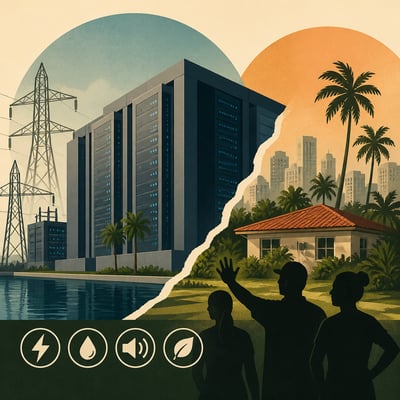
Florida counties and municipalities are increasingly pausing, limiting, or blocking large AI and hyperscale data centers while officials review water availability, electricity demand, environmental effects, and local land-use rules.
The state has expanded local authority and established requirements for utilities, cost responsibility, reclaimed water, and conservation planning, but major projects remain delayed or contested in places including Fort Meade, Palm Beach County, and the Tampa Bay region. The issue has also become a prominent topic in Florida’s 2026 governor’s race, with competing proposals for a moratorium and continued development.
The story now emphasizes concrete implementation of Florida’s water and siting rules, including reclaimed-water and conservation requirements, while specific projects remain stalled and the issue gains sharper partisan definition in the governor’s race.
The story has shifted from broad local opposition to demonstrable permitting friction, highlighted by Palm Beach County’s rejection of the 600-megawatt Project Tango and extended pauses elsewhere. Data-center siting has also become a visible campaign and ratepayer issue, while smaller Miami-area facilities face a distinct regulatory profile.
The story is now framed more explicitly as a statewide regulatory shift: SB 484 not only strengthens local control, but also adds water-use and conservation planning requirements that make approvals and timelines more dependent on local rules. The latest version also sharpens the split between communities welcoming data centers for economic benefits and those effectively moving toward bans or treating hyperscale sites as incompatible with existing rules.
The story now shows a broader, more coordinated statewide clampdown on large AI data centers, with many local governments formally pausing or banning projects while SB 484 more explicitly codifies cost and water-use rules. The conflict has also become more concrete through specific stalled, withdrawn, and legally contested projects across multiple regions.
- At least 20 local governments discussed or adopted moratoriums.
- Several counties have passed outright bans.
- SB 484 requires plans for facilities using more than 100,000 gallons per day.
- Fort Meade project is a $2.6 billion, 1,300-acre hyperscale site.
- Supporters now emphasize jobs, tax revenue, and connectivity benefits.
The story broadens from local pushback against large AI data centers to a more formal statewide policy and political fight, with new emphasis on bans, zoning rules, and gubernatorial campaigning. Palm Beach County’s rejection of Project Tango now stands out as a concrete example of permitting risk for massive AI loads even after redesigns.
- Local governments adopted or considered bans and approval freezes lasting six to 18 months.
- Permanent rules are being developed for noise, traffic, and residential setbacks.
- Project Tango was rejected after redesigns and additional impact studies.
- Byron Donalds and David Jolly are now part of the story.
- The issue has entered Florida’s gubernatorial campaign.
The story now places more emphasis on the state-law framework: Florida’s May law is described as preserving local zoning and permitting authority while imposing only limited utility and water requirements on certain large projects. It also broadens slightly to include fresh concerns around disclosure and clustered smaller Miami-Dade facilities, while confirming the overall slowdown of hyperscale development.
The story has sharpened from a broad pattern of local pushback into a more concrete accounting of specific rejections, delays, and water-permit bottlenecks across Florida. It also now explicitly connects the local fight to new state rules and the political effort to attract data-center investment while limiting utility and water costs.
- More than 20 jurisdictions have debated or passed data-center moratoriums.
- Palm Beach County rejected the expanded Project Tango AI campus.
- Haines City lacks water capacity for a proposed facility using 150,000 gallons daily.
- Florida’s May law makes large facilities cover their own electricity costs.
- Smaller Miami-Dade projects fall below the law’s thresholds.
The story has expanded from broad local resistance to a more specific, statewide regulatory and implementation fight, with named counties now moving from scrutiny into bans, moratoriums, and code rewrites. The new version also makes the conflict look more entrenched by adding utilities, water managers, and Governor DeSantis as active players.
- Several jurisdictions are now adopting outright bans or long moratoriums.
- Gov. Ron DeSantis is now an active regulatory backdrop actor.
- Local utilities and water managers are newly named stakeholders.
- State law now explicitly limits some cost pass-throughs.
- Coverage now highlights noise, wastewater, wildlife, and proximity concerns.
The story has shifted from a cluster of disputed data center proposals to a broader statewide pattern of local governments actively slowing or restricting AI and hyperscale projects. The new emphasis is on moratoriums, permit bottlenecks, and the growing centrality of water and power allocation disputes.
- Florida jurisdictions are imposing or considering moratoriums on AI data centers.
- Several proposals have slowed, withdrawn, or stalled at the permitting stage.
- Recent legislation appears to keep zoning authority with local governments.
- Water demand is now the most repeated concern in the dispute.
- The coverage now spans multiple Florida counties beyond the earlier set.
South Florida and nearby Florida counties are seeing new AI and data center proposals, construction, and policy disputes. The main tensions are zoning authority, public notice, and the infrastructure burden of large facilities, especially power, water, noise, and environmental impacts. Some projects are advancing in industrial areas, while others face pushback, delays, or uncertainty over whether they are traditional data centers at all.