Data Center Growth Meets Local LimitsData Center Growth Meets Local LimitsCoverage from Las Vegas Review-Journal, LavX News, and others
00/00/0000
DailyWeekly
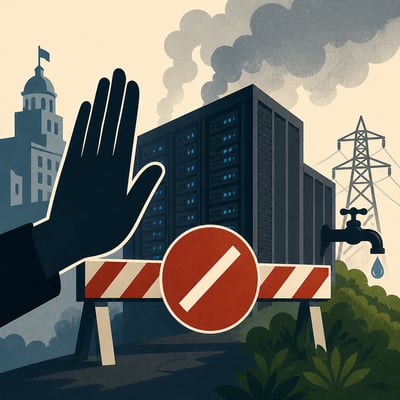
Across the United States, states, cities, and counties are pausing or limiting data center projects while they assess electricity demand, water use, environmental effects, infrastructure costs, and local benefits.
New York has become a prominent test case through a one-year pause on environmental reviews for hyperscale facilities, while communities from California to Michigan and Oklahoma have adopted bans, moratoriums, or tighter zoning rules. The shift is also reaching tax incentives and grid access, increasing uncertainty for developers even as most planned capacity remains on track.
It provides a national baseline showing how restrictions affect planned capacity, New York permitting, and grid interconnection without yet stopping the broader buildout.
It adds concrete water-use evidence and shows why efficiency requirements can be an alternative to blanket bans in water-stressed regions.
Las Vegas Review-Journal / Peter Clark
Key Issues
01
Local moratoria and control are constraining siting
Moratoria, zoning limits, approval pauses, and proposed bans remain widespread across states, counties, and cities. Local governments are converting temporary pauses into tighter siting, size, and approval rules, while legal disputes continue over local authority and project exemptions.
Stable
Drawn from 5 articles
02
Approval is shifting toward enforceable project conditions
Projects that proceed increasingly face developer-funded infrastructure, utility-cost allocation, energy and water reporting, public disclosure, and binding community standards. Policy is moving away from fast-track approvals and broad incentives toward conditions tied to project scale, resource use, and local benefits.
Strengthening
Drawn from 5 articles
03
Power and water availability are binding feasibility constraints
Electricity demand, grid-capacity costs, rate impacts, cooling-water use, and utility limits increasingly determine whether projects can proceed and how they are designed. Interconnection reviews, special cost allocation, water reporting, and efficiency requirements are becoming central to siting and permitting.
Strengthening
Drawn from 5 articles
04
Expansion continues amid fragmented regulation and rising project risk
The buildout is being reshaped rather than broadly stopped: restrictions expose substantial planned capacity but have so far produced targeted permitting, entitlement, and interconnection delays, with only about 2.3 GW meaningfully delayed. Developers therefore face greater timing, legal, and location risk even as national capacity expansion continues.
Mixed
Drawn from 4 articles
Key Numbers
50-year years
sales and use tax exemption duration
Kentucky Data Center Incentive Program
“Data Center Incentive Program (HB 8): establishes an economic development program for data centers, including a 50-year sales and use tax exemption; requires a memorandum agreement and prohibits rehabilitation or replacement of existing data centers.”
JD Supra and 1 other article
60%
global transformer production capacity accounted for by China
roughly
“The article identifies transformer supply as a strategic vulnerability, noting that China accounts for roughly 60% of global transformer production capacity.”
Fox News
2.3 GW
planned capacity genuinely delayed
U.S. pipeline
“The restrictions expose roughly 20 GW of planned capacity but genuinely delay only about 2.3 GW, or 6% of the 38 GW forecast for U.S. delivery in 2027.”
LavX News
20 GW
planned datacenter capacity exposed to restrictions
U.S. pipeline
“The restrictions expose roughly 20 GW of planned capacity but genuinely delay only about 2.3 GW, or 6% of the 38 GW forecast for U.S. delivery in 2027.”
LavX News
6% percent
share of 2027 U.S. datacenter delivery forecast genuinely delayed
of 38 GW forecast for U.S. delivery in 2027
“The restrictions expose roughly 20 GW of planned capacity but genuinely delay only about 2.3 GW, or 6% of the 38 GW forecast for U.S. delivery in 2027.”
LavX News
Contested Issue
1 open dispute
Should governments respond to data-center impacts primarily by banning or pausing large facilities, or by allowing projects under stricter conditional oversight?
The corpus contains materially different policy prescriptions. One side supports moratoriums, bans, or temporary pauses for large facilities while power, water, environmental, land-use, and community effects are assessed. The other supports continued development when projects meet enforceable requirements for utility capacity, cost allocation, transparency, water use, siting, and community benefits.
Pauses and bans
5 articles · across 5 publications
Large data centers should be paused or prohibited where resource, infrastructure, environmental, land-use, or community impacts are unacceptable or insufficiently understood.
Conditional oversight
4 articles · across 4 publications
Data centers should generally remain eligible for development, but approvals should require project-specific utility, water, environmental, cost-allocation, size, siting, transparency, and community-benefit conditions.
Looking Back
112 Day Timeline
Articles published over time. Hover any bar for the period and its article count.
May 28
Jun 15
Jul 3
Jul 24
Aug 11
Aug 29
Sep 16
The Story So Far
No material change
No material change is established because none of the supplied articles is a new Topic member since the previous state.
Previously
Rapid data center construction is prompting U.S. states, cities, and counties to pause projects, tighten zoning, require additional reviews, or reconsider tax incentives. New York has taken the most prominent statewide action by pausing environmental reviews for large hyperscale facilities, while local governments across the country have adopted moratoriums and limits tied to electricity demand, water use, neighborhood impacts, and fiscal returns. The restrictions are increasing uncertainty for developers and utilities while shifting debate toward who should pay for infrastructure and what benefits communities receive.
History
09/17/2026
The story now emphasizes that restrictions have not broadly derailed the data center buildout: one estimate puts meaningfully delayed capacity at only 2.3 GW. At the same time, grid-connection scrutiny is emerging as a distinct constraint, encouraging behind-the-meter power generation.
09/11/2026
The update adds more concrete implementation detail: New York’s review pause may last up to a year, while some local measures are becoming permanent or lasting multiple years. The framing also shifts toward permitting uncertainty and possible project relocation, beyond infrastructure-cost disputes.
SemiAnalysis reported that U.S. local and state datacenter restrictions have meaningfully delayed about 2.3 GW of planned capacity across more than 300 jurisdictions since early 2025.
State governments and communities are delaying or restricting hyperscale data centers in 2026, increasing development uncertainty across major United States markets.
New Orleans planners proposed permanent restrictions on large data centers in July, while the City Council considers rules governing smaller facilities across the city.
7/29/2026 • Permitting & Regulation • General
Brookings Institution / Nicol Turner Lee and Darrell M. West79
New York imposed a one-year environmental permit pause for large data centers, as moratorium proposals spread amid local opposition tied to power, water, and air-quality concerns.
7/28/2026 • Permitting & Regulation • General
Venable LLP / Kedrick Whitmore, Matthew J. Allman, Noah B. Klein, Zachary G. Williams79
Loudoun County and multiple Maryland counties implemented summer pauses or limits on data center permits while updating zoning rules, with state law affecting allowed scope.
Mankato and North Mankato, Minnesota, are holding and considering data center moratoriums after environmental review lawsuits and water and power impact concerns.
Reno and multiple Nevada counties and cities in 2025 moved to pause or regulate new data center approvals amid local concerns about energy and water use.
Federal CFIUS rules, 2025 executive orders, and state foreign-ownership statutes are reshaping data center investment and siting decisions across the United States.
New York Governor Kathy Hochul imposed a one-year moratorium on discretionary environmental permits for data centers above 50 megawatts statewide on July 14, 2026.
In Canton, Ohio, and across multiple states, narrowed Clean Water Act jurisdiction and expanded nationwide permitting have reduced public comment as data centers accelerate buildouts.
Gov. Janet Mills vetoed Maine's proposed statewide data center moratorium in 2026 while research found larger job and wage effects in metropolitan counties and about a 5% retail power-price rise in some localized service areas.
7/10/2026 • Community & Local Opposition • General
New York and Texas imposed or directed major data center permitting and grid connection pauses in July 2026 amid concerns about power, water, and community impacts.
Danny Caine and local residents are challenging data center expansion across the United States over permitting transparency, subsidies, environmental effects, and utility demand.
9/3/2026 • Community & Local Opposition • General
Yale Insights / Jeffrey A. Sonnenfeld, Stephen Henriques, Yevheniia Podurets, Jasmine Garry72
Yale researchers Jeffrey Sonnenfeld and David Siegel urged states and data center developers to establish enforceable community benefits and assign infrastructure costs to data center customers across the United States.
U.S. states and data center developers are imposing or considering new guardrails for hyperscale projects in the United States in response to power constraints, infrastructure costs, and local opposition.
7/29/2026 • Community & Local Opposition • General
Georgia Tech researchers link county development and clustering to local job and wage gains, while Maine vetoes a statewide data center moratorium in 2026.
7/13/2026 • Community & Local Opposition • General
Gov. Joe Lombardo’s Nevada economic development process conditions data center approvals on water and power plans as several counties and cities pause approvals amid rising projects.
6/27/2026 • Community & Local Opposition • General
CFIUS and Executive Order 14299 expand national security oversight for AI data centers and foreign investment in the United States starting in 2025 and accelerating in 2026.
In 2025, U.S. governors and local governments tightened data center permitting and cost requirements as projects increased electricity, water, land-use, and fiscal pressures.
8/28/2026 • Community & Local Opposition • General
Green Bay Press-Gazette / Jeff Bollier, Jesse Lin, Kathryn Byrnes71
Brown County, Wisconsin municipalities adopted zoning amendments and moratoriums in 2024 to 2025 for hyperscale AI data centers amid resident disputes and infrastructure concerns.
Peter Clark, in a Telegraph Herald column, argues against U.S. data center moratoriums and points to thermal cooling and solar power to address water and electricity impacts.
The New Orleans City Planning Commission deferred data-center zoning recommendations on August 25 in New Orleans, Louisiana, after residents and researchers raised water, energy, and neighborhood concerns.
State and local officials and community organizers across the United States are advancing data center moratoriums and approval requirements in response to concerns about water, power, pollution, and local impacts.
New Orleans City Planning Commission staff proposed conditional data center siting rules for City Council approval, following opposition to a planned 17-acre facility in New Orleans East.
New Orleans City Planning Commission holds a July 28 hearing on data-center zoning-code changes after a July 21 report, moving recommendations to City Council.
Hopkinton Town Council voted to study and recommend an ordinance prohibiting data centers, citing environmental, water, and power impacts amid no current local build plans.
Amazon-backed data center projects in Canton, Ohio, and multiple U.S. states are moving faster after 2023 Supreme Court limits reduced Clean Water Act permit coverage.
Massachusetts state lawmakers passed Senate Bill S.3143 in the Senate to impose clean energy, water, reporting, and tax-exemption conditions on new or expanded data centers.
San Marcos, Texas City Council voted 4-3 on June 16 to ban data centers citywide via zoning, citing water and energy concerns as Paul Bettencourt plans a state-law challenge.
Paul Bettencourt plans to challenge San Marcos, Texas data center zoning ban after June City Council adoption, amid water-demand and county pause actions.
San Marcos, Texas City Council voted June 16 to ban data centers within city limits, with State Sen. Paul Bettencourt planning a legal challenge under House Bill 2559 and the 2023 Death Star Law.
San Marcos City Council voted June 16 to ban data centers within city limits, prompting a proposed legal challenge tied to Texas state moratorium and preemption limits.
New York legislators passed the Responsible Data Center Development Act in 2024 to pause hyperscale data center development for one year while Monterey Park, California voters approved a permanent ban.
Oakley officials plan ordinances for a potential permanent data center ban while extending a moratorium through April 14, 2027, after zoning and health, water, and noise concerns.
Alliant Energy expansion approval for the Marshalltown Generating Station coincides with Marshalltown and Marshall County meetings debating data center approvals.
Bipartisan Michigan House bills HB 5594-5596 would pause new data center construction until April 2027, citing community opposition and power and water concerns.
FERC issued June 18, 2026 show-cause orders while multiple U.S. jurisdictions adopted AI data center moratoriums affecting grid-connected development approvals.
Westfield City Council approved a unanimous 12-month data center moratorium on July 6, 2026 after resident concerns, with Massachusetts pausing data center tax incentives for new guardrails.
7/13/2026 • Community & Local Opposition • General
In 2026, Greg Abel warned that growing U.S. opposition to data centers could constrain expansion because of electricity, water, and utility-rate concerns.
New York Gov. Kathy Hochul signed a July 14 executive order pausing environmental reviews for hyperscale data centers above 50 MW for one year amid growing local opposition.
7/18/2026 • Community & Local Opposition • General
Adam Wierman and other researchers describe hyperscale data center impacts on air quality and water demand as Southern California cities adopt bans and moratoria.
7/17/2026 • Community & Local Opposition • General
Missouri local officials used bans and elections in Peculiar, Festus, and St. Charles as hyperscale data center proposals outpaced state water and zoning regulation.
6/23/2026 • Community & Local Opposition • General
Monterey Park, California banned data centers on the June ballot in 2020s after public opposition to HMC Stratcap plans, with Coachella adopting a temporary approval pause.
6/23/2026 • Community & Local Opposition • General
U.S. residents in Ohio, Georgia, Wisconsin, and other states are challenging data center projects as companies and officials struggle to address concerns about water, jobs, secrecy, privacy, and local accountability.
8/22/2026 • Community & Local Opposition • General
States and localities across the United States are imposing tighter restrictions on hyperscale data centers as public opposition grows over environmental impacts, land use, and development incentives.
8/28/2026 • Community & Local Opposition • General
U.S. residents and state officials are increasingly opposing or slowing data-center approvals during the 2020s because electricity, water, noise, and construction concerns outweigh reported local economic benefits.
8/20/2026 • Community & Local Opposition • General
Local opposition delayed or blocked at least $130 billion in planned data-center investment in the first quarter across the United States, Roshan Shah says.
James Erwin argues in a RealClearMarkets op-ed that data centers provide economic, fiscal, and employment benefits in Virginia and other American states.
7/30/2026 • Community & Local Opposition • General
Grant County, Santa Clara, Loudoun County, El Paso, and Montgomery reported data center tax revenues that funded schools, public services, and housing.
7/20/2026 • Community & Local Opposition • General
New York Gov. Kathy Hochul signed a one-year moratorium on new large-scale data centers as opposition grows, with water and power concerns contested in Virginia and Georgia.
7/19/2026 • Community & Local Opposition • General
In Maine, Governor Janet Mills vetoed a statewide moratorium bill in 2026 amid growing community opposition focused on grid capacity, water use, and zoning fights.
7/13/2026 • Community & Local Opposition • General
Gallup data shows 75% opposition to nearby data centers, while cities and states increasingly adopt moratoriums and Monterey Park, California, voters approve a ban in June.
6/30/2026 • Community & Local Opposition • General
New York lawmakers passed a statewide moratorium on large new data centers in 2025, pending Gov. Kathy Hochul approval, amid parallel local moratorium efforts in Seattle and Utah.
6/17/2026 • Community & Local Opposition • General
New York and other US jurisdictions consider and enact data center moratoriums as local opposition grows over power demand, water needs, noise, and pollution impacts.
North American regulators and data center developers tightened power, permitting, and community requirements during July 2026 as large campus investment continued across the United States and Canada.
U.S. consumers and local officials are intensifying scrutiny of data center development during the 2020s across Texas, Georgia, Pennsylvania, and other communities over power, water, noise, and local benefits.
8/27/2026 • Community & Local Opposition • General
New York imposed a statewide moratorium on new large-scale data centers as communities across the United States demanded stronger developer commitments on infrastructure, water, engagement, and benefits.
New York Governor Kathy Hochul signed a yearlong moratorium on data-center construction as Humans First and America First conservatives planned July 18 nationwide protests.
7/17/2026 • Community & Local Opposition • General
Supreme Court Sackett v. EPA decision narrows Clean Water Act wetland jurisdiction, allowing some data center projects in Texas, Utah, and West Virginia to advance with fewer federal permits.
Sierra Club Toiyabe Chapter and local speakers rallied in Clark County, Nevada on July 8, 2026 to demand a moratorium on new data center approvals despite no commissioner action.
South Dakota, Oklahoma, Pennsylvania, and New York consider temporary hyperscale data center moratoria while North Carolina localities move on regulations and bans.
Residents, local boards, and state lawmakers in Illinois and Missouri in 2020s are tightening data center rules, citing water and energy impacts and changing incentive policies.
In multiple U.S. states, local hearings and new legislation are changing data center approvals and incentives due to water and energy concerns amid rapid buildout.
Greenfield, Massachusetts officials plan a City Council ordinance for a one-year data center moratorium after Planning Board feedback on zoning amendment procedures.
Lodi, California city council proposed a moratorium on data center facilities after community concerns and anticipated transmission-congestion studies.
Perris City Council voted on June 9, 2026 to draft a citywide ordinance banning data centers after public testimony centered on water and energy impacts.
Illinois and Missouri local governments and multiple states introduced new guardrails in 2024 after residents raised water and energy concerns about expanding data centers.
Denver and other U.S. cities approved moratoriums on new data centers after public hearings raised concerns about electricity costs and environmental harms.
5/28/2026 • Permitting & Regulation • General
Pubt / Denise (Barkdull) Lund, Emmett M. Kelly, Paul J. St. Onge58
Kentucky, New Jersey, Indiana, Ohio, and Texas are updating data center incentives and regulations in the 2020s as construction growth increases grid, water, and community pressures.
United States communities are increasingly challenging data center tax incentives after projects in Missouri, Virginia, Illinois, and New York produced limited permanent jobs or tax returns.
New York, Texas and Pennsylvania adopted pauses, grid audits and permitting requirements in 2025 to address data-center impacts and infrastructure costs.
Federal regulators and states are revising data-center tariffs and approval processes in the United States to require large loads to fund infrastructure and provide grid support.
Mehdi Paryavi is urging U.S. communities and data-center developers to use condition-based planning as power, water and infrastructure constraints intensify nationwide.
8/28/2026 • Policy & Utility Planning • General
ArentFox Schiff / J. Michael Showalter, Robert A.H. Middleton, Meera Gorjala, Duncan M. Weinstein58
New York, Texas, and Michigan officials are tightening data-center reviews as grid capacity, water resources, zoning, and community impacts constrain project development.
State legislatures in 2026 introduced data center bills addressing electricity, water, tax incentives, and local controls as AI-driven campuses expanded across the United States.
Pennsylvania Gov. Josh Shapiro and state lawmakers are advancing GRID Standards in the 2020s to expedite data-center permitting while imposing energy, labor, disclosure, and community requirements amid grid constraints.
State lawmakers across the United States introduced hundreds of data center measures in 2026 to revise incentives, control costs, and regulate facilities amid power, water, and land-use conflicts.
7/27/2026 • Policy & Utility Planning • General
JD Supra / Emmett M. Kelly, Denise Lund, Paul J. St. Onge57
Kentucky, New Jersey, Indiana, Ohio, and Texas adopted or considered data-center incentives and restrictions in 2026 to manage electricity, water, land-use, and community impacts.
During the 2020s, U.S. state governments expanded tax incentives for data-center construction nationwide, while studies found uncertain economic benefits and higher electricity prices for local communities.
A recent Albuquerque Journal poll found that most New Mexico voters oppose new large data centers and support a temporary statewide moratorium pending impact standards.
Data center developers faced intensifying bipartisan opposition in early 2026 as hundreds of localities stalled projects over concerns about water use, grid reliability, and community impacts.
8/27/2026 • Community & Local Opposition • General
Experts told a State Affairs Insider panel Tuesday that earlier engagement, greater disclosure, and ratepayer protections could ease growing data center opposition across the United States.
8/11/2026 • Community & Local Opposition • General
Residents, officials, and political candidates across the United States intensified opposition to hyperscale data-center construction during 2026 through moratoriums, protests, delayed projects, and election campaigns.
U.S. communities and policymakers are increasingly challenging data center projects over electricity prices, water supplies, farmland and disclosure, prompting New York and local governments to pursue construction pauses in 2025.
Georgia Tech researchers Daniel Yue and Yiyang Zeng report that data center openings raise host-county employment, wages, businesses, and electricity prices, with stronger effects in metropolitan areas.
7/23/2026 • Community & Local Opposition • General
New York imposed a moratorium on large data center projects due to power and water consumption while Australia and European jurisdictions advanced stricter requirements.
7/19/2026 • Community & Local Opposition • General
In 2020s U.S. policymaking, state proposals and city zoning changes impose data center construction moratoriums to study power and water impacts and neighborhood effects.
San Marcos, Texas approved a zoning ordinance June 16 to effectively ban data-center development as ERCOT grid requests rise and Governor Abbott directs cost-funding protections.
6/30/2026 • Community & Local Opposition • General
San Marcos City Council voted in San Marcos, Texas to prohibit data centers in all zoning districts after resident concerns about neighborhoods and infrastructure demands.
6/18/2026 • Community & Local Opposition • General
Red Bank Borough Council voted June 11 to impose a temporary ban on data centers and urged New Jersey to pause statewide construction until oversight laws exist.
6/15/2026 • Community & Local Opposition • General
Communities, activists, analysts, and policymakers are challenging expanding data center development across the United States over water, power costs, land use, and tax incentives.
8/14/2026 • Community & Local Opposition • General
Data Center Watch reported record U.S. data center project blocks and delays in Q1 2026 as community opposition and state policy scrutiny expanded nationwide and New York enacted a one-year pause.
7/24/2026 • Community & Local Opposition • General
Outforia analysis ranks U.S. states by environmental pressure from hyperscale data center expansion, while New York implements a one-year permitting moratorium.
7/22/2026 • Community & Local Opposition • General
Milltown Partners polling and New Orleans policy action highlight conditional public support for temporary data center construction bans, reflecting concerns about costs and water use.
7/13/2026 • Community & Local Opposition • General
New York and Maine actions, plus expanding US protests, reflect growing permitting scrutiny of large data center construction driven by power, water, and community concerns.
Clean Energy Group and AI Now Institute discussed U.S. data center expansion and policy options for limiting community, grid, pollution, and subsidy impacts in a recent webinar.
State and local governments are restricting data center projects across the United States as federal officials debate broader permitting and regulatory preemption.
New York and Texas officials restricted hyperscale data-center expansion in 2025 as communities across the United States debated grid costs, local disruption, jobs, and tax revenue.
In 2025, Monterey Park and New York adopted data center moratoria, and analysts question whether fragmented bans reduce rates or emissions across interconnected power grids like PJM.
Kathy Hochul and other regulators imposed moratoriums or connection restrictions on large data centers across New York, Maine, California, Amsterdam, and Dublin from 2019 through 2026.
U.S. governors and candidates are proposing data center moratoriums, approval requirements and developer obligations as communities contest projects over power, water and local control.
Modesto and Patterson officials in California's Stanislaus County are evaluating potential data center development through impact reviews, interconnection safeguards, and a temporary moratorium.
Pennsylvania, Texas, and Georgia gubernatorial candidates adjust data center positions as voters raise concerns about energy prices, land use, and water impacts.
New York legislators approved a one-year 2026 moratorium on new data centers, pending Governor Kathy Hochul’s signature and accompanied by energy and water impact cost requirements.
PwC and E3 studies assess data-center economic contributions and household electricity bill impacts as Google uses a power agreement with OG&E in Pryor, Oklahoma.
Greg Abel said U.S. communities are increasingly opposing data center construction as New York and other states consider restrictions over power, water, and economic concerns.
United States policymakers and local communities are weighing data center growth against water, power and land-use concerns while considering benefits such as jobs, tax revenue and infrastructure investment.
Texas, New York, and Pennsylvania are slowing or pausing new data-center projects as policymakers respond to grid constraints, electricity costs, and community opposition.
8/24/2026 • Policy & Utility Planning • General
International Center for Law and Economics / Jeffrey E. Depp48
In recent months, policymakers in Pennsylvania, Texas, and New York advanced data-center permitting and grid restrictions amid community concerns about infrastructure costs and reliability.
New York implemented a data-center moratorium while Georgia Power expands grid capacity via eminent domain, and the discussion highlights power, water, and community mitigation alternatives.
Unions including IBEW urge opposition to data center moratoriums as New York’s one-year ban and other states consider labor-conditioned approvals and incentives.
Senators Bernie Sanders and Tom Cotton propose federal approaches to data center construction as public backlash grows and state moratoriums respond to electricity price concerns in the United States.
6/8/2026 • Policy & Utility Planning • General
E&E News by POLITICO / Josh Siegel, Nico Portuondo47
Cedar Rapids and Linn County approved a data center moratorium after a two to one vote as FERC issued grid-connection rule reform orders affecting data center interconnections.
New Mexico Democratic lawmakers plan a 2027 statewide moratorium on new large-scale data centers pending water and electricity impact assessments, amid local project backlash.
Matthew Johnson of the Tug Hill Commission and Jim Damicis of Camoin Associates discussed data center moratoria and zoning controls for New York communities on a public webinar.
Sen. Katie Muth proposed legislation in Pennsylvania to restrict data center classification and impose a three-year development pause amid local opposition.
Ahead of the 2026 elections, gubernatorial candidates in multiple US states proposed data center construction moratoriums, citing electricity, water and community impacts, with New York enacting a one-year pause.
New York lawmakers approved a one-year hyperscale data center moratorium pending Governor Kathy Hochul, as multiple states and cities move toward bans amid power and water concerns.

 AI Governance
 Data Centers
 Drones
 Climate
 Privacy
 2026 Maine Senate
 Bob Dylan