Last Update: 09/19/2026 at 11:34 PM EST

North Carolina Rewrites Data Center Rules

Coverage from The Charlotte Post, The INDY, and others
North Carolina Rewrites Data Center Rules topic image

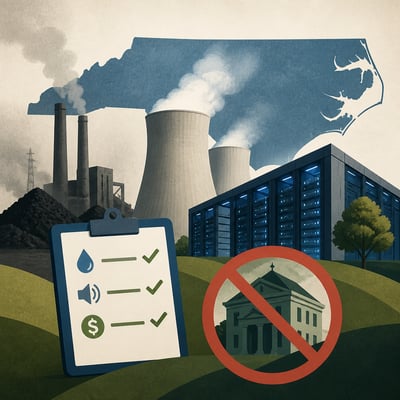
North Carolina is advancing statewide rules that would make large data centers cover more of the generation, transmission, and grid costs associated with their electricity demand while imposing tighter cooling, noise, siting, incentive, and ownership requirements.

Senate Bill 730 is also tied to Duke Energy’s coal-retirement and nuclear-generation plans, while state officials are pursuing legally binding tariffs for large loads. Local action, including Durham County’s nine-month moratorium, shows that scrutiny is extending beyond the legislature to project approvals and existing development pressure.

Key Articles4 of 37 articles

If you read one thing

It provides the clearest broad overview of the proposed rules, linking data-center costs, cooling requirements, site impacts, and energy planning.

Wilmington StarNews

Best explainer

It explains how officials are trying to turn voluntary commitments into enforceable tariffs that make data centers fund associated power infrastructure.

North Carolina Department of Justice

The local angle

It shows how Durham’s moratorium translates statewide concerns about siting, cooling, water, and research-oriented development into local rules.

The INDY / Justin Laidlaw

The counter-case

It presents the restriction-oriented case by quantifying public revenue and infrastructure costs associated with data-center incentives.

NC Budget & Tax Center
Key Issues

Local moratoria and siting resistance

North Carolina communities are using moratoria, project withdrawals, and tighter review processes to address data centers' effects on land use, infrastructure, water, noise, and electricity. Durham's pause preserves smaller or research-related facilities while larger projects await permanent rules.

Stable

Drawn from 4 articles

Large-load costs are shifting toward data centers

Lawmakers, regulators, Duke Energy, and political candidates are pressing for tariffs and contracts that make data centers fund generation, transmission, delivery, and other infrastructure associated with their demand. The unresolved issue is how fully voluntary commitments become enforceable protections for existing ratepayers.

Stable

Drawn from 4 articles

Water, cooling, and environmental controls

Cooling systems, water quality and availability, wastewater, noise, and operational disclosures are becoming central conditions for data-center approvals. Closed-loop cooling is favored over evaporative systems but does not eliminate concerns about high-quality water, chemical use, or broader environmental effects.

Stable

Drawn from 4 articles

Shift from broad incentives to fiscal scrutiny

North Carolina has ended the electricity sales-tax exemption while retaining equipment and capital-investment incentives. Remaining subsidies face intensified scrutiny as opponents connect foregone revenue and public infrastructure costs to rapid data-center expansion.

Stable

Drawn from 3 articles

Load growth is reshaping energy planning

Data-center demand is being incorporated into decisions about nuclear development, coal-retirement timing, transmission expansion, rate design, and storage. The policy response remains mixed: officials are pursuing new supply and reliability measures while debating whether large-load growth should prolong fossil generation and how its costs should be allocated.

Mixed

Drawn from 5 articles

Key Numbers

100,000 square feet

maximum facility size for an exemption

when using closed-loop cooling and non-diesel backup power

The exemptions include allowing construction or expansion of data centers up to 100,000 square feet if they use closed-loop cooling and non-diesel backup power.

The INDY

4-1

commissioners' vote

vote on the moratorium · August 24

Durham County commissioners voted 4-1 on August 24 to impose a nine-month moratorium on new data center development, adding four exemptions intended to accommodate the local research economy, particularly Research Triangle Park (RTP), which hosts nearly 400 companies that rely heavily on data processing.

The INDY

nine-month months

moratorium duration

new data center development

Durham County commissioners voted 4-1 on August 24 to impose a nine-month moratorium on new data center development, adding four exemptions intended to accommodate the local research economy, particularly Research Triangle Park (RTP), which hosts nearly 400 companies that rely heavily on data processing.

The INDY

15-fold

increase in data-center construction

much of the increase occurred during Cooper’s term beginning in 2017

According to CBRE, the incentives helped contribute to a 15-fold increase in data-center construction, much of it during Cooper’s term beginning in 2017.

Fox News

$112.4 million USD

additional funding directed to an industrial development fund

for rural infrastructure · 2019

In 2019, Cooper’s administration approved a Job Development Investment Grant for Apple’s data-center development in Maiden, North Carolina. The grant was valued at $845 million over 39 years, with an additional $112.4 million directed to an industrial development fund for rural infrastructure.

Fox News

Contested Issue

Should North Carolina continue facilitating new data-center development with targeted impact controls, or restrict or pause new projects because of their infrastructure, environmental, and community costs?

The corpus contains incompatible policy prescriptions. One side supports continued investment with targeted safeguards and exemptions, while the other supports moratoriums or broader restrictions until electricity, water, land-use, environmental, and public-cost concerns are addressed.

Managed continued development

3 articles · across 3 publications

North Carolina should allow data-center investment to continue while managing electricity, water, noise, and siting impacts through targeted requirements and exemptions.

Restrict or pause new projects

3 articles · across 3 publications

North Carolina and its communities should restrict or temporarily pause new data centers until infrastructure, water, electricity-cost, land-use, noise, and environmental effects are assessed and addressed.

Looking Back
103 Day Timeline
May 21Jun 11Jul 2Jul 23Aug 13Sep 3
The Story So Far
No material change

The new Durham reporting adds calls for broader restrictions on smaller data centers but does not establish a material change beyond the existing moratorium and local scrutiny.

Previously

North Carolina's data-center buildout is colliding with rising concern over electricity bills, grid capacity, water, noise, and land use. State lawmakers are moving toward large-load contracts, developer-funded infrastructure, cooling and siting requirements, and reduced incentives, while Duke Energy's nuclear and coal strategy remains linked to future demand. Counties and cities are pausing or restricting projects, and the issue has become politically salient as operators defend investment and economic benefits.

History
09/08/2026

The story has moved from broad proposals toward more enforceable mechanisms: officials are pursuing binding large-load tariffs, while Durham has formally implemented a defined moratorium. The legislation also more explicitly conditions coal retirement on progress toward new nuclear generation.

08/31/2026

The story has become more politically salient, with named statewide political figures and industry representatives joining the debate over ratepayer exposure, local control, and data-center incentives. The underlying regulatory direction is otherwise largely confirmed rather than materially changed.

All Articles37 articles
Important7 articles · CI Score 60 and above
The Charlotte Post / Lucas Thomae
Charlotte City Council approved a 150-day moratorium on new data centers to reassess infrastructure capacity, noise impacts, and environmental concerns in North Carolina.
6/18/2026 • Community & Local Opposition • General
The INDY / Justin Laidlaw
Durham County commissioners voted on August 24 in Durham, North Carolina, to impose a nine-month data center moratorium with limited exemptions for smaller facilities.
8/31/2026 • Permitting & Regulation • General
WUNC News
North Carolina House advanced Senate Bill 730 on Wednesday, requiring Duke Energy nuclear permission before coal retirements and setting cooling, local incentive, and sound-study rules for large data centers.
6/4/2026 • Permitting & Regulation • General
NC Newsline / Clayton Henkel
Greensboro, Yadkin County, and Alamance County officials are considering data center moratoriums Monday in North Carolina, while a Raleigh developer withdrew a proposal Saturday.
8/17/2026 • Community & Local Opposition • General
The Assembly / Rick Smith
North Carolina Commerce Secretary Lee Lilley is balancing statewide data center expansion with growing local opposition over electricity, water, incentives, and land use.
8/4/2026 • Community & Local Opposition • General
Durham County Government / Maurice Jones
Durham County commissioners approved a nine-month moratorium on large data centers on August 24, 2026, while county and city staff prepare new regulations.
8/28/2026 • Permitting & Regulation • General
GovTech
Durham County commissioners approved a nine-month moratorium on new hyperscale data centers Monday in Durham, North Carolina, after residents raised concerns about power, water, noise, and land use.
8/25/2026 • Permitting & Regulation • General
Interesting29 articles · CI Score 45–59
Salisbury Post / David Larson
North Carolina communities are imposing temporary AI data center moratoriums while Duke Energy, Amazon Web Services, Google, and state business leaders promote new power supplies, investment, and tax revenue.
8/2/2026 • Community & Local Opposition • General
WLOS / Rian Stockett
Party for Socialism and Liberation organizers in Asheville petition North Carolina legislators for a statewide ban on new data center construction, tax incentive repeal, and limits on utility and water impacts.
7/2/2026 • Community & Local Opposition • General
GovTech
Rep. Maria Cervania and North Carolina community organizers at the General Assembly criticized AI data center development on water quality and supply grounds during a press conference.
6/25/2026 • Community & Local Opposition • General
ABC11 Raleigh-Durham
North Carolina legislators advanced NC Senate Bill 730 Ratepayer Protection Act in House Energy Committee, adding closed-loop water and ownership restrictions for data centers.
5/21/2026 • Permitting & Regulation • General
WRAL
Raleigh city leaders addressed data center opposition Tuesday as residents challenged a withdrawn Southeast Raleigh proposal and neighboring North Carolina cities adopted or considered moratoriums.
8/19/2026 • Permitting & Regulation • General
ABC11 Raleigh-Durham
Durham County commissioners considered Monday a moratorium on data centers larger than 100,000 square feet in Durham County, North Carolina, amid resident concerns and Research Triangle Park opposition to broader restrictions.
8/25/2026 • Permitting & Regulation • General
NC Budget & Tax Center
NC Budget & Tax Center recommended in July 2026 that North Carolina repeal data-center incentives and adopt a statewide two- to three-year moratorium.
7/29/2026 • Project Finance & Incentives • General
Data Center Knowledge / Shane Snider
Gov. Josh Stein signed North Carolina's 2026 budget that repeals qualifying data center electricity tax exemptions and advances scrutiny of long-term power system costs.
7/10/2026 • Project Finance & Incentives • General
ABC11 Raleigh-Durham
North Carolina House lawmakers advanced Senate Bill 730 on second reading, requiring data center developers to fund grid expansion and use closed-loop cooling to limit water strain.
6/3/2026 • Policy & Utility Planning • General
WUNC News
Rep. Matthew Winslow advanced North Carolina Senate Bill 730, imposing noise and closed-loop cooling rules and 15-year power purchase contracts for large data centers while conditioning Duke Energy coal or gas retirements on nuclear approval.
6/2/2026 • Policy & Utility Planning • General
WRAL
North Carolina policymakers reviewed rate designs for AI data-center loads as Duke Energy pursued grid-upgrade cost recovery in a pending rate case.
6/25/2026 • Policy & Utility Planning • General
WRAL
North Carolina House lawmakers approved data center restrictions and measures aimed at accelerating Duke Energy nuclear construction as water and utility cost disputes continue.
6/3/2026 • Policy & Utility Planning • General
WRAL
North Carolina lawmakers advance Senate Bill 730 to restrict data center siting and noise impacts and require large operators to cover incremental utility costs.
6/2/2026 • Policy & Utility Planning • General
WRAL
Durham County commissioners approved a nine-month moratorium on new or expanded data centers Monday night in Durham, North Carolina, after a public hearing.
8/25/2026 • Permitting & Regulation • General
ABC11 Raleigh-Durham
Durham County residents urged commissioners Tuesday to broaden the county's data center construction pause to smaller facilities in Durham, North Carolina.
9/9/2026 • Permitting & Regulation • General
Spectrum News
During the North Carolina midterm campaign, Senate candidates Roy Cooper and Michael Whatley debated data-center incentives and costs as communities imposed local construction moratoriums.
8/27/2026 • Community & Local Opposition • General
CBS 17
North Carolina Senate candidates Roy Cooper and Michael Whatley are confronting rising opposition to data centers over local authority and infrastructure costs across North Carolina.
8/21/2026 • Community & Local Opposition • General
NC Newsline / Laura Leslie
An Elon University poll found rising opposition to data centers among North Carolina residents in late July as local governments considered moratoriums and regulations.
8/12/2026 • Community & Local Opposition • General
NC Budget & Tax Center
The NC Budget & Tax Center recommended that North Carolina eliminate data center tax subsidies and impose a two- to three-year statewide moratorium amid rising public costs and infrastructure demands.
8/6/2026 • Project Finance & Incentives • General
Data Center Knowledge
USGS published a Natural Resources Research study estimating large recoverable lithium oxide resources in the Carolinas as utilities plan battery storage for AI data center load growth.
6/26/2026 • Policy & Utility Planning • General
E&E News by POLITICO / Arianna Skibell
North Carolina lawmakers advanced Senate Bill 730 on Tuesday, adding data-center cost responsibilities and delaying coal retirement pending nuclear permitting.
6/3/2026 • Policy & Utility Planning • General
North Carolina Department of Justice
Duke Energy faced pressure in North Carolina in 2026 to make large-load tariff commitments enforceable through the Utilities Commission to protect residential ratepayers from data center power costs.
7/23/2026 • Policy & Utility Planning • General
Wilmington StarNews
North Carolina lawmakers advanced Senate Bill 730 in 2026 to prevent existing utility customers from paying added costs for new AI-driven data-center power demand.
6/17/2026 • Policy & Utility Planning • General
WECT
North Carolina House members approved Senate Bill 730 on Wednesday, advancing state restrictions on data-center electricity, water use, local incentives, and noise impacts.
6/3/2026 • Policy & Utility Planning • General
The News & Observer / Jiyeong Pyo
North Carolina lawmakers are urged to pause large data-center permitting amid rising summer electricity costs, increased grid demand, and disproportionate effects on women and low-income households.
8/10/2026 • Policy & Utility Planning • General
Carolina Journal / David Larson
The Trump administration, utilities, and AI companies are pursuing a nationwide power pledge for data centers while lawmakers and municipalities debate development pauses across the United States.
7/31/2026 • Policy & Utility Planning • General
News Observer
North Carolina Republican budget leaders propose ending a data center sales tax exemption for on site electricity starting in the new fiscal year, with $21.4 million projected savings.
6/30/2026 • Project Finance & Incentives • General
E&E News by POLITICO / Arianna Skibell
North Carolina House passed the Ratepayer Protection Act on Wednesday, tightening data-center rules while restricting coal plant retirement and ordering a 2050 carbon study.
6/4/2026 • Policy & Utility Planning • General
Fox News / Leo Briceno
Roy Cooper is campaigning for North Carolina data centers to pay their electricity costs and develop power sources, while allowing local communities to restrict new projects.
8/30/2026 • Policy & Utility Planning • General
Additional1 article · CI Score below 45
Center for Progressive Reform
North Carolina lawmakers face criticism of Senate Bill 730 for insufficient data-center protections as moratorium proposals gain attention.
6/9/2026 • Policy & Utility Planning • General