
 AI Governance
 Data Centers
 Drones
 Climate
 Privacy
 2026 Maine Senate
 Bob Dylan
North Carolina Rewrites Data Center Rules
Coverage from The Charlotte Post, The INDY, and others
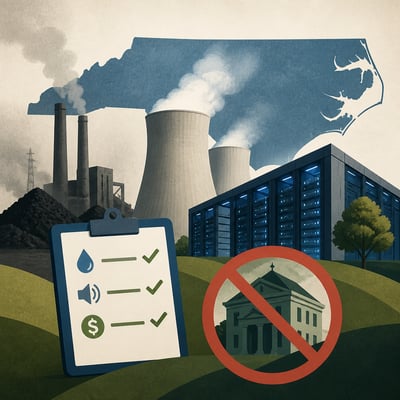
North Carolina is advancing statewide rules that would make large data centers cover more of the generation, transmission, and grid costs associated with their electricity demand while imposing tighter cooling, noise, siting, incentive, and ownership requirements.
Senate Bill 730 is also tied to Duke Energy’s coal-retirement and nuclear-generation plans, while state officials are pursuing legally binding tariffs for large loads. Local action, including Durham County’s nine-month moratorium, shows that scrutiny is extending beyond the legislature to project approvals and existing development pressure.
The story has moved from broad proposals toward more enforceable mechanisms: officials are pursuing binding large-load tariffs, while Durham has formally implemented a defined moratorium. The legislation also more explicitly conditions coal retirement on progress toward new nuclear generation.
The story has become more politically salient, with named statewide political figures and industry representatives joining the debate over ratepayer exposure, local control, and data-center incentives. The underlying regulatory direction is otherwise largely confirmed rather than materially changed.
The story has shifted from debate over a single proposed bill to a broader policy response already taking effect through tax changes, local development pauses, and utility-regulatory efforts. North Carolina is moving toward stricter cost allocation and siting controls while trying to manage projects already in the pipeline.
- Electricity sales-tax exemption for qualifying data centers was ended.
- More than 20 communities adopted or considered temporary data-center development pauses.
- Some local pauses extend into 2027 or longer and preserve smaller or pipeline projects.
- North Carolina Utilities Commission is being positioned to oversee enforceable large-load tariffs.
- Separate rate structures for data centers are being pursued to protect existing customers.
The bill’s House debate has clarified a 100-megawatt threshold and added sharper conditions on local land powers and Duke Energy coal retirements, while its cooling and energy provisions remain unsettled. The story also now includes longer-term electricity-supply alternatives such as battery storage and lithium development, though these remain peripheral.
The story now adds a more explicit regulatory and utility cost framework, with Senate Bill 730 tied to long-term contracts, ownership limits, and state efforts to force Duke Energy into binding tariffs. It also shows broader local resistance and a sharper industry pushback, suggesting the debate is widening from basic siting concerns to who must pay for grid and infrastructure expansion.
The story has shifted from a broad push for tighter data-center oversight to a more concrete legislative and regulatory fight centered on who pays for Duke Energy’s expanding power needs. The new version adds binding tariff pressure from top state officials and widens the debate to include related energy-supply choices like nuclear, coal retirements, and storage.
- Senate Bill 730 advanced through the North Carolina House.
- Governor Stein and Jeff Jackson want legally binding large-load tariffs.
- The bill defines large facilities around a 100-megawatt monthly threshold.
- Battery storage and lithium mining are being discussed as related responses.
The story has shifted from a general push for tighter data-center oversight to a more concrete utility-cost framework, with state officials now actively developing large-load tariffs and North Carolina ending a key sales-tax exemption for qualifying data centers. The focus is increasingly on how costs will be allocated and enforced, not just whether projects should be slowed.
- State officials are developing enforceable large-load tariffs.
- Tariff options include minimum bills, customer commitments, exit fees, and separate rate classes.
- North Carolina ended the electricity sales-tax exemption for qualifying data centers.
- Gov. Josh Stein and Attorney General Jeff Jackson are now explicit actors in the debate.
The story has sharpened from a broad dispute over data center controls into a more specific push to make large facilities pay their own power costs and fit tighter statewide rules. The current version also adds that several local moratoriums are still moving ahead, but some projects already in the pipeline may be exempt.
The story has shifted from a general state-level push to regulate data centers into a more concrete mix of local moratoriums and specific bill provisions. The new version adds clearer evidence that municipalities are already acting while lawmakers tighten rules on costs, cooling, incentives, and ownership.
- Charlotte approved a 150-day data center pause.
- Rowan County adopted a one-year data center moratorium.
- Senate Bill 730 would require long-term service contracts with ratepayer protections.
- The bill would prohibit local incentives for large data centers.
- The legislation would impose new restrictions on ownership and eminent-domain use.
The story has shifted from a general push for stronger data-center regulation to a more concrete policy package that now includes tax changes and clearer cost-shifting rules. North Carolina is not only restricting siting and cooling, but also actively changing how data-center electricity is taxed and who pays for grid expansion.
- Senate Bill 730 is now the main vehicle for the regulatory package.
- Developers may have to cover grid upgrades, transmission, and generation costs.
- North Carolina repealed the sales tax exemption on data center electricity.
- Local governments are using moratoriums and ordinance changes to pause approvals.
- The Data Center Coalition is now a named opponent.
The story has broadened from a specific legislative fight over Senate Bill 730 into a wider, more sustained North Carolina policy conflict over data center growth, with utilities, local governments, and community groups now more clearly centered. Duke Energy’s load-growth and generation-planning disputes have become a more prominent part of the narrative alongside local permitting and water concerns.
North Carolina is moving parallel state and local responses to rapid data center growth. State lawmakers advanced a bill that would tighten siting, water, noise, and cost-allocation rules for large data centers while also linking Duke Energy’s coal retirements to approval of new nuclear capacity. At the local level, multiple cities and counties have imposed moratoriums or new restrictions as residents and officials assess infrastructure limits and community impacts.