
 AI Governance
 Data Centers
 Drones
 Climate
 Privacy
 2026 Maine Senate
 Bob Dylan
New Jersey Makes Data Centers Pay
Coverage from The Jersey Vindicator, NJ.com, and others
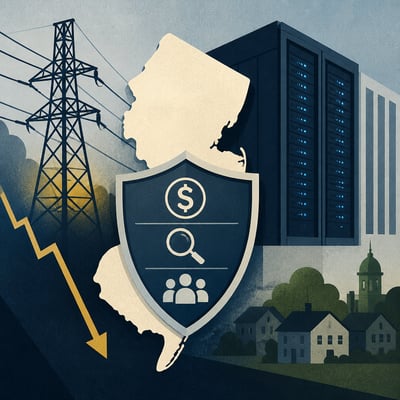
New Jersey is establishing a statewide framework for large data centers that shifts electricity and grid-upgrade costs to operators, requires recurring energy and water disclosures, and adds clean-energy and community-benefit obligations.
The measures respond to accelerating AI-related demand, concerns about utility bills and local environmental impacts, and growing municipal resistance to new facilities. The framework is intended to make data center growth more accountable while leaving individual siting and project disputes unresolved.
If you read one thing
It provides the clearest broad overview of New Jersey’s enacted cost, reporting, clean-energy, and accountability measures.
The counter-case
It presents the strongest contrasting case that the new rules improve disclosure while leaving major siting and resource-use risks unresolved.
Latest development
It captures the latest broadening of the Topic into a significant statewide and local political conflict.
The evidence
It adds distinct detail on how data-center access is linked to household demand reduction and cleaner grid capacity.
Large-load cost allocation is enforceable
New Jersey has enacted a separate rate framework requiring large data centers to absorb electricity, transmission, and grid-upgrade costs associated with their load, limiting intended cost shifting to other ratepayers. Practical effects still depend on utility filings and BPU implementation standards.
Resource reporting is an operating condition
Data centers above 100 MW must report energy, cooling, water, and backup-power information to the BPU twice a year, creating a standardized oversight baseline. The rules improve regulatory visibility but do not impose statewide consumption caps or fully resolve questions about enforcement and public access.
Large-load access is tied to cleaner and more flexible capacity
New Jersey is linking data-center expansion to clean-energy supply, grid support, and demand-reduction measures such as household efficiency upgrades. Capacity access is therefore being conditioned on operator-funded or operator-supported system resources rather than load growth alone.
Municipal leverage is expanding amid persistent opposition
State guidance and the enacted framework give municipalities more leverage to negotiate community benefits addressing infrastructure, noise, pollution, emergency response, and workforce impacts. At the same time, dozens of municipalities and more than 60 organizations continue to seek restrictions or a statewide moratorium, leaving local acceptance politically unsettled.
$250 million USD
CoreWeave tax-credit award preserved
“The tax-credit law eliminates $250 million in uncommitted credits under the Next New Jersey program, but leaves intact the $250 million award already approved for CoreWeave's planned AI data center in Kenilworth by the New Jersey Economic Development Authority in November 2025.”
$250 million USD
uncommitted Next New Jersey data-center tax credits eliminated
“The tax-credit law eliminates $250 million in uncommitted credits under the Next New Jersey program, but leaves intact the $250 million award already approved for CoreWeave's planned AI data center in Kenilworth by the New Jersey Economic Development Authority in November 2025.”
at least 39 municipalities
New Jersey municipalities with enacted data-center bans or restrictions
“He says at least 39 New Jersey municipalities have enacted data center bans or restrictions, with at least six more pursuing them, because the state has failed to establish statewide planning rules.”
More than 60 organizations
New Jersey organizations calling for a statewide data-center moratorium
“More than 60 New Jersey organizations have called for a statewide moratorium.”
100MW
data center capacity threshold for reporting requirements
“The rules require facilities to submit semiannual reports to the New Jersey Board of Public Utilities. Reports must detail total energy consumption, energy used for cooling versus IT equipment, peak daily water use, water sources, and on-site and backup power supplies. The requirements apply to existing and new data centers with capacity exceeding 100MW.”
Contested Issue
Do New Jersey's enacted data-center guardrails meaningfully control industry impacts, or do they mainly improve disclosure while leaving major growth and siting risks unresolved?
The corpus contains opposing assessments of the framework's practical effect. Government, industry, and policy-oriented accounts describe meaningful cost allocation, clean-energy obligations, recurring reporting, and expanded local oversight. Critics argue that the enacted measures impose no resource-use caps, statewide siting or environmental standards, or moratorium, leaving major community and environmental risks unresolved.
Meaningful accountability framework
The enacted framework provides substantive guardrails by assigning data centers responsibility for energy and grid costs, requiring clean-energy support, mandating recurring reporting, and increasing municipal oversight.
Disclosure without sufficient limits
The framework is inadequate because reporting and cost-allocation provisions do not impose resource-use caps, statewide siting or environmental standards, or a pause on new development, leaving major local and environmental risks unresolved.
Data-center opposition becomes a bipartisan statewide election issue
Opposition to New Jersey data centers is expanding beyond municipal restrictions and project-level concerns into a bipartisan statewide political issue, with candidates expected to campaign on voters’ quality-of-life and financial concerns.
Previously
New Jersey has moved from debate over large data center impacts to a statewide framework that assigns operators more responsibility for electricity and grid costs, requires clean-energy procurement, and mandates recurring reporting on energy, cooling, water, and backup power. The state is also providing municipalities with guidance for community benefit agreements as local resistance grows over noise, pollution, water use, and potential effects on utility bills. The framework’s practical effects will depend on implementation, including the final scope of reporting, rate structures, and local agreements.
The story gains a concrete commercial dimension with a planned 300-megawatt AI facility in Vineland, identified with DataOne and Nebius, reinforcing the scale of projected demand.
The story has moved modestly toward implementation: New Jersey’s framework now has more specific reporting and municipal-support details, while its practical effects remain dependent on final regulatory and local arrangements.