
 AI Governance
 Data Centers
 Drones
 Climate
 Privacy
 2026 Maine Senate
 Bob Dylan
New Jersey Tightens AI Data Center Rules
Coverage from Greenbaum Law, Nj1015, and others
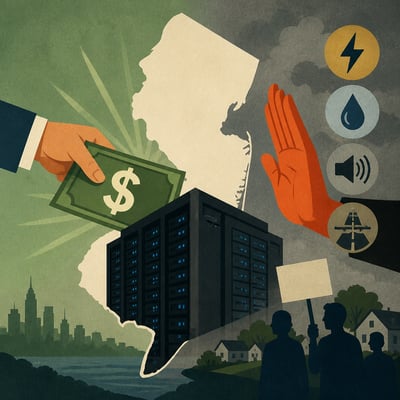
New Jersey is shifting from broadly attracting AI data centers with tax credits toward requiring developers to account for grid costs, provide greater transparency, and meet stronger operating and community safeguards.
The state has paused new applications to its $500 million Next New Jersey Program-AI while lawmakers debate ending unallocated credits, even as business and labor groups argue incentives are needed to compete for investment. CoreWeave’s $1.8 billion Kenilworth facility, already approved for up to $250 million in credits, remains under construction and is expected to require as much as 250 megawatts of electricity.
If you read one thing
It provides the broadest account of New Jersey's shift toward tighter AI data-center incentives, grid obligations, and local safeguards.
Best explainer
It explains how the Next NJ Program-AI incentive framework connects tax credits to data-center development and infrastructure constraints.
The evidence
It details the new utility-rate and grid-cost rules that make developers responsible for their electricity-system impacts.
Latest development
It captures the consequential legislative action to withdraw uncommitted AI data-center incentives.
AI incentive retrenchment
New Jersey has moved from reviewing the $500 million Next New Jersey Program-AI to pausing applications and withdrawing or targeting roughly $250 million in unallocated future credits. The approved Kenilworth project remains the principal cited exception, while business and labor groups oppose further rollback.
Developer responsibility for grid impacts
The policy framework is shifting costs and reliability obligations toward AI data-center operators through a dedicated utility rate class, requirements to cover related grid costs, and curtailment rules intended to protect residential customers during grid stress. Transparency, permitting, and compliance requirements are also becoming more central to eligibility and operation.
Local and environmental constraints on siting
AI data-center expansion is facing organized local opposition and tighter scrutiny over zoning, electricity demand, water use, noise, infrastructure, and environmental effects. These concerns are moving the debate beyond statewide investment incentives toward municipal control and project-level restrictions.
New Jersey enacts withdrawal of uncommitted AI data center tax breaks
New Jersey’s incentive reassessment has produced a concrete policy outcome: legislation ending roughly $250 million in uncommitted AI data center tax breaks became law, alongside tighter resource reporting and permit enforcement. The change sharpens the state’s move away from broad subsidies while leaving the approved CoreWeave project as the principal cited beneficiary.
Previously
New Jersey is reassessing its strategy for attracting AI data centers as large projects increase pressure on electricity systems and face opposition over costs, water use, noise, and local impacts. The NJEDA paused new applications for the $500 million Next New Jersey Program-AI, while lawmakers and the governor advanced proposals that would end or revise future credits, require data centers to cover grid costs, and impose stronger transparency and operating requirements. The approved CoreWeave facility in Kenilworth remains the central project and is generally outside proposals targeting uncommitted incentives.
The story has shifted from a general reassessment of AI data center incentives to a more concrete policy direction: New Jersey is now actively reducing future tax support while locking in rules that push grid costs and operational safeguards onto developers. CoreWeave’s approved Kenilworth project remains the anchor example, but the broader debate has hardened around whether incentives should continue at all.
The biggest shift is from a general debate over AI data center incentives to concrete state action: New Jersey paused new applications for the program and advanced laws that make future projects pay their own grid costs and face tighter operating rules. The approved Kenilworth CoreWeave project is now the clear exception, while the policy fight is centered on uncommitted incentives.