Moratoriums Slow Midwest Data CentersMoratoriums Slow Midwest Data CentersCoverage from City of Peosta, KCRG, and others
00/00/0000
DailyWeekly
Local governments in Iowa and St.
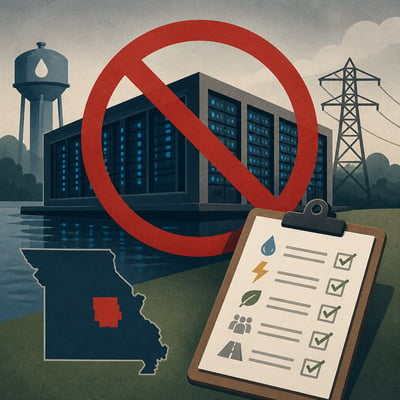
Louis are slowing data center development through temporary moratoriums, delayed zoning votes, and proposed project-specific restrictions. Dubuque County, Peosta, Marshalltown, and Linn County have adopted or advanced pauses of different lengths, while Dubuque and St. Louis are considering additional city-level rules. The decisions are driven by unresolved questions about water use, electric capacity, land and neighborhood impacts, noise, environmental effects, emergency response, and the terms of local economic benefits.
It presents the strongest permitting-under-conditions alternative through St. Louis safeguards on siting, infrastructure, renewable energy, and community accountability.
It adds the distinct legal and community-contestation dimension by documenting a lawsuit challenging an approved St. Louis project.
St. Louis Public Radio
Key Issues
01
Local pauses remain the dominant development control
Cities and counties continue to use moratoria, delayed approvals, and rezoning pauses to slow large data-center projects while they establish local rules. The pattern spans Iowa, Minnesota, Wisconsin, and Missouri, while St. Louis has moved from temporary debate to an enacted framework.
Stable
Drawn from 5 articles
02
Water and grid capacity constrain approvals
Cooling-water demand, electricity requirements, and grid reliability are being treated as approval prerequisites rather than secondary operating issues. Local rules increasingly require utility coordination, water analysis or agreements, capacity verification, and restrictions on water-intensive cooling.
Stable
Drawn from 4 articles
03
Rulemaking is becoming more specific and conditional
Local governments are moving beyond generic zoning and simple pauses toward tiered standards for facility size and power, siting buffers, noise, water use, renewable energy, grid capacity, reporting, and community benefits. St. Louis has enacted a dedicated framework, while other jurisdictions are drafting comparable conditions during moratorium periods.
Strengthening
Drawn from 5 articles
04
Opposition is producing political and legal friction
Community resistance is affecting both prospective and approved projects through strong local opposition, bans or restrictions, delayed decisions, and litigation over permitting and environmental review. Approval pathways therefore remain exposed to political and judicial challenge.
Drawn from 4 articles
Key Numbers
150-foot feet
micro facility setback
“Data centers are prohibited in residential districts and local neighborhood commercial zones. In permitted industrial and commercial zones, required setbacks vary by facility size: micro facilities under 10,000 square feet and 5 MW require a 150-foot setback; standard facilities between 10,000 and 250,000 square feet or 5–30 MW require 300 feet; and major facilities over 250,000 square feet or at least 30 MW require 600 feet from homes, schools, public parks, light rail stations, and transit centers.”
City of St. Louis
5 MW
micro facility power threshold
“Data centers are prohibited in residential districts and local neighborhood commercial zones. In permitted industrial and commercial zones, required setbacks vary by facility size: micro facilities under 10,000 square feet and 5 MW require a 150-foot setback; standard facilities between 10,000 and 250,000 square feet or 5–30 MW require 300 feet; and major facilities over 250,000 square feet or at least 30 MW require 600 feet from homes, schools, public parks, light rail stations, and transit centers.”
City of St. Louis
5 dBA or dBC
maximum operational noise increase above baseline
at property lines
“Operational noise may not exceed 5 dBA or dBC above pre-application baseline studies at property lines. Cooling equipment and backup generators must be enclosed in sound-dampening structures. Water-intensive evaporative cooling systems are prohibited. Developers must enter binding agreements with the St. Louis Water Division, fund hydraulic model studies, and pay applicable system impact fees. Operations cannot begin without written verification of grid capacity from the electric utility provider.”
City of St. Louis
10,000 computer servers
server-count threshold
one threshold for temporary restriction
“The ordinance would temporarily restrict facilities larger than 100,000 square feet or 2.3 acres, using 75 megawatts of electricity, using 50 gallons of water per minute, or containing 10,000 computer servers.”
Telegraph Herald
100,000 square feet
facility size threshold
one threshold for temporary restriction
“The ordinance would temporarily restrict facilities larger than 100,000 square feet or 2.3 acres, using 75 megawatts of electricity, using 50 gallons of water per minute, or containing 10,000 computer servers.”
Telegraph Herald
Contested Issue
1 open dispute
Should local governments pause or prohibit large data center development, or allow projects to proceed under enforceable siting, infrastructure, environmental, and community-benefit conditions?
The corpus contains a substantive policy disagreement between jurisdictions and residents seeking moratoriums or halted projects until water, grid, land-use, health, and neighborhood effects are studied, and officials or developers supporting conditional approval frameworks intended to manage those effects while preserving economic and infrastructure benefits.
Pause or prohibit pending review
3 articles · across 3 publications
Large data centers should be temporarily blocked, or projects already approved should be halted or reconsidered, until governments establish dedicated rules and resolve concerns about water demand, grid reliability, land use, environmental effects, and community impacts.
Permit under enforceable conditions
3 articles · across 3 publications
Data centers should remain eligible for approval when developers meet defined zoning, utility-capacity, water, noise, renewable-energy, and community-benefit requirements, preserving potential jobs, tax revenue, and infrastructure-linked investment.
Looking Back
122 Day Timeline
Articles published over time. Hover any bar for the period and its article count.
May 19
Jun 9
Jun 27
Jul 18
Aug 8
Aug 26
Sep 16
The Story So Far
No material change
The new articles repeat the previously established developments in St. Louis and Plymouth without adding a material change to the topic.
Previously
Local governments in Iowa and St. Louis are slowing data center development through temporary moratoriums, delayed zoning votes, and proposed project-specific restrictions. Dubuque County, Peosta, Marshalltown, and Linn County have adopted or advanced pauses of different lengths, while Dubuque and St. Louis are considering additional city-level rules. The decisions are driven by unresolved questions about water use, electric capacity, land and neighborhood impacts, noise, environmental effects, emergency response, and the terms of local economic benefits.
History
09/09/2026
The story is largely a confirmation of the existing pattern, with added specificity about Dubuque’s proposed hyperscale thresholds and the 120 MW St. Louis project. Local pauses are now more clearly tied to studies, utility coordination, and operating conditions.
09/02/2026
The story now extends beyond Iowa and St. Louis with Plymouth, Massachusetts, considering a broad yearlong ban covering data center applications, construction, expansions, and conversions. St. Louis also provides a more specific indication of the proposed zoning change, including a threshold reduction from 75 MW to 30 MW.
Karis contacted the City of Dubuque in preparation for a possible data center near Dubuque Regional Airport, but no application filed and county moratorium delays City Council action.
Marshalltown City Council is considering Ordinance 15123 on August 24 in Marshalltown, Iowa, to temporarily halt data center development while zoning rules are prepared.
St. Louis Mayor Cara Spencer signed Board Bill 49 on September 17, 2026, establishing citywide data center zoning, infrastructure, environmental, and community requirements.
Marshalltown's Planning and Zoning Commission unanimously recommended a four-month moratorium on new data center construction during a public meeting in Marshalltown, Iowa.
Linn County, Iowa, began July 20 public input on an EU-2 zoning amendment to allow nuclear-linked data centers while an EU-3 rezoning moratorium remains in force.
St. Louis aldermen advanced amendments to Board Bill 49 for data center zoning after contentious debate over renewable-energy waivers and land-use exemptions.
Marshalltown, Iowa, Planning and Zoning Commission scheduled work sessions, a community roundtable, and public hearings to develop data-center zoning rules after a four-month moratorium.
July 29 Board of Adjustment appeals will review conditional approval for a 120-megawatt data center planned for the former Famous-Barr warehouse in Midtown St. Louis.
St. Louis advanced Board Bill 49 regulating large data centers, including siting distance, cool or green roofs, and 10-year renewable power, amid NAACP opposition and ongoing appeals of a Midtown 120-megawatt project.
St. Louis aldermen advanced amended data-center zoning rules on July committee action Tuesday, with added water, energy, and noise conditions prompting developer and environmental group disputes.
North Mankato, Minnesota, City Council will consider a 12-month moratorium on new data centers after months of community debate over water and energy impacts.
Linn County, Iowa, approved a moratorium effective immediately through January 1, 2028 on EU-3 large-scale data center rezoning applications in unincorporated areas.
Linn County, Iowa Board approves an 18-month moratorium on EU-3 rezoning applications for large-scale data centers in unincorporated areas, effective immediately.
St. Louis City approved a conditional use permit for a data center at The Armory on April 21, 2026 after rejecting a data center moratorium and advancing zoning regulations in 2025-2026.
Imperial County supervisors imposed a 45-day urgency ordinance moratorium on data center projects after community opposition and pending an ad hoc committee report.
Miriam Keller and the St. Louis Planning Commission advanced stricter city data center regulations on Wednesday, including lower megawatt thresholds and a 50 percent renewable requirement at operation.
The St. Louis County Planning Commission is considering tiered data-center zoning regulations for unincorporated areas before a possible referral to the County Council on September 14.
Marshalltown City Council approved a four-month moratorium on data center construction, directing public rulemaking for Planning and Zoning Commission regulations in Iowa.
Superior, Wisconsin approved a one-year data center moratorium in 2024 while city officials study zoning and utility impacts after local concerns about health, water, and energy use.
Plymouth City Council approved a one-year moratorium on data centers of at least 50,000 square feet in Plymouth, Minnesota, to study zoning, water, and grid impacts.
Plymouth residents will decide at the October 17 Town Meeting whether to impose a yearlong moratorium on data center development after a September 23 public hearing at Town Hall.
DeKalb County commissioners extended the county's data center moratorium through March 2027 in Georgia while developing approval rules and debating environmental oversight.
Independence, Missouri approved a 180-day moratorium on new data centers and BESS projects after resident pressure, excluding ongoing Nebius and Patmos applications.
Woodbury County, Iowa, plans a one-year moratorium for unincorporated-area data center projects after resident opposition to a MidAmerican Energy site considered for development near Salix.
Community opponents filed a lawsuit Friday in St. Louis, Missouri, seeking to suspend and overturn approval of a proposed $3 billion Midtown data center.
8/29/2026 • Community & Local Opposition • General
The St. Louis County Planning Commission is reviewing four-tier data center zoning guidelines in unincorporated St. Louis County, with public comments accepted through Aug. 31.
The St. Louis County Planning Department presented proposed data center zoning and operating rules during a Planning Commission hearing in unincorporated St. Louis County, Missouri.
Iowa Citizens for Community Improvement and local residents are challenging data center expansion through protests and moratoriums across Iowa in 2026.
Iowa Citizens for Community Improvement says statewide residents are pushing for county moratoriums on new data centers due to water, energy, farmland, and subsidy impacts.
7/11/2026 • Community & Local Opposition • General
Brown County, Wisconsin committee members on June 2 declined a proposed countywide moratorium on data centers, citing lack of zoning authority over independent municipal rules.
Linn County supervisors in Iowa decided Monday to reject EU-2 zoning amendments that would have allowed large data centers near the Duane Arnold Energy Center.
Dubuque County zoning officials discussed a data center ordinance in a work session Thursday, citing zoning, land suitability, and electric transmission map constraints.
Mankato City Council approved a one-year moratorium on data centers and high-impact utility consumers on July 13 while staff study local zoning, water, and health impacts.
Dubuque County supervisors agreed to seek county attorney permission to hire a consultant to explore a data center ban while the zoning ordinance moves forward, after airport and economic impact presentations.
Linn County, Iowa supervisors voted 2-1 to impose an 18-month moratorium on new data center development in unincorporated areas while newly adopted zoning water rules are evaluated.
St. Charles County Council introduced a six-month moratorium on large-scale data centers in Missouri while health and infrastructure impact studies are conducted.
St. Charles County Council in Missouri introduced a six-month moratorium on large-scale data center proposals and expansions to conduct local impact studies.
PathOne Data Centers and Sunstone Investments appeared before Sioux County supervisors in Iowa in response to a new data center moratorium after stating an end user was secured before the pause.
Sioux County Board of Supervisors planned an informational session on a Hull, Iowa data center proposal after a one-year moratorium on new data centers.
Seminole County commissioners discussed a potential data center moratorium in Florida, citing a county code review and new July 1 authority for regulating large load customers.
Scott Nelson criticized Dubuque County's one-year data center development moratorium as legally weak after supervisors voted to pause projects while drafting an ordinance.
Mayor Jill Shudak sought a up to one-year moratorium on new data center projects in Council Bluffs, Iowa, to review infrastructure and ordinances amid water and power concerns.
Plymouth County supervisors approved a one-year revocable moratorium on data center and industrial battery storage construction in Iowa on Tuesday, citing rulemaking needs for water, power, and noise.
Winnebago County, Wisconsin, proposed a 12-month moratorium on hyperscale AI data center permitting after concerns about power demand, water use, and local infrastructure strain.
Woodbury County, Iowa supervisors planned a one-year data center moratorium after Salix annexed farmland, while MidAmerican Energy confirmed a potential site under consideration within Salix limits.
Boone County commissioners in Indiana approved a one-year moratorium on new unincorporated data center development on June 15, 2026 to reassess land use and infrastructure impacts.
Lee County supervisors in Iowa discussed seeking legal counsel for a possible six-month moratorium on new data center construction during a Tuesday work session.
St. Louis Planning Commission sent finalized data-center zoning rules to the Board of Aldermen after public comment and amendments addressing siting, size limits, and renewable energy requirements.
DeKalb County commissioners extended a data center application moratorium by 100 days through end-of-September after resident requests for additional health, environmental, and water studies.
The Advisory Committee on Data Centers met in Dane County, Wisconsin on June 9, 2026 to consider a moratorium on zoning permit applications for data center siting.
Dubuque County, Iowa approved a 12-month data center moratorium on Tuesday to draft zoning rules amid resident concerns and city water-connection review requirements.
Dubuque County Zoning Commission recommended a moratorium on new data-center development to county supervisors after large resident turnout and opposition at a Tuesday meeting.
St. Charles city council voted 7-1 to permanently ban new data center construction on Tuesday night using zoning-based permitting and conditional use prohibitions.
A Las Vegas developer seeks final city approval for a 120 MW Midtown St. Louis data center after conditional use permitting and resident concerns over water, air, noise, and power grid impacts.
St. Louis Planning Commission delayed a data center zoning rules vote in Midtown, Missouri, after public comment and proposed changes to megawatt thresholds and renewable energy timelines.
The St. Louis Board of Aldermen advanced Board Bill 49 on August 28, 2026, establishing dedicated data center zoning and operating rules in St. Louis, Missouri.
More than 70 people attended a Mankato, Minnesota community forum in 2024-style hearing format to question public health and environmental effects of proposed large-scale data centers.
7/26/2026 • Community & Local Opposition • General
Iowa Colony City Council will consider a July 20 resolution opposing data centers after Brazoria County adopted strict conditional development requirements addressing water, electricity, and community impacts.
7/18/2026 • Community & Local Opposition • General
Dubuque County supervisors in Iowa approved a 12-month moratorium on data center development applications and approvals after resident opposition during a special meeting Tuesday.
5/27/2026 • Community & Local Opposition • General
Dubuque County, Iowa officials prepared a 120-day moratorium on data center development after zoning meetings and petition-driven opposition near Dubuque Regional Airport.
5/22/2026 • Community & Local Opposition • General
Dubuque County, Iowa zoning commissioners considered recommending a future data center moratorium after residents raised water, land-use, and noise concerns at a public meeting.
5/20/2026 • Community & Local Opposition • General
Dawn Vogel and Iowa county officials supported a temporary data-center moratorium in 2025 as local opposition spread across partisan lines amid rapid AI infrastructure expansion.
Southcentral Minnesota Clean Energy Council holds a July 25 community event in Mankato, Minnesota to discuss data-center impacts during a year-long city moratorium.
7/20/2026 • Community & Local Opposition • General
Dubuque County, Iowa held a first public town hall on a data-center ordinance in Peosta after a 12-month development halt, amid concerns about water quality and utilities.
6/24/2026 • Community & Local Opposition • General
A former Marshall County development director urges Marshalltown, Iowa to delay a two-year data center moratorium and instead coordinate with Alliant Energy and Marshalltown Water Works.
More than 100 Marshalltown residents discussed data center regulations at a Thursday public roundtable as city officials gathered information before drafting rules.
8/29/2026 • Community & Local Opposition • General
Marshalltown's city council recently enacted a four-month moratorium on data center development after residents raised environmental, safety, tax, and land-use concerns in Marshalltown, Iowa.
8/28/2026 • Community & Local Opposition • General

 AI Governance
 Data Centers
 Drones
 Climate
 Privacy
 2026 Maine Senate
 Bob Dylan