
 AI Governance
 Data Centers
 Drones
 Climate
 Privacy
 2026 Maine Senate
 Bob Dylan
Moratoriums Slow Midwest Data Centers
Coverage from City of Peosta, KCRG, and others
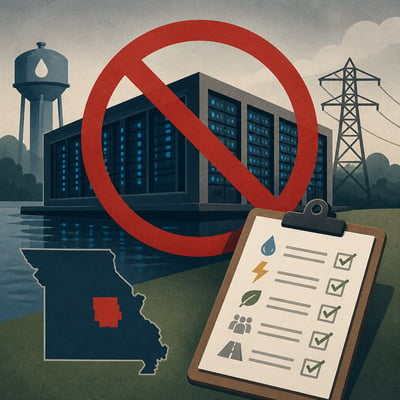
Local governments in Iowa and St.
Louis are slowing data center development through temporary moratoriums, delayed zoning votes, and proposed project-specific restrictions. Dubuque County, Peosta, Marshalltown, and Linn County have adopted or advanced pauses of different lengths, while Dubuque and St. Louis are considering additional city-level rules. The decisions are driven by unresolved questions about water use, electric capacity, land and neighborhood impacts, noise, environmental effects, emergency response, and the terms of local economic benefits.
The story is largely a confirmation of the existing pattern, with added specificity about Dubuque’s proposed hyperscale thresholds and the 120 MW St. Louis project. Local pauses are now more clearly tied to studies, utility coordination, and operating conditions.
The story now extends beyond Iowa and St. Louis with Plymouth, Massachusetts, considering a broad yearlong ban covering data center applications, construction, expansions, and conversions. St. Louis also provides a more specific indication of the proposed zoning change, including a threshold reduction from 75 MW to 30 MW.
The story shifts from temporary pauses toward more detailed, potentially stricter operating rules, especially in St. Louis, while named utilities and stronger local opposition become more prominent.
The story is now more tightly focused on Iowa and St. Louis, with clearer project scale and timing: Linn County’s restriction runs through January 1, 2028, and St. Louis is considering rules affecting a proposed 120 MW, $3 billion facility.
The story is mostly unchanged, but the current version adds more specific regulatory details and reframes the pauses as rulemaking tied to measurable local limits and public benefits. It also sharpens the scope of several moratoria and the St. Louis vote delay.
The story has shifted from a general pattern of local data-center restrictions to specific, active moratoria and zoning delays in several Iowa jurisdictions plus DeKalb County and St. Louis. The most important new development is that multiple governments are now formally pausing approvals while they write facility-specific rules, which could directly delay projects already under consideration.
- Dubuque County approved a 12-month moratorium.
- Peosta adopted a six-month pause and started drafting an ordinance.
- DeKalb County extended its moratorium through March 2027.
- Marshalltown scheduled a four-month data center rulemaking process.
- St. Louis delayed a vote to lower the major-facility threshold from 75 MW to 30 MW.
The story has broadened from a few Midwestern and California cases into a wider regional pattern of local governments using moratoria and conditional permitting to control data-center growth. It now emphasizes that these actions are shaping project feasibility through water, grid, noise, and community-benefit requirements, with some places moving all the way to bans.
- DeKalb County, Georgia, extended its moratorium through March 2027.
- St. Charles, Missouri, imposed a permanent ban on new data centers.
- Dubuque County, Marshalltown, and Independence add new local policy actions.
- The story now includes Wisconsin and Georgia communities.
- Local rules now explicitly cover community benefits and emergency response.
Cities and counties in Missouri, Iowa, Minnesota, and California are slowing or reshaping data center development through moratoriums, zoning rules, public studies, and project appeals. Officials are weighing economic benefits against concerns about water use, electrical and public infrastructure, environmental impacts, emergency response, land use, and renewable-energy compliance. The direction is toward more site-specific review and stronger conditions, but several projects remain subject to unresolved appeals, legal challenges, or pending rule changes.