
 AI Governance
 Data Centers
 Drones
 Climate
 Privacy
 2026 Maine Senate
 Bob Dylan
Kansas Data Centers Meet Local Limits
Coverage from The Kansas City Star, Topeka Capital-Journal, and others
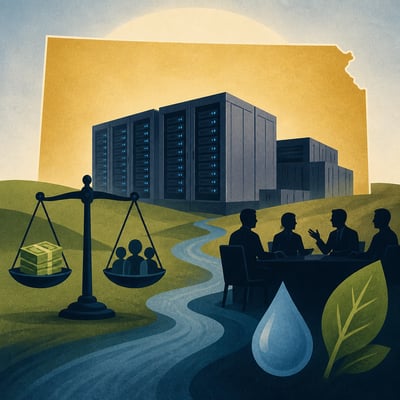
Data center proposals across Kansas and the Kansas City region are advancing alongside stronger local scrutiny and organized opposition.
Communities are weighing potential investment and tax-base growth against electricity costs, water use, noise, environmental risks, transparency, and the terms of tax incentives. Several proposals have been withdrawn or rejected, while major campuses in De Soto, Edgerton, and Shawnee County remain subject to planning, permitting, or public review.
The update adds concrete setbacks: projects in Spring Hill and Gardner were withdrawn, reinforcing that opposition is affecting outcomes rather than only delaying review.
The story has shifted from primarily proposed projects and general opposition toward concrete implementation and regulatory divergence: Emporia and De Soto are advancing, while multiple jurisdictions have imposed moratoriums or permit pauses. New large-load details, including Compass Datacenters’ proposed 400-megawatt Shawnee County campus, make grid capacity and infrastructure costs more immediate concerns.
The story has moved beyond project proposals and withdrawals to formal community and government action: Emporia voters secured a ballot question on a data center ban, while Kansas City’s Plan Commission rejected a major downtown project.
- Emporia residents secured a November ballot question on a proposed data center ban.
- The ballot measure’s legal effect remains unresolved.
- Kansas City’s Plan Commission unanimously rejected the proposed downtown data center.
- The rejected project would have replaced the historic Western Newspaper Union Building.
- Lower-frequency noise and historic preservation became prominent opposition concerns.
The story has broadened beyond De Soto-area projects to include a downtown Kansas City, Missouri proposal and a more explicit look at local enforcement, disclosure, and noise-rule adequacy. The current version also shows the debate moving from general opposition to more concrete planning and regulatory reviews in multiple communities.
The biggest update is that Kansas Senate Bill 98 is now explicitly central to the story, and some proposals have moved from debate into execution or local regulation. A nearby shift also broadens the story slightly into Kansas City–area jurisdictions and Missouri, with Lawrence adding a moratorium and De Soto's Beale project breaking ground.
- Beale Infrastructure has broken ground on its De Soto campus.
- Kansas Senate Bill 98 now anchors the tax incentive debate.
- Lawrence adopted a two-year moratorium on related development.
- Kansas City and Independence, Missouri, are now in scope.
- Developers have proposed specific mitigation measures.
The story now places stronger emphasis on project accountability and local protections, with new withdrawals in Gardner and Spring Hill showing opposition can stop proposals, not just slow them. It also sharpens the focus on incentive terms, utility arrangements, and transparency concerns as central battlegrounds across Kansas.
- Gardner and Spring Hill proposals were withdrawn after opposition.
- Tax incentives are now a central dispute point.
- Possible utility upgrades and emergency curtailment are newly emphasized.
- Transparency concerns include NDAs and ownership disclosures.
- Statewide large-load service arrangements are now part of the debate.
The story has broadened from a set of contested Kansas proposals into a more advanced wave of data center development, with Emporia approving zoning and other jurisdictions adding moratoria, hearings, and operating rules. Utility planning and developer mitigation efforts are now part of the core narrative alongside local opposition.
- Emporia approved zoning changes for the Flint Hills Digital Campus.
- Topeka adopted a one-year city moratorium.
- Shawnee County's Compass Datacenters proposal remains under review.
- De Soto now hosts multiple major data center proposals.
- Developers are presenting mitigation measures, including wastewater recycling and closed-loop cooling.
The story now shows a broader, more procedurally advanced Kansas data center backlash: Emporia’s dispute has been delayed for revisions, Edgerton’s moratorium fight has advanced to a narrow council vote, and opposition has expanded into more communities. The framing also sharpens around transparency, infrastructure costs, and enforceability of developer promises.
The story has sharpened around Emporia, where the Flint Hills Digital Campus has become the main flashpoint for opposition, transparency concerns, and disputes over ownership and financing. Separate local actions in Edgerton and De Soto also show the debate moving from broad concern to concrete land-use and regulatory decisions.
- Emporia hearing drew more than 400 attendees.
- Flint Hills Digital Campus faces questions about ownership and financing.
- Edgerton rejected a six-month moratorium.
- DAMAC Digital’s $860 million proposal was denied by the planning commission.
- De Soto said data centers are permitted in its M-1 industrial district.
The story has broadened from local permitting disputes into a more coordinated statewide utility-and-policy issue. Kansas officials and Evergy now appear more central, with load growth, tariff design, and tax policy weighing alongside zoning fights.
The story has broadened from a general Kansas backlash into a more concrete, utility- and permitting-driven set of active disputes across Kansas and nearby Missouri. The main new emphasis is on specific approvals, power planning, and incentive structures shaping whether projects advance.
- Nearby Missouri communities are now part of the dispute.
- Evergy is now a visible actor in load planning and infrastructure coordination.
- Kansas Senate Bill 98 is shaping tax treatment and project structuring.
- Some hearings, votes, and follow-up reviews are scheduled into July and August 2026.
- The story now includes infill and redevelopment proposals, not only greenfield campuses.
The story has sharpened from a broad pattern of Kansas data center resistance into a more explicit account of widespread local backlash moving through zoning, permitting, and appeals. The main new emphasis is that opposition and regulatory friction are now the dominant frame, not just isolated project disputes.
The story has shifted from general local pushback to a more developed statewide pattern of multiple large data center proposals moving through Kansas planning systems, with some projects already being slowed or stopped. The main new development is the clearer evidence of project-by-project outcomes: some proposals are being withdrawn or delayed while local governments tighten rules and continue weighing tax and utility terms.
- Some proposals have been withdrawn or delayed after resident opposition.
- Local governments are tightening zoning rules and imposing short moratoriums.
- Senate Bill 98 is shaping project economics.
- Power discussions now include load guardrails and on-site generation.
- The story now spans Johnson, Shawnee, Pottawatomie, Finney, and nearby metro counties.
The story has shifted from general debate over proposed data centers to a more concrete permitting and regulatory phase, with multiple Kansas jurisdictions now actively drafting or applying rules. The added emphasis is on formal backlash: moratoriums, tighter conditions, and utility/tax negotiations are becoming the main battlegrounds.
The story has broadened from a general Kansas data-center zoning and incentive fight into a more formalized statewide policy and utility-cost issue, with new actors and a clearer regulatory framework emerging. The addition of Finney County and Garden City also shows the debate extending into new parts of Kansas beyond the earlier metro-focused disputes.
- Finney County and Garden City are newly part of the dispute.
- Kansas Senate Bill 98 now shapes data center tax incentives.
- Kansas Corporation Commission is involved in large-load energy-cost rules.
- Triple Oak Power is proposing a Garden City-area project.
- Derek Schmidt is weighing in on local control and resource sourcing.
The story has broadened from general Kansas data center pushback into a larger, more specific wave of hyperscale and AI proposals, with zoning, incentives, and utility regulation now emerging as the main battlegrounds. New actors and sites make it clear this is a multi-jurisdiction siting and policy fight, not just isolated local resistance.
- Hyperscale and AI data center proposals are now explicitly driving the debate.
- Kansas Corporation Commission guardrails on large-load users are newly part of the story.
- Some proposals involve redevelopment of industrial or brownfield sites.
- De Soto and Shawnee County emerge as visible focal points.
- Kansas Senate Bill 98 is now a key incentive framework in dispute.
The story has broadened from northeast Kansas data center planning into a more concrete, multi-city debate with specific proposals, local opposition, and utility preparation for load growth. The main new element is that communities are now actively considering rules and moratoriums while developers and utilities position for projects that may move forward.
- Communities are actively reviewing specific proposed data center projects.
- Some counties and cities are considering moratoriums and public comment processes.
- Evergy is preparing for rapid load growth and capacity needs.
- New proposal-linked actors include Alcove Development and DAMAC Digital Solutions Kansas LLC.
- Local opposition now prominently includes noise and lighting concerns.
Northeast Kansas officials are drafting rules and weighing terms for prospective data center projects as developers explore sites in Pottawatomie County and nearby jurisdictions. The debate centers on tax incentives, utility demand, water and environmental safeguards, and whether counties can capture economic benefits without shifting costs onto residents.