
 AI Governance
 Data Centers
 Drones
 Climate
 Privacy
 2026 Maine Senate
 Bob Dylan
Warming Expands Disease Seasons and Ranges
Coverage from Climate Central, The New York Times, and others
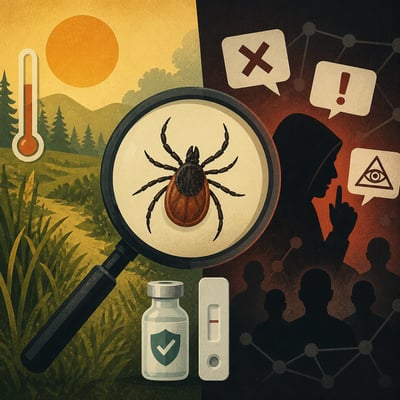
Warming temperatures and related ecological changes are creating more favorable conditions for ticks, mosquitoes, Vibrio bacteria, and some other pathogens, extending transmission seasons and shifting disease risks into new areas.
The strongest evidence concerns expanding tick and mosquito activity in the United States, while warmer coastal waters and changing food and water conditions are raising concerns in Europe and elsewhere. The pattern increases pressure on surveillance, diagnostics, prevention, and coordinated public-health responses, although the scale of future impacts varies by pathogen and local conditions.
If you read one thing
It provides the clearest high-level account of how warming is lengthening tick seasons, expanding ranges, and increasing disease exposure.
Best explainer
It explains how warming shifts mosquito ranges and transmission windows while showing why coordinated surveillance is necessary.
The local angle
It gives a concrete European coastal example of warmer, low-salinity waters increasing Vibrio risks and affecting communities.
The evidence
It adds a distinct, mechanism-focused example of the more qualified evidence linking warming and altered water conditions to Cyclospora risk.
Tick seasons, ranges, and disease burden are expanding
Warmer winters and longer warm periods are supporting greater tick survival, longer activity seasons, and range expansion across the United States and beyond. The associated risks include Lyme disease, coinfection, and alpha-gal syndrome, while land use and human exposure continue to shape local outcomes.
Mosquito transmission windows are lengthening and shifting geographically
Rising temperatures and changing rainfall are increasing the number of days suitable for mosquito activity and disease transmission in many U.S. cities. Mosquito populations and associated risks are also moving into cooler regions, broadening seasonal exposure to diseases such as West Nile virus and eastern equine encephalitis.
Warmer, low-salinity coastal waters are elevating Vibrio risk
Coastal warming, heatwaves, and low-salinity conditions are making parts of the Mediterranean, northern Europe, and the Atlantic coast more favorable to Vibrio proliferation. Reported consequences include severe-infection concerns, seafood risk, beach closures, and disruption to coastal tourism.
Foodborne risks are plausible but evidentially less settled
Hotter and longer warm periods, altered rainfall, drought, irrigation, wastewater reuse, and produce-distribution conditions may increase Cyclospora and other foodborne pathogen risks. The specific contribution of climate to outbreaks and contamination pathways remains less established than the tick, mosquito, and coastal Vibrio patterns.
Surveillance and response capacity remains uneven
Monitoring, diagnostics, data sharing, and vector-control capacity are not uniform across affected regions. The corpus points to a need for locally tailored surveillance and coordinated prevention, while fragmented systems and limited resources constrain early detection and response.
The supplied articles do not represent new Topic members since the prior state, so they provide no evidence of a material change in the underlying disease-risk developments.
Previously
Warming temperatures, altered rainfall, and warmer coastal waters are changing disease ecology across North America, Europe, Türkiye, and the MENA region. Tick and mosquito seasons are lengthening, coastal Vibrio risk is rising, and foodborne outbreak links remain less certain while surveillance capacity varies.
The story now places greater emphasis on the strongest U.S. evidence for expanding tick and mosquito risks, while broadening concern about Vibrio into U.S. coastal waters and adding agricultural and animal-health implications.
The story broadens from a mainly U.S./Europe tick-mosquito-Vibrio risk narrative into a wider North America–Europe–MENA framing, with stronger evidence of climate-linked disease ecology shifts but continued uncertainty around Cyclospora and uneven surveillance capacity. The new version also adds a concrete quantitative finding on West Nile-suitable mosquito days and more explicit reporting of local response constraints.