
 AI Governance
 Data Centers
 Drones
 Climate
 Privacy
 2026 Maine Senate
 Bob Dylan
Warming Expands Disease Seasons and Ranges
Coverage from Climate Central, The New York Times, and others
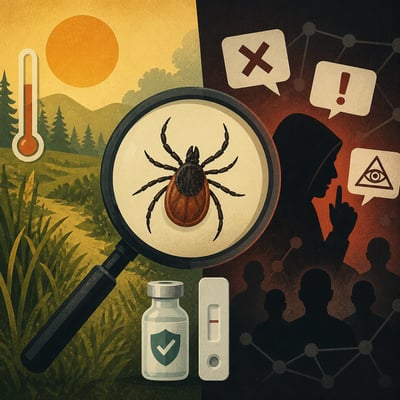
Warming temperatures and related ecological changes are creating more favorable conditions for ticks, mosquitoes, Vibrio bacteria, and some other pathogens, extending transmission seasons and shifting disease risks into new areas.
The strongest evidence concerns expanding tick and mosquito activity in the United States, while warmer coastal waters and changing food and water conditions are raising concerns in Europe and elsewhere. The pattern increases pressure on surveillance, diagnostics, prevention, and coordinated public-health responses, although the scale of future impacts varies by pathogen and local conditions.
The story now places greater emphasis on the strongest U.S. evidence for expanding tick and mosquito risks, while broadening concern about Vibrio into U.S. coastal waters and adding agricultural and animal-health implications.
The story broadens from a mainly U.S./Europe tick-mosquito-Vibrio risk narrative into a wider North America–Europe–MENA framing, with stronger evidence of climate-linked disease ecology shifts but continued uncertainty around Cyclospora and uneven surveillance capacity. The new version also adds a concrete quantitative finding on West Nile-suitable mosquito days and more explicit reporting of local response constraints.
The story is now more explicitly centered on specific diseases and vectors, especially Lyme disease, while also adding stronger evidence that public health response is moving toward surveillance and early warning. The geography has broadened modestly to highlight specific U.S. regions and coastal waters, and the Cyclospora link is now framed as less certain.
The story has broadened from a general climate-driven vector-borne disease trend into a more operational, current-risk narrative centered on active surveillance findings, especially in the US and Canada. It now adds cyclospora and emphasizes cross-jurisdiction monitoring and structural, ongoing risk rather than just seasonal expansion.
The story broadened beyond a general climate-driven vector-risk trend into a more specific, multi-region public health picture centered on Lyme, alpha-gal syndrome, mosquitoes, and coastal Vibrio exposure. It also now emphasizes uneven prevention capacity and clearer evidence of compounded human exposure from development and land use.
The story has broadened from a general climate-linked rise in tick and other pathogen risks to a more specific emphasis on mosquitoes and Vibrio, with public health agencies now actively building surveillance and early-warning systems. The current version also adds more explicit regional specificity and highlights that some local conditions are not yet producing uniform year-round risk.
The story has broadened from a tick-specific climate and misinformation narrative into a wider climate-sensitive infectious disease story, with stronger emphasis on observed health impacts and regional evidence across multiple continents. The new version also leans more on surveillance and clinician preparedness than on online conspiracy coverage.
- Tick-bite emergency-room visits are near their highest levels since 2017.
- The scope now includes Vibrio infections and fungal diseases.
- Regional evidence now explicitly includes Canada and Denmark/Nordic reporting.
- The story emphasizes observed health impacts over online conspiracy claims.
- Cross-border coordination is newly highlighted as a response need.
Tick-borne disease risk is rising as warmer temperatures extend tick seasons, expand tick habitats, and increase the chance of exposure to multiple pathogens. At the same time, conspiracy theories about deliberate tick planting and other false causes are gaining attention online, complicating public understanding of the real drivers. The material also points to ongoing gaps in surveillance, diagnostics, and prevention, even as new vaccines and tests are emerging.