
 AI Governance
 Data Centers
 Drones
 Climate
 Privacy
 2026 Maine Senate
 Bob Dylan
School Districts Formalize Classroom AI Governance
Coverage from AZPM, Spectrum News 13, and others
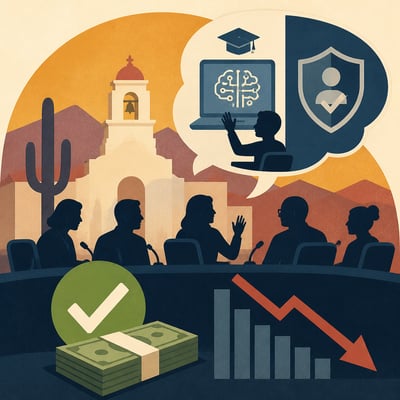
School districts are turning classroom AI use into formal governance, pairing approved-tool and privacy controls with teacher oversight, academic-integrity rules, and AI literacy.
Local approaches range from prohibitions and tight authorization to supervised pilots and curriculum integration.
The story has broadened from districts drafting AI rules into a more formal governance phase, with several systems now adopting policies, pilots, and implementation frameworks rather than just reviewing proposals. It also expands beyond the earlier state-set deadlines to include school-board association guidance and an Australian independent school example.
The story is now framed less as a set of isolated district policy moves and more as a broader wave of formal AI governance, with Ohio’s state deadline and local board processes driving implementation. The current version also sharpens the emphasis on approved platforms and human oversight while showing continued variation in how far districts will allow AI use.
The story has broadened from a handful of district policy debates into a more clearly defined statewide implementation push, led by Ohio’s mandate and reflected in a wider set of district responses. It now emphasizes execution details like approved platforms, student-use limits, human oversight, and academic-integrity rules, while showing that districts are still adopting uneven approaches.
- Ohio requires public school districts to adopt AI policies.
- Akron bans ChatGPT and Claude for district use.
- Tucson has paused expansion of approved AI use beyond high schools.
- Districts are limiting AI detection scores as sole discipline evidence.
- Policies now cover grading, hiring, communications, and human review.
The story broadens from Tucson’s board debate into a wider pattern of districts formalizing AI rules across classrooms and operations. The new emphasis is on policy implementation—approved tools, privacy limits, and oversight—rather than just whether to expand access.
- Several districts are creating formal AI policies.
- Some districts are blocking specific AI products.
- Privacy rules now limit uploading student information.
- Teacher training is paired with stricter staff oversight.
- Akron and Santa Paula join Tucson in the story.
Tucson Unified’s board approved teacher raises funded by a voter-backed override while stopping short of expanding AI platform use beyond high schools. The AI discussion centered on guardrails, teacher oversight, and whether district policy should broaden classroom access to approved tools. The meeting also reflected wider operational pressures, including attendance decline and enrollment loss that are pushing new staffing and data efforts.