
 AI Governance
 Data Centers
 Drones
 Climate
 Privacy
 2026 Maine Senate
 Bob Dylan
China’s Bid to Shape AI Rules
Coverage from Asia News Network, Asia Times, and others
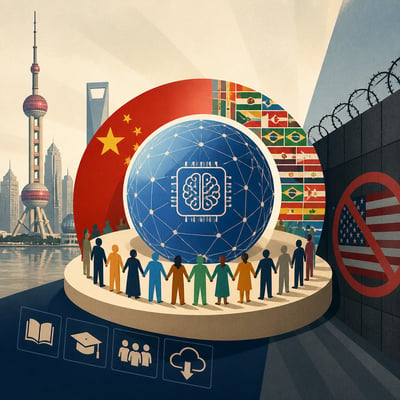
China is using the World AI Conference and the proposed World Artificial Intelligence Cooperation Organization to promote a multilateral approach to AI rules, standards, model access, and capacity building.
The initiative combines calls for human control and safety with offers of training, regional cooperation centers, and AI systems for developing countries, positioning Beijing as an alternative to approaches centered on national-security restrictions and export controls. Its practical significance will depend on WAICO’s confirmed membership, institutional authority, and ability to influence standards beyond China’s existing diplomatic partners.
If you read one thing
It provides the clearest broad introduction to WAICO’s institutional purpose, China’s multilateral strategy, and its Global South focus.
Best explainer
It explains WAICO’s proposed governance model while highlighting the still-untested nature of its enforcement and dispute mechanisms.
The counter-case
It presents the strongest contrasting case that WAICO could deepen fragmentation between competing AI governance systems.
Latest development
As the Story So Far driver, it updates the topic with evidence on Chinese open-model adoption, capacity building, and intensifying governance competition.
WAICO has a visible but unsettled institutional foothold
WAICO is widely reported as a China-backed channel for international AI coordination, involving dozens of countries and agendas covering standards, safety, human control, and cross-regional cooperation. Its institutional status, membership, and degree of formal establishment remain unsettled.
Access and capacity building are China’s main coalition-building instruments
China is pairing WAICO diplomacy with training, technology transfer, open-model cooperation, and regional initiatives aimed at developing countries. Lower-cost, locally deployable Chinese models give this governance offer a practical digital-sovereignty component beyond rule-setting.
US-China competition is deepening governance fragmentation
WAICO and US-linked initiatives are developing parallel approaches to standards, model access, safety, and national-security controls. The resulting pressure is increasing policy and compliance divergence, even as countries such as Kazakhstan and governments in Africa seek to avoid choosing a single bloc.
WAICO’s practical authority remains untested
WAICO’s reported participation has not yet demonstrated binding implementation, enforcement, dispute resolution, or durable effects on enterprise compliance. Its ability to shape standards beyond China’s established partners remains uncertain, making institutional influence the key unresolved constraint.
1.2 percent
tokens used by US firms on OpenRouter
“Chinese models accounted for 58 percent of tokens used by US firms on OpenRouter in July, up from 1.2 percent in December 2024, while Chinese models are often 60 to 90 percent cheaper than comparable closed systems from Anthropic and OpenAI.”
60 to 90 percent
price difference versus comparable closed models
“Chinese models accounted for 58 percent of tokens used by US firms on OpenRouter in July, up from 1.2 percent in December 2024, while Chinese models are often 60 to 90 percent cheaper than comparable closed systems from Anthropic and OpenAI.”
Contested Issue
Will WAICO strengthen inclusive global AI governance or deepen fragmentation between competing governance systems?
The corpus contains opposing strategic assessments of WAICO’s likely international effect. Some sources present it as an inclusive, UN-centered mechanism that broadens participation and coordinates standards and capacity building, while others forecast that it will create a China-led governance orbit, increase regulatory divergence, and intensify geopolitical fragmentation.
Inclusive coordination
WAICO can broaden Global South participation and strengthen shared AI standards, capacity building, and multilateral coordination.
Governance fragmentation
WAICO is likely to establish a China-led governance orbit that increases divergence between regulatory frameworks and complicates coordinated global oversight.
Chinese open-weight models turn AI diplomacy into a practical adoption strategy
China’s AI influence effort is gaining a concrete commercial and technological channel: Chinese open-weight models are attracting substantial use from U.S. firms because they are cheaper and locally deployable. This extends WAICO’s significance beyond diplomatic positioning toward competition over real-world model adoption, while users continue to balance suppliers rather than form fixed U.S.- or China-led blocs.
Previously
China is using the World AI Conference and the proposed World Artificial Intelligence Cooperation Organization to promote a multilateral approach to AI rules, standards, model access, and capacity building. The initiative combines calls for human control and safety with offers of training, regional cooperation centers, and AI systems for developing countries, positioning Beijing as an alternative to approaches centered on national-security restrictions and export controls. Its practical significance will depend on WAICO’s confirmed membership, institutional authority, and ability to influence standards beyond China’s existing diplomatic partners.
The story has shifted from treating WAICO as a formalized institution to emphasizing that its legal status, membership, authority, and external influence remain uncertain. China’s broader governance strategy is confirmed, but its practical institutional impact is now presented as unproven.
WAICO has moved from a proposed Chinese initiative to a formally established Shanghai-based institution, making China’s international AI governance push more concrete. The story is now framed less as a prospective alternative and more as one track in a fragmented but interconnected global governance system.