
 AI Governance
 Data Centers
 Drones
 Climate
 Privacy
 2026 Maine Senate
 Bob Dylan
China’s Bid to Shape AI Rules
Coverage from Asia News Network, Asia Times, and others
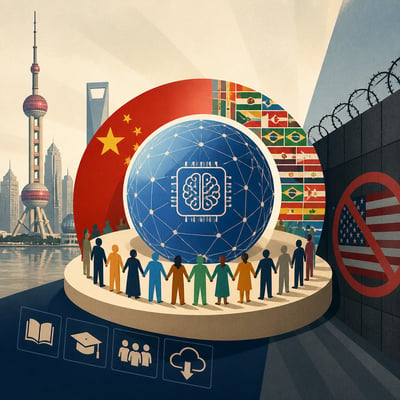
China is using the World AI Conference and the proposed World Artificial Intelligence Cooperation Organization to promote a multilateral approach to AI rules, standards, model access, and capacity building.
The initiative combines calls for human control and safety with offers of training, regional cooperation centers, and AI systems for developing countries, positioning Beijing as an alternative to approaches centered on national-security restrictions and export controls. Its practical significance will depend on WAICO’s confirmed membership, institutional authority, and ability to influence standards beyond China’s existing diplomatic partners.
The story has shifted from treating WAICO as a formalized institution to emphasizing that its legal status, membership, authority, and external influence remain uncertain. China’s broader governance strategy is confirmed, but its practical institutional impact is now presented as unproven.
WAICO has moved from a proposed Chinese initiative to a formally established Shanghai-based institution, making China’s international AI governance push more concrete. The story is now framed less as a prospective alternative and more as one track in a fragmented but interconnected global governance system.
- WAICO was formalized in Shanghai on July 16–17, 2026.
- The organization has 29 reported founding signatories.
- Pax Silica and bilateral US-China safety talks now feature prominently alongside WAICO.
- Existing OECD, UNESCO, G7, G20, and EU frameworks remain governance baselines.
- National AI oversight now increasingly covers autonomous agents, digital twins, election deepfakes, registries, and labor impacts.
The initiative is now portrayed less as an established intergovernmental body and more as a proposed platform whose membership and institutional durability remain uncertain. Reporting also broadens the claimed founding participation and places the effort alongside expected US-China AI safety discussions.
WAICO has progressed from a proposed China-backed institution with a signed founding agreement to a formally launched intergovernmental body. Its framing has also sharpened as an open, UN-centered alternative to U.S.-style security restrictions and export controls, intensifying the standards competition.
WAICO has moved from a broadly described launch into a more concrete China-backed governance vehicle, with clearer emphasis on standards, data governance, and technology deployment. The biggest new element is practical outreach: China is now tying the institution to specific assistance plans, including a meteorological warning system rollout in 30 countries.
China has formalized the World Artificial Intelligence Cooperation Organization with 29 founding countries and a headquarters in Shanghai, presenting it as an inclusive forum for AI cooperation, capacity building, and rules that give developing countries a larger role. Beijing has paired the initiative with training opportunities, regional cooperation centers, and support for affordable or open-source AI, while criticizing technology restrictions associated with the United States. WAICO’s practical influence remains uncertain: its membership excludes major Western economies, and it has not yet demonstrated binding rules, enforcement powers, or delivery of its promised programs.