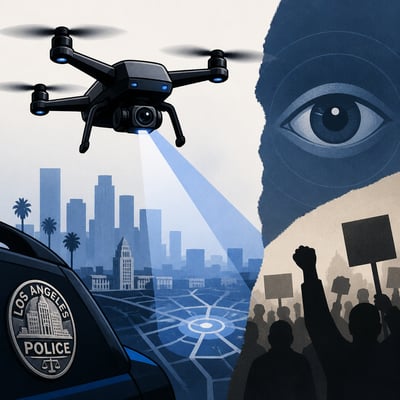
Police Drones Test Privacy BoundariesPolice Drones Test Privacy BoundariesCoverage from LewRockwell, The Appeal, and others
00/00/0000
DailyWeekly
U.
S. police departments are expanding drone-as-first-responder programs that use rooftop docking stations, thermal imaging, automated flight, and real-time video to support emergency response and investigations. The growth is bringing renewed scrutiny over recording in private spaces, facial recognition, data retention, vendor access, flight transparency, and the authority to deploy drones. Cities are responding unevenly, ranging from new restrictions and public reporting requirements to expanded surveillance capabilities and contract pauses.
Looking Back
117 Day Timeline
Articles published over time. Hover any bar for the period and its article count.
Apr 28
May 16
Jun 6
Jun 24
Jul 12
Aug 2
Aug 20
History
09/09/2026
The story is increasingly framed around governance and contractual control rather than deployment growth alone. The core expansion trend remains unchanged, but vendor access, stored data, flight transparency, and uneven local safeguards receive greater emphasis.
08/24/2026
The story has shifted from scattered local deployments to a rapidly scaling, increasingly autonomous public-safety drone infrastructure, supported by FAA waivers and integration with dispatch, license-plate, and AI systems. Quantified growth is now clearer, but public resistance has also halted or complicated some deployments.
Police departments across the United States are expanding autonomous drone surveillance, linking live aerial video with AI analytics and police databases while cities contest oversight requirements.
8/22/2026 • Data Collection & Surveillance Practices • General
United States law enforcement agencies expanded autonomous surveillance drone programs in 2026, prompting privacy concerns and oversight responses in Nashville, New Orleans, and San Francisco.
8/12/2026 • Data Collection & Surveillance Practices • General
By February 2026, more than 1,000 US public safety agencies obtained FAA waivers to deploy drone-as-first-responder programs, expanding autonomous video surveillance and driving privacy concerns.
7/23/2026 • Data Collection & Surveillance Practices • General
Sam Curry and Maik Robert reported publicly accessible Skydio-connected San Francisco Police Department drone live feeds in mid-June, after researchers found video, GPS traces, and operator contact details.
7/17/2026 • Data Collection & Surveillance Practices • General
Minneapolis City Council considers a 75-day Skydio autonomous drone pilot after resident testimony raised privacy and civil-liberties concerns over recorded aerial footage and real-time deployment.
7/11/2026 • Data Collection & Surveillance Practices • General
On July 9 in Pasadena, Pasadena Police Department officials will present a draft drone policy restricting facial recognition, immigration enforcement support, and warrantless surveillance.
7/8/2026 • Data Collection & Surveillance Practices • General
San Francisco police expanded facial-recognition drone deployments in early 2026 after Proposition E, prompting privacy advocates to seek clearer rules and near real-time flight transparency.
7/4/2026 • Data Collection & Surveillance Practices • General
Las Vegas Metropolitan Police Department expanded first-responder drone missions in Clark County in 2024, raising Fourth Amendment privacy concerns over warrant-exempt flights.
5/10/2026 • Data Collection & Surveillance Practices • General
LAPD stopped renewing its Flock Safety ALPR contract after a July 11 inspector general audit found vehicle misidentifications and unresolved data privacy and security requirements.
7/15/2026 • Data Collection & Surveillance Practices • General
LAPD reported thousands of drone flights since a July 2025 start while describing protest privacy limits, facial recognition bans, and cloud-controlled dock data under the Los Angeles Police Board.
4/28/2026 • Data Collection & Surveillance Practices • General
Los Angeles Police Department reported thousands of drone flights for first-responder duties, citing real-time intelligence benefits and privacy limits on facial recognition.
4/28/2026 • Data Collection & Surveillance Practices • General
Hayward City Council approved eight police drones as first responders on June 16, with an annual $589,000 cost and a reactive-only policy excluding facial recognition.
6/22/2026 • Data Collection & Surveillance Practices • General
Detective Michael Hackman briefed the Los Angeles Police Commission on LAPD drone deployments after privacy scrutiny about protest surveillance in Los Angeles.
4/30/2026 • Data Collection & Surveillance Practices • General
Montgomery County Police Department upgrades a dock-based Drone as First Responder program for 911 calls in Maryland, citing live-video capabilities plus stated privacy safeguards.
7/6/2026 • Data Collection & Surveillance Practices • General
Orlando Police Department launched a Drone as a First Responder program using Skydio X10 drones and Axon Prepared on 911 calls to speed risk assessment.
7/3/2026 • Data Collection & Surveillance Practices • General

 AI Governance
 Data Centers
 Drones
 Climate
 Privacy
 2026 Maine Senate
 Bob Dylan