
 AI Governance
 Data Centers
 Drones
 Climate
 Privacy
 2026 Maine Senate
 Bob Dylan
Police Drones Test Privacy Boundaries
Coverage from LewRockwell, The Appeal, and others
U.
S. police departments are expanding drone-as-first-responder programs that use rooftop docking stations, thermal imaging, automated flight, and real-time video to support emergency response and investigations. The growth is bringing renewed scrutiny over recording in private spaces, facial recognition, data retention, vendor access, flight transparency, and the authority to deploy drones. Cities are responding unevenly, ranging from new restrictions and public reporting requirements to expanded surveillance capabilities and contract pauses.
The story is increasingly framed around governance and contractual control rather than deployment growth alone. The core expansion trend remains unchanged, but vendor access, stored data, flight transparency, and uneven local safeguards receive greater emphasis.
The story has shifted from scattered local deployments to a rapidly scaling, increasingly autonomous public-safety drone infrastructure, supported by FAA waivers and integration with dispatch, license-plate, and AI systems. Quantified growth is now clearer, but public resistance has also halted or complicated some deployments.
- LAPD reported over 3,000 drone flights in 2025 and over 3,000 by late April 2026.
- San Francisco reported 3,558 drone deployments during the first five months of 2026.
- Over 1,000 public-safety agencies reportedly held FAA automation waivers by February 2026.
- Police drone systems are being connected to dispatch, license-plate readers, AI analytics, and intelligence platforms.
- A Nashville drone trial ended after criticism; opposition affected a proposed Minneapolis Skydio pilot.
The story is slightly more concrete and operationalized: Los Angeles’s Flock dispute now centers on specific data-control terms, and the drone programs are described as more routine tools for 911 response and investigations. The overall direction remains the same, but the current version emphasizes implementation details and policy tightening more clearly.
The story has become more concrete and operational, with newly identified dock-based drone responder programs in Orlando, Montgomery County, and Las Vegas showing rapid scaling. At the same time, the privacy side sharpened through a San Francisco drone-feed exposure and LAPD’s pause of its Flock contract over data-control concerns.
- Orlando and Montgomery County are deploying dock-based Drone as First Responder systems.
- Las Vegas expanded Blue Sky to 75 drones and 13 Skyports.
- San Francisco drone feeds exposed thermal imagery, GPS traces, and pilot information.
- LAPD paused Flock renewal after an audit flagged 161 misidentified vehicle owners.
- Pasadena draft policy would bar facial recognition and immigration-enforcement assistance.
The story has broadened from LAPD’s drone expansion into a wider multi-city policy and vendor landscape, where the central issue is now less operational use than governance over surveillance data, facial recognition, and access controls. New examples show departments pairing drone rollouts with formal restrictions or controversial enforcement decisions, making policy implementation the main story.
- Multiple police departments beyond LAPD are now central to the story.
- Pasadena is developing explicit drone privacy limits, including warrant requirements.
- Orlando is integrating first-responder drones with live 911 access.
- LAPD halted its Flock Safety contract over data ownership and security terms.
- Skydio and Axon appear as recurring public-safety technology vendors.
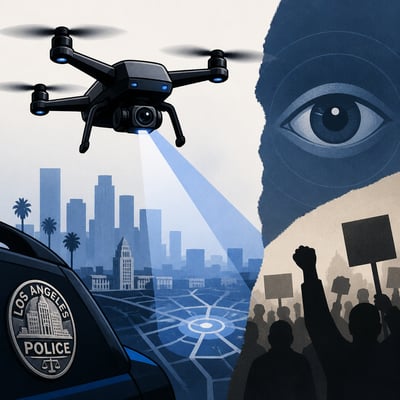
The LAPD has rapidly expanded its Drone as First Responder program, reporting more than 3,000 drone uses in 2025 and continued growth in 2026. The program sends camera-equipped drones to emergency calls and high-risk incidents before officers arrive, with officials citing faster assessments and fewer unnecessary ground responses. At the same time, the expansion has renewed concerns about protest surveillance, privacy limits, data handling, and drone safety.