
 AI Governance
 Data Centers
 Drones
 Climate
 Privacy
 2026 Maine Senate
 Bob Dylan
FTC Draws Line on Data-Driven Prices
Coverage from Arnold & Porter, Sidley Austin LLP, and others
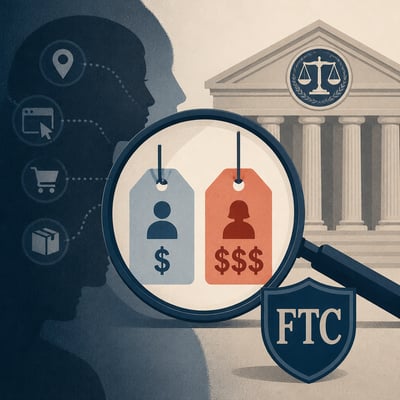
The Federal Trade Commission is seeking public comment on a proposed enforcement policy for personalized pricing, where businesses use consumer data or inferences to set different prices or estimate willingness to pay.
The proposal would focus on undisclosed price personalization, misleading representations, and inadequately authorized data use under Section 5 of the FTC Act, rather than creating a universal ban. The initiative reflects growing scrutiny of data-driven pricing across retail, food delivery, hotels, rideshare, and related services, alongside state-level legislative activity.
If you read one thing
It provides the broadest, clearest overview of the FTC proposal, its Section 5 basis, transparency focus, and profiling risks.
Latest development
It materially updates the federal proposal with validated detail on New Jersey’s law and the expanding state legislative response.
Best explainer
It clarifies how the nonbinding FTC policy would operate, including its disclosure focus, Section 5 implications, and relationship to state action.
FTC is treating hidden price personalization as a Section 5 risk
The FTC is positioning undisclosed or inadequately authorized use of consumer data to set individualized prices as potentially deceptive or unfair under Section 5. The proposal targets enforcement priorities rather than creating a categorical ban.
Transparency remains the principal near-term regulatory lever
The proposed framework centers on clear disclosure that a price is personalized, why it was personalized, and what data was used. Because the FTC cannot impose a universal ban through this initiative, the immediate federal approach remains nonbinding guidance and enforcement under existing law.
Consumer profiling is central to the pricing-risk problem
The compliance concern extends beyond the displayed price to behavioral, location, household, loyalty, and third-party data used to estimate willingness to pay. Consent failures, opaque inferences, and possible unequal treatment remain material risks, although the corpus does not establish their prevalence or legal liability.
State restrictions are adding a more prescriptive regulatory layer
State activity is moving beyond federal disclosure-focused guidance toward enacted restrictions, private rights of action, and a large pipeline of surveillance-pricing bills. This is producing an increasingly consequential but uneven compliance landscape alongside the FTC proposal.
26 states
states with pending surveillance-pricing bills
“More than 50 surveillance-pricing bills are pending across 26 states.”
November 2025
effective date of New York’s Algorithmic Pricing Disclosure Act
“New York’s Algorithmic Pricing Disclosure Act, effective November 2025, requires disclosure when prices are set using an algorithm based on consumers’ personal data. A separate bill banning surveillance pricing is awaiting the governor’s signature.”
first
state law on personalized pricing with a private right of action
“The proposal follows New Jersey’s enactment of the first state law on personalized pricing to include a private right of action. Dozens of surveillance-pricing bills, along with related electronic-shelf-label bills, are pending across roughly two dozen states.”
Four states
states that have enacted laws directly addressing personalized pricing
“Four states have already enacted laws directly addressing personalized pricing, and dozens of additional bills are pending.”
State surveillance-pricing regulation expands into enacted bans, disclosures, and private suits
The regulatory response has become more concrete beyond the FTC’s preliminary federal proposal: New York’s disclosure law is effective, New Jersey has enacted a food-pricing ban with a private right of action, and more than 50 related bills are pending across 26 states. A final FTC policy could also influence state enforcement and private litigation despite its limited direct authority.
Previously
U.S. privacy and consumer-protection policy is converging on data-driven personalized pricing. The FTC's August 2026 proposal would treat undisclosed use of browsing, purchase, location, household, and inferred willingness-to-pay data as potentially deceptive or unfair under Section 5 of the FTC Act. The initiative is disclosure-focused and nonbinding, while related state restrictions create an emerging but uneven regulatory layer.
The story is more concrete about implementation pressure: New Jersey is identified as having enacted surveillance-pricing legislation with a private right of action, while California and additional industries broaden the regulatory scope. The FTC framework itself remains largely consistent with the prior version.
The story is now framed as a developing federal-state regulatory landscape: the FTC’s nonbinding, disclosure-focused approach is being supplemented by uneven state restrictions. New reporting also raises potential discrimination and data-sharing risks while cautioning that their prevalence and legal consequences remain unproven.