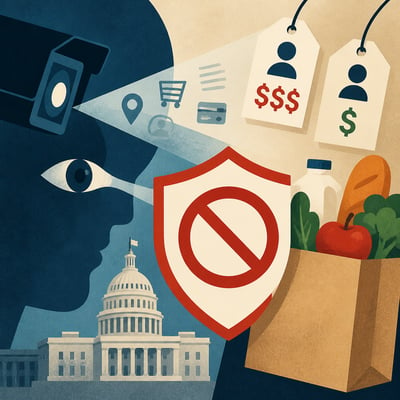
Surveillance Pricing Faces State LimitsSurveillance Pricing Faces State LimitsCoverage from KTBS, The Digital Courier, and others
00/00/0000
DailyWeekly
U.
S. lawmakers and regulators are examining pricing systems that combine browsing, purchase, location, loyalty, device, and demographic data to estimate what individual customers may be willing to pay. The practice is drawing concerns about opaque pricing, discrimination, consent, and possible algorithmic coordination, while retailers and business groups argue that algorithmic pricing can improve efficiency or reduce prices. Maryland, Connecticut, and New Jersey have enacted differing restrictions, and federal lawmakers are considering broader safeguards, but the scope of covered practices and acceptable discounts remains unsettled.
It provides the broadest overview of surveillance pricing, linking personal-data collection, algorithmic coordination, and electronic shelf-label technology.
It adds concrete examples of alleged individualized pricing and shows why attribution and federal policy responses remain unsettled.
Senate / Katie Yarborough
Key Issues
01
State restrictions remain fragmented
Maryland, Connecticut, and New Jersey have enacted differing limits on personal-data-based pricing, ranging from bans and disclosure requirements to private enforcement rights and a pause on new electronic shelf-label deployments. Divergent definitions, exemptions, effective dates, and enforcement models prevent a uniform state framework.
Stable
Drawn from 4 articles
02
Federal scrutiny is focused on broader safeguards
Senate hearings, FTC warnings, and bipartisan legislative proposals frame surveillance pricing as a combined privacy, consumer-protection, discrimination, and competition issue. The federal approach remains unsettled, especially on legitimate discounts, demand-based pricing, disclosures, and enforcement.
Stable
Drawn from 3 articles
03
Pricing technology is expanding across retail and travel
Electronic shelf labels enable rapid remote price changes, while airline pricing systems are being developed to combine customer and market variables in estimating willingness to pay. These tools increase the capacity for individualized pricing, but deployment alone does not establish that personal data determines each customer’s price.
Stable
Drawn from 3 articles
04
Evidence of individualized pricing remains contested
Reported tests and incidents indicate that customers may see different prices, including Instacart price gaps and a disputed JetBlue fare increase, but the causal role of personal tracking is not consistently established. Retailer denials and distinctions among dynamic pricing, targeted discounts, and identity-based pricing preserve a significant attribution gap.
Stable
Drawn from 3 articles
Looking Back
201 Day Timeline
Articles published over time. Hover any bar for the period and its article count.
Feb 19
Mar 26
Apr 23
May 28
Jul 2
Jul 30
Sep 3
The Story So Far
No material change
The newly supplied articles reiterate existing concerns about AI-driven personalized pricing, privacy, and fairness without establishing a material change in the topic’s real-world state.
Previously
U.S. lawmakers, regulators, and state governments are examining pricing systems that use personal data, algorithms, and tracking information to estimate willingness to pay or vary prices between customers. The debate centers on privacy, transparency, discrimination, consumer protection, and whether digital pricing tools enable harmful personalization or legitimate discounts. Several states have enacted restrictions, while federal lawmakers are considering broader safeguards and companies continue deploying technologies such as electronic shelf labels.
History
09/09/2026
The main new development is that Instacart ended retailer pricing experiments following investigations and public scrutiny. Otherwise, the update largely confirms existing concerns while adding that California and other states are considering further restrictions.
08/24/2026
The story has moved from proposed restrictions and investigations toward enacted state laws with concrete implementation timelines. A major Senate hearing and new federal legislation proposals also broaden the debate to algorithmic coordination, deceptive discounts, and enforcement design.
A Senate Judiciary subcommittee examined Tuesday in the United States how corporations use AI, personal data, and behavioral profiles to vary consumer prices.
8/4/2026 • Data Collection & Surveillance Practices • General
A Senate Judiciary subcommittee examined AI-driven surveillance pricing by major retailers and service companies in the United States, focusing on personal-data collection, consumer harms, and algorithmic competition risks.
8/4/2026 • Data Collection & Surveillance Practices • General
EFF supports California A.B. 2654, authored by Chris Ward, to ban surveillance pricing based on personally identifiable information collected through electronic surveillance, amid stalled San Francisco Board action.
7/28/2026 • Data Collection & Surveillance Practices • General
California attorney general is investigating surveillance pricing that uses tracked personal data, including cookies and location data, to set individualized prices.
6/22/2026 • Data Collection & Surveillance Practices • General
The Senate Judiciary Subcommittee on Crime and Counterterrorism examined in the United States how companies use AI and consumer data to individualize prices.
8/6/2026 • Data Collection & Surveillance Practices • General
The Senate Judiciary Subcommittee on Crime and Counterterrorism examined AI-driven surveillance pricing in Washington, D.C., with Josh Hawley seeking stronger consumer protections.
8/4/2026 • Data Collection & Surveillance Practices • General
Airlines are developing AI pricing systems that use behavioral and third-party data to personalize fares, prompting privacy scrutiny in the United States.
7/30/2026 • Data Collection & Surveillance Practices • General
Maryland, Connecticut, and New Jersey enacted differing surveillance-pricing restrictions in 2026, while a Senate hearing examined consumer costs and privacy risks nationwide.
8/18/2026 • Regulation, Law & Enforcement • General
Senator Josh Hawley announced planned federal legislation after a Washington Senate hearing to restrict companies using personal data and artificial intelligence for individualized pricing.
8/6/2026 • Regulation, Law & Enforcement • General
U.S. Senate Judiciary subcommittee members examined AI-driven surveillance pricing and related privacy risks during an August 4 hearing in Washington, D.C.
8/5/2026 • Regulation, Law & Enforcement • General
House Energy and Commerce ranking member Frank Pallone, Jr. launched an inquiry into surveillance pricing by 25 retailers using personal data to set prices.
5/12/2026 • Data Collection & Surveillance Practices • General
New Jersey Gov. Mikie Sherrill-backed law will take effect next year, banning retailers from using personal data for surveillance pricing of identical products.
7/24/2026 • Regulation, Law & Enforcement • General
New Jersey policy debates address privacy risks from electronic shelf labels enabling surveillance pricing using personal data and identification technologies.
The Federal Trade Commission has highlighted surveillance pricing, in which companies such as Uber, Target and Kroger use personal data to vary customer prices.
9/7/2026 • Data Collection & Surveillance Practices • General
The Federal Trade Commission investigates surveillance pricing as state laws in Maryland, Connecticut, Colorado, and New York restrict AI-based personalized pricing.
6/30/2026 • Data Collection & Surveillance Practices • General
Walmart uses electronic shelf labels and AI pricing models to update prices based on individuals near shelves, prompting investigations and state bans in 2026.
6/1/2026 • Data Collection & Surveillance Practices • General
Grocery chains deploying digital shelf labels can vary prices in real time using behavioral tracking and inferred consumer profiles, with monitoring components integrated into retail aisles and displays.
5/22/2026 • Data Collection & Surveillance Practices • General
Grocery chains adopting digital shelf labels and in-store tracking systems are described as enabling real time personalized pricing based on behavioral profiling.
5/20/2026 • Data Collection & Surveillance Practices • General
Lawmakers and consumer advocates in Maryland and New York focus on disclosure rules as retailers adopt electronic shelf labels supporting consumer data driven pricing.
5/2/2026 • Data Collection & Surveillance Practices • General
EFF and a cited 2025 FTC report describe surveillance pricing that uses browsing history and location data, supporting California S.B. 2564 to ban the practice.
6/11/2026 • Consumer Privacy & Digital Rights • General
Businesses are expanding data-driven pricing practices in the United States, prompting consumer concerns and state legislative responses over individualized prices and transparency.
8/8/2026 • Data Collection & Surveillance Practices • General
The Senate Judiciary Committee held an August 4 hearing in Washington, D.C., where bipartisan senators considered federal safeguards for surveillance pricing based on consumer data.
8/14/2026 • Regulation, Law & Enforcement • General
Bipartisan senators debated AI surveillance pricing on August 4 in Washington, DC, focusing on companies using personal data to vary prices for identical goods.
8/10/2026 • Regulation, Law & Enforcement • General
New York and Maryland enacted bans on using customer personal data for personalized grocery pricing after consumer advocates challenged surveillance pricing practices.
6/8/2026 • Consumer Privacy & Digital Rights • General
The Senate Judiciary Subcommittee on Crime and Counterterrorism examined AI surveillance pricing in Washington on August 4 as grocery associations defended loyalty programs and electronic shelf labels.
8/6/2026 • Regulation, Law & Enforcement • General
Rep. Frank Pallone asked 25 companies in the U.S. in 2024 to explain whether personal data enables individualized pricing using AI, citing privacy and affordability concerns.
5/12/2026 • Corporate Data Practices & Accountability • General
New Jersey lawmakers and Gov. Mikie Sherrill backed the Fair Price Protection Act to ban surveillance pricing in grocery stores using individualized personal data for online and electronic-sign prices.
3/18/2026 • Corporate Data Practices & Accountability • General
New Jersey lawmakers approved the Fair Price Protection Act to restrict surveillance pricing in grocery stores, with enforcement by Attorney General Jennifer Davenport.
3/18/2026 • Corporate Data Practices & Accountability • General

 AI Governance
 Data Centers
 Drones
 Climate
 Privacy
 2026 Maine Senate
 Bob Dylan