
 AI Governance
 Data Centers
 Drones
 Climate
 Privacy
 2026 Maine Senate
 Bob Dylan

Thermal Drones Meet Flooded Tunnels
Coverage from ClickOnDetroit, BostonGlobe.com, and others
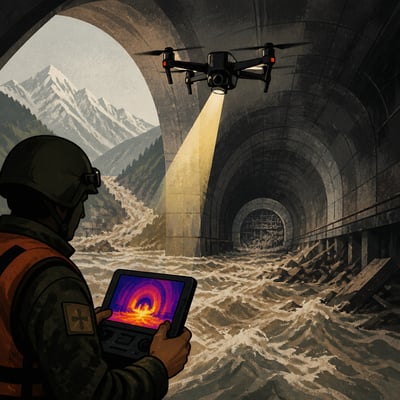
After glacial-collapse floods struck Nepal and Tibet on Aug.
26, the Nepal Army and drone pilot Manish Maharjan used thermal drones and speaker-equipped aircraft to search for missing people and hydropower workers. Drones helped scan hillsides, contact some stranded survivors, and inspect sections of dangerous tunnels, but mud, debris, distance, and bends blocked access to many passages. The operation highlights both the practical value of drones in hazardous rescue work and their limits in confined, obstructed environments where hundreds of workers remained missing.
If you read one thing
It provides the clearest overall account of drones’ rescue value and their limits in Nepal’s flooded tunnels.
The evidence
It adds validated figures on the missing workers while documenting both open-area utility and tunnel constraints.
Best explainer
It explains how tunnel walls, distance and debris limited drone detection during the unresolved search.
Strong utility in exposed areas
Thermal and speaker-equipped drones expanded rescue teams' reach across hillsides, isolated locations and other areas dangerous or difficult for rescuers to access. Audio prompts helped locate some stranded survivors.
Severe limits in obstructed tunnels
Drone searches are most viable in long, straight passages. Bends, zigzags, tunnel walls, distance, mud and debris sharply restrict flight and detection, leaving many sections inaccessible or effectively unsearchable.
Large-scale disappearance remains unresolved
The rescue operation remains defined by a substantial unresolved human toll: roughly 900 workers were reported missing across 12 hydropower projects, including about 500 believed trapped in tunnels. Repeated thermal searches at Rasuwagadhi found no survivors, and that search was abandoned.
About 500
workers believed trapped inside power plant tunnels
“As authorities mobilized dozens of rescue and relief teams, Maharjan joined the Nepal Army’s rescue efforts a day after the flash floods, which have killed more than 1,000 people and left thousands missing in Nepal and China. Maharjan has been operating thermal drones to help locate at least 900 workers still missing from 12 hydropower projects buried under mud and debris. About 500 are believed to be trapped inside power plant tunnels.”
at least 900
missing workers
“As authorities mobilized dozens of rescue and relief teams, Maharjan joined the Nepal Army’s rescue efforts a day after the flash floods, which have killed more than 1,000 people and left thousands missing in Nepal and China. Maharjan has been operating thermal drones to help locate at least 900 workers still missing from 12 hydropower projects buried under mud and debris. About 500 are believed to be trapped inside power plant tunnels.”
Speaker-equipped drones locate some survivors outside blocked tunnels
New reporting clarifies that drones were not only used to inspect hazardous flood zones and tunnels: speaker-equipped aircraft helped rescuers locate some people stranded on hillsides. Their usefulness remained sharply constrained inside mud-filled tunnels with bends and debris.
Previously
Nepal Army teams and civilian drone operators used thermal drones, audio prompts and other rescue tools to search flooded hydropower tunnels after flash floods and a glacial collapse in the Himalayas. The drones reached areas considered dangerous for rescuers and, in some cases, the far ends of tunnels, but mud, debris, distance and tunnel barriers limited what they could detect. The searches found no confirmed signs of life, while large numbers of workers and residents remained missing across affected hydropower sites.
The story now shows drones producing limited rescue successes: speaker-equipped aircraft contacted some stranded survivors, while searches at Rasuwagadhi were ultimately abandoned without finding survivors. The scale of the disappearance is also clearer, with about 900 workers missing across 12 projects.