
 AI Governance
 Data Centers
 Drones
 Climate
 Privacy
 2026 Maine Senate
 Bob Dylan
Texas Data Centers Face Election-Year Pushback
Coverage from Houston Public Media, National Review, and others
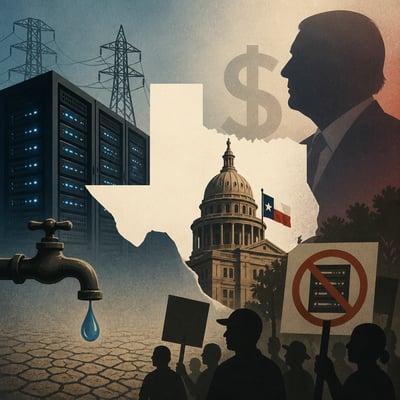
Texas officials and candidates are responding to growing opposition to data centers by proposing limits on rural projects, reviewing new grid connections, reconsidering tax incentives, and requiring developers to address power, water, and infrastructure costs.
Governor Greg Abbott and Attorney General Ken Paxton are seeking to balance artificial intelligence investment with concerns about electricity prices, water use, land use, and limited local benefits. The issue has become prominent in the 2026 election campaign, with local resistance and industry-backed political spending intensifying the debate.
If you read one thing
It provides the broadest overview of the fight across state-local authority, infrastructure burdens, and electoral scrutiny.
The evidence
It adds concrete evidence on the projected cost of tax incentives and state efforts to shift grid-infrastructure costs to developers.
Latest development
It captures the latest broadening of opposition as national political arguments join Texas concerns about data-center impacts.
State-local regulatory conflict
Texas is moving toward tighter state review of data-center permits and grid connections, while counties and candidates contest how much authority local governments should retain to pause, approve, or restrict projects. The conflict includes developer responsibility for infrastructure and differing proposals on siting and technology controls.
Infrastructure and community burdens
Electricity demand, water consumption, wastewater needs, and local effects such as noise, traffic, pollution, and property-value concerns are the principal constraints reshaping support for rapid expansion. These burdens are being used to justify reviews, tighter standards, and proposals to make developers pay more of the associated infrastructure costs.
Electoral and incentive scrutiny
Data-center policy has become a prominent Texas electoral issue, with candidates proposing restrictions or changes to tax incentives while presenting themselves as responsive to public concerns. Industry-linked contributions to Ken Paxton's political operation have intensified scrutiny of his regulatory positioning.
Data-center opposition becomes a national competitiveness issue
Opposition to data-center expansion is now being challenged not only through Texas regulatory and electoral debate but also by national political leaders framing resistance as a threat to U.S. competition with China.
Previously
Texas's rapid data center buildout has become a state-local governance and 2026 electoral dispute. Officials and residents are pressing over grid and water burdens, tax incentives, rural siting, developer-paid infrastructure, and the authority to approve or halt projects.
The story adds concrete evidence of political financing and identifies the OpenAI-linked Stargate campus in Abilene as a major project continuing despite backlash. The underlying policy debate and regulatory posture remain largely unchanged.
The issue is now framed more explicitly as a major 2026 Senate and gubernatorial election battleground, with candidates attaching specific incentive, power-capacity, cooling, and local-control proposals to the debate. ERCOT and the Public Utility Commission are also identified as central institutional actors.