
 AI Governance
 Data Centers
 Drones
 Climate
 Privacy
 2026 Maine Senate
 Bob Dylan
Texas Data Centers Face Election-Year Pushback
Coverage from Houston Public Media, National Review, and others
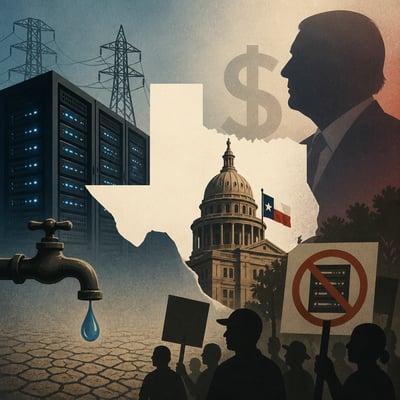
Texas officials and candidates are responding to growing opposition to data centers by proposing limits on rural projects, reviewing new grid connections, reconsidering tax incentives, and requiring developers to address power, water, and infrastructure costs.
Governor Greg Abbott and Attorney General Ken Paxton are seeking to balance artificial intelligence investment with concerns about electricity prices, water use, land use, and limited local benefits. The issue has become prominent in the 2026 election campaign, with local resistance and industry-backed political spending intensifying the debate.
The story adds concrete evidence of political financing and identifies the OpenAI-linked Stargate campus in Abilene as a major project continuing despite backlash. The underlying policy debate and regulatory posture remain largely unchanged.
The issue is now framed more explicitly as a major 2026 Senate and gubernatorial election battleground, with candidates attaching specific incentive, power-capacity, cooling, and local-control proposals to the debate. ERCOT and the Public Utility Commission are also identified as central institutional actors.
The story has shifted from review and political debate toward active state intervention, with permit or grid-connection pauses and a new estimate that incentives could exceed $3 billion. The scale of public support is also presented as more uncertain because facility counts vary across reports.
The dispute is now framed more explicitly as a 2026 electoral and state-local governance contest, with competing candidates advancing specific restrictions and cost-shifting proposals. The core concerns and project disputes remain largely confirmed rather than materially changed.
Texas data center development is facing heightened political scrutiny as Ken Paxton’s political operation reports at least $448,000 in contributions from industry executives and political committees while his office considers a Hood County moratorium. Residents and state officials are also debating water use, electricity costs, pollution, traffic, noise, tax incentives, and the limits of local authority as Texas reviews additional facilities before they connect to the grid.