
 AI Governance
 Data Centers
 Drones
 Climate
 Privacy
 2026 Maine Senate
 Bob Dylan
OpenAI’s Georgia Campus Tests Local Limits
Coverage from Georgia Recorder, The Atlanta Journal-Constitution, and others
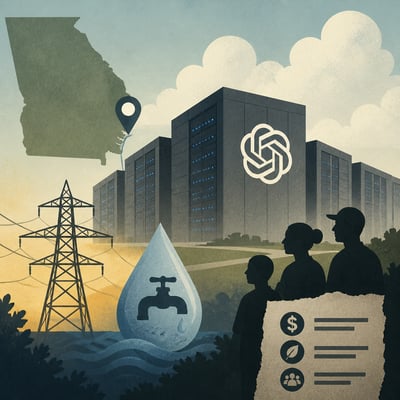
OpenAI is proposing a roughly $20 billion data center campus, Project Camellia, at the Savannah Gateway Industrial Hub near Rincon, Georgia.
The project could receive up to 3.2 gigawatts from Georgia Power between 2028 and 2032, while OpenAI says it will fund required power infrastructure, use closed-loop cooling and provide community investments. Its scale has prompted scrutiny over electricity costs, water, noise, tax abatements, transparency and the remaining county and state reviews.
If you read one thing
This broad local report introduces the project’s approval path, unresolved water issues, and central transparency concerns.
Best explainer
It clearly explains the approved power contract’s cost protections, demand-response provisions, and infrastructure obligations.
The counter-case
This report presents organized local opposition focused on transparency, tax incentives, public consent, and remaining approvals.
Latest development
The latest major development shows scrutiny expanding into a PSC hearing over transparency, electricity costs, and customer protections.
The evidence
It adds concrete detail on the campus’s projected power, water-access constraints, and infrastructure requirements.
Utility approval secured, build-readiness unresolved
Project Camellia has cleared Georgia Power's contract stage, but it remains pre-construction. County site-plan, water and sewer arrangements, environmental disclosures, and additional state reviews remain outstanding.
Exceptional grid demand with formal cost protections
The approved Georgia Power commitment represents roughly 3.1–3.2 gigawatts, an unusually large prospective load. OpenAI is assigned infrastructure and termination obligations and may reduce demand during peaks, but stranded-cost exposure and contract transparency remain contested.
Local consent dispute is gaining institutional force
Residents continue to oppose the project over limited advance notice, noise and safety risks, infrastructure impacts, and the need for enforceable commitments. Scrutiny has expanded from county meetings into PSC hearings and broader demands for disclosure and safeguards.
Water and wastewater capacity remain constraints
OpenAI presents closed-loop cooling as a way to limit ongoing water demand, but wastewater treatment, aquifer access, distribution capacity, and environmental disclosure remain unsettled. These issues continue to shape county review and resident opposition.
Tax incentives and community benefits define the local bargain
Supporters emphasize projected tax revenue, jobs, education, workforce programs, and OpenAI's proposed $80 million community package. The value proposition remains contested because the project also receives a 50% property-tax abatement for 15 years, keeping foregone revenue and benefit enforceability central to the debate.
15 years
duration of property tax abatement
“Brant Herndon, CEO of the Effingham County Industrial Development Authority, previously told Savannah Morning News that the IDA board approved an incentives package including a 50% property tax abatement for 15 years. In exchange, OpenAI would be locked into the county’s 2026 millage rate for the duration of the agreement.”
1,000 megawatts MW
maximum electricity that could be diverted to other customers
“OpenAI has also agreed to allow Georgia Power to reduce electricity delivered to the facility during periods of high system demand. As much as 1,000 megawatts could be diverted to other customers. The article describes the agreement as the first of its kind in the nation.”
15 days
deadline for Georgia Power to notify the PSC after early termination
“If a large-load customer terminates early, Georgia Power must notify the PSC within 15 days and cannot shift cost deficiencies to residential or small-business customers.”
3.2 gigawatts
power supply for the Effingham County data center
“On Aug. 26, the Georgia Public Service Commission approved a contract allowing Georgia Power to supply 3.2 gigawatts of power to the Effingham County data center, an amount described as equivalent to the electricity use of about 2 million homes.”
four and a half hours
meeting duration
“More than 100 residents attended a Saturday meeting at the Effingham County Board of Commissioners chambers to hear a presentation and raise questions about the recently announced proposal. The meeting lasted four and a half hours, including three hours of public comment, during which residents overwhelmingly opposed the project.”
Contested Issue
Should Project Camellia proceed under existing approval and utility frameworks, or should development be paused pending broader public, environmental, and infrastructure review?
The corpus contains an explicit policy conflict. Supporters emphasize developer-funded electricity and infrastructure, flexible demand response, protections for residential customers, closed-loop cooling, and community-benefit commitments. Opponents argue that the project should be paused or subjected to broader restrictions until transparency, public participation, environmental and wastewater capacity, tax incentives, and potential utility-cost effects are resolved.
Proceed with safeguards
Allow Project Camellia to advance through existing approvals while relying on developer-funded infrastructure, demand response, utility protections, water controls, and community-benefit commitments to manage impacts.
Pause pending broader review
Pause Project Camellia or impose broader data-center restrictions until public disclosure, community participation, infrastructure and wastewater capacity, environmental safeguards, tax incentives, and responsibility for potential utility costs are adequately resolved.
PSC scrutiny turns into a push for fuller contract disclosure
Project Camellia’s transparency dispute has moved into a local Georgia PSC forum, where residents raised concerns and the commission chair said Georgia Power must provide more unredacted contract information.
Previously
OpenAI is proposing a roughly $20 billion data center campus, Project Camellia, at the Savannah Gateway Industrial Hub near Rincon, Georgia. The project could receive up to 3.2 gigawatts from Georgia Power between 2028 and 2032, while OpenAI says it will fund required power infrastructure, use closed-loop cooling and provide community investments. Its scale has prompted scrutiny over electricity costs, water, noise, tax abatements, transparency and the remaining county and state reviews.
The Georgia Public Service Commission has now approved the power contract, moving Project Camellia beyond proposed utility review while county and other state reviews remain. The story is increasingly framed around balancing projected economic benefits against unresolved oversight and community concerns.
The main update is a tentative construction start as early as 2027, adding a nearer-term development horizon to a project previously described mainly as remaining in planning and review. The current version otherwise largely confirms the existing account while identifying the Effingham County Industrial Development Authority and Gov. Brian Kemp as more prominent participants.