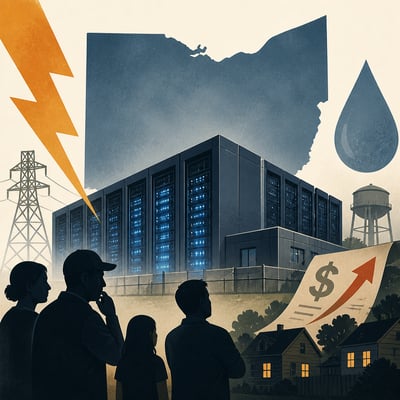
Ohio Data Center Regulation ConflictOhio Data Center Regulation ConflictCoverage from Ohio Capital Journal, The Columbus Dispatch, and others
00/00/0000
DailyWeekly
Ohio's rapid hyperscale data center buildout is driving a broad regulatory response involving electricity cost allocation, grid planning, water and wastewater permits, tax incentives, zoning, ballot measures, and demands for greater local control.
It documents the scale of Ohio's incentive commitments and the resulting political push to reassess subsidies.
Ohio Capital Journal / Marty Schladen
Key Issues
01
Local control and opposition are expanding
Data-center development is a statewide local-governance conflict, with 18 communities pursuing ballot measures, bans, moratoriums, zoning changes, or legal action. Opposition targets extraordinary power demand, land use, environmental effects, transparency, and the limited role of local residents in project approvals.
Stable
Drawn from 4 articles
02
Grid-cost responsibility and supply remain unsettled
Utilities and policymakers are weighing special tariffs, long-term commitments, financial guarantees, and developer responsibility for grid upgrades as hyperscale demand strains interconnection capacity. Developers are also considering on-site or dedicated generation, but the allocation of cost, reliability, and environmental obligations remains unresolved.
Mixed
Drawn from 3 articles
03
Water oversight is shifting toward project-specific controls
Water consumption, wastewater discharge, sewer capacity, and related environmental effects are receiving more individualized scrutiny. Ohio EPA withdrew a statewide general wastewater pathway in favor of project-specific permits, while Columbus proposals seek reporting, pretreatment, efficiency, and infrastructure obligations.
Stable
Drawn from 5 articles
04
Tax incentives remain under fiscal and political reassessment
Ohio's incentive model remains contested after reported multibillion-dollar commitments and a pause on new incentives. State proposals would restrict or eliminate benefits, while local abatements and existing project incentives continue to influence development decisions.
Stable
Drawn from 5 articles
Key Numbers
$1.4 billion dollars
2025 incentive costs above what taxpayers had been told
2025
“Gov. Mike DeWine also supported incentives, but paused new ones in May after Signal Ohio reported that their 2025 costs were $1.4 billion higher than taxpayers had been told.”
Ohio Capital Journal
$2.3 billion dollars
incentives provided to data center projects in Ohio
“Ohio has already provided $2.3 billion to data center projects controlled by some of the world’s wealthiest people.”
Ohio Capital Journal
18 municipalities and townships
communities holding data-center ballot decisions
Ohio · this Election Day
“Voters in 18 Ohio municipalities and townships will decide the future of data centers in their communities this Election Day.”
Ohio Capital Journal
25 megawatts per month
threshold in proposed data-center bans
“Nine petitions—in Conneaut, Defiance, Granville, Oregon, Pataskala, Piqua, Sunbury, Trenton, and Upper Sandusky—mirror a statewide effort to ban data centers that draw more than 25 megawatts of energy per month.”
Ohio Capital Journal
1,400 megawatts
expected power demand of Meta’s proposed Piqua data center
around
“In Piqua, after Meta announced plans for a data center expected to demand around 1,400 megawatts of power, organizer Alisha Lange gathered signatures for petitions to recall the mayor and two city commissioners, change recall signature requirements, and invalidate a city agreement to power the facility.”
Ohio Capital Journal
Contested Issue
1 open dispute
Should Ohio require local voter approval, moratoriums, or bans for large data centers, or preserve predictable permitting while addressing impacts through regulation?
The evidence shows a substantive policy conflict between local-control advocates seeking voter approval, moratoriums, or power-based restrictions and development-oriented positions warning that broad local approval requirements or bans could make permitting unpredictable and jeopardize planned investment. The latter position favors enforceable safeguards without blocking development.
Local approval and restrictions
3 articles · across 3 publications
Large data centers should face local voter approval, moratoriums, or power-threshold restrictions because their electricity demand and community impacts warrant stronger local control.
Predictable permitting with safeguards
3 articles · across 3 publications
Ohio should avoid bans and broad local-vote requirements because they could make permitting unpredictable and jeopardize major planned investment; impacts should instead be managed through enforceable safeguards.
Looking Back
130 Day Timeline
Articles published over time. Hover any bar for the period and its article count.
May 8
May 29
Jun 19
Jul 13
Aug 3
Aug 24
Sep 14
The Story So Far
Escalation
Local opposition reaches ballot, recall, and court challenges across Ohio
Resistance to Ohio data centers has escalated into direct approval and governance challenges: voters in 18 communities are considering restrictions, residents are pursuing recalls and power-agreement reversals over Meta’s proposed Piqua facility, and state Supreme Court rulings are determining which ballot measures can proceed.
Previously
Ohio is weighing new limits on data centers as large projects increase electricity and water demands across communities including central Ohio and the Mahoning Valley. Proposed state legislation, local moratoriums, voter-approval measures, utility cost rules, and paused tax incentives reflect growing concern that residents and existing ratepayers could bear costs that developers do not fully cover. The debate remains unresolved, with officials balancing billions of dollars in proposed investment against infrastructure, environmental, fiscal, and community impacts.
History
09/15/2026
The debate has moved beyond proposed restrictions toward concrete regulatory decisions, notably Ohio EPA’s case-by-case wastewater permitting and the failure of House Bill 646. Grid planning has also become more central as PJM, utilities, and developers consider dedicated generation to accommodate hyperscale demand.
08/29/2026
The debate now includes a concrete state response: Ohio paused new data-center tax-break requests after exemptions reportedly reached $1.57 billion in one year. The scale of existing development is also clearer, with more than 200 operating facilities statewide and over 100 near Columbus.
Ohio House legislators introduced House Bill 983 last week in Ohio to require local voter approval and impose environmental and fiscal controls on large data center projects.
Christopher Wyche proposed Columbus, Ohio data center regulations at a public hearing, requiring water plans, decommissioning plans, and sewer permitting with infrastructure upgrades.
Ohio EPA abandoned a proposed statewide data-center wastewater permit after more than 7,000 Ohio residents and organizations submitted comments opposing reduced oversight.
Christopher Wyche held a July 22 Columbus hearing on draft data center water and sewer rules, with residents and advocates requesting stronger environmental limits and incentive bans.
Ohio EPA in Ohio rejected a blanket NPDES general permit for data-center wastewater discharges on Tuesday and will consider projects through individual permits.
Ohio EPA rejected a proposed statewide NPDES general permit for data center wastewater discharges after more than 7,000 public comments, requiring individual project permitting in Ohio.
Ohio EPA announced July 21 that a proposed general wastewater discharge permit for some data centers would be scrapped, with future approvals handled case by case.
Greater Cincinnati communities in Ohio weighed data center proposals through moratoriums and zoning code changes, citing infrastructure capacity, water use, and PJM-linked electricity rate concerns.
Oxford Township residents opposed a proposed 250-megawatt hyperscale data center in Ohio, prompting township trustees to table the project after a contentious public meeting.
8/28/2026 • Community & Local Opposition • General
Amazon Web Services and Prologis are constructing a 250-megawatt data center in Trenton, Ohio, prompting resident concerns about transparency, water, and local impacts.
8/11/2026 • Community & Local Opposition • General
Dayton, Ohio city leaders approved zoning code amendments restricting large-scale data centers, increasing local control over future data center locations.
Pataskala City Council plans to decide whether a proposed data center restriction reaches voters after Licking County officials disputed organizers' signature total and eligibility.
Amazon Web Services and Prologis are constructing a 250-megawatt data center in Trenton, Ohio, prompting residents to challenge project transparency and potential land, water, noise, and utility impacts.
8/19/2026 • Community & Local Opposition • General
Jon Husted proposed Ohio Ratepayer Protection Act rules requiring data centers to fund grid upgrade costs and provide guarantees, amid rising grid pressure from expanding data center demand.
Sunbury, Ohio residents will vote Nov. 3 on a charter amendment limiting large-scale data center peak loads to 25 MW, following City Council certification on July 15.
7/16/2026 • Community & Local Opposition • General
Springfield, Ohio residents Melissa Rexroth and Nicole Bethel seek a November ballot charter amendment restricting new large data centers, while the City Commission considers a July 14 moratorium.
7/12/2026 • Community & Local Opposition • General
Springfield, Ohio residents collected signatures for a November ballot charter amendment banning large data centers, alongside a planned July 14 city moratorium.
7/10/2026 • Community & Local Opposition • General
Ohio residents and regulators question data-center-driven load growth as utility safeguards and proposed reforms stall during sales-tax break disagreement.
Columbus City Council held a public hearing on Sept. 16-scheduled legislation requiring large data centers to provide water conservation, decommissioning, and sewer permit plans.
Michigan gubernatorial candidates discuss 2024 data-center tax breaks, accountability, water limits, and preventing electricity rate increases amid local control debates.
Ohio lawmakers, candidates, residents, and courts are challenging data-center development through proposed restrictions, moratoriums, and referendum protections across Ashville, Jerome Township, and statewide elections.
Maureen Willis testified before Ohio lawmakers that Ohio should allocate data center load costs and reliability requirements to developers using credible supply planning.
Ohio Attorney General Dave Yost certified a March 26 citizen petition that could ban data centers over 25 MW after Perry Township hearings, alongside House Bill 646 commission proposals.
Ohio Attorney General Dave Yost certified a March 26 petition for a potential fall ballot ban on data centers above 25 MW while House Bill 646 created a Data Center Study Commission.
Ohio Republican lawmakers proposed legislation in Columbus requiring citizen approval and banning local nondisclosure agreements for new data center projects.
Ohio Republican lawmakers proposed legislation requiring citizen approval for new data centers and banning local nondisclosure agreements with developers across Ohio.
Trenton residents and Ohio legislative candidates are opposing a major data center project over water, farmland, electricity, and transmission impacts in Ohio.
8/10/2026 • Community & Local Opposition • General
Trenton residents and Ohio legislative candidates are contesting a nearly one-million-square-foot data center under construction in Trenton over farmland, aquifer, electricity, and emissions concerns.
8/10/2026 • Community & Local Opposition • General
United States communities, officials, and residents are challenging AI-related data-center projects in 2020s markets, including Ohio, over environmental impacts, utility needs, and local control.
8/22/2026 • Community & Local Opposition • General
Third Act Ohio's working group and Save Ohio Parks discussed data center growth and divided permitting authority during preparations for Ohio's November election.
Sunbury, Ohio residents collected signatures for a November ballot charter amendment restricting large data centers, as multiple Ohio communities push local limits after a statewide measure missed.
7/20/2026 • Community & Local Opposition • General
Ohio election campaigns in 2020s momentum build around a proposed pause on new data centers, following a Bowling Green State University poll and disputes over tax exemptions tied to major tech firms.
7/10/2026 • Community & Local Opposition • General
Conserve Ohio said it will not file more than 413,000 signatures for a November 2026 data-center ban ballot measure in Ohio by July 1 and will target 2027 instead.
6/22/2026 • Community & Local Opposition • General
During the 2026 election cycle, Ohio candidates and national political committees made data-center growth, utility costs, and local resource pressures central campaign issues.
8/20/2026 • Community & Local Opposition • General
Federal and Ohio policymakers debated data-center permitting reform at a Sept. 3 Columbus summit as rapid growth fueled concerns about energy, water, subsidies, and local impacts.
Ohio communities and gubernatorial candidates challenged data center expansion in 2025 over grid costs, water use, tax incentives, and local development conditions.
Ohio gubernatorial candidates Amy Acton, Don Kissick, and Vivek Ramaswamy proposed pausing or restricting new data center approvals statewide until legislative standards address land use, costs, environmental safeguards, and community benefits.
On Thursday in Columbus, Ohio Senator Bernie Moreno proposed a 100 percent federal tax on state and local data center incentives amid backlash over project costs and resource demands.
In 2025, Ohio gubernatorial candidates Vivek Ramaswamy and Amy Acton proposed stricter data-center requirements as communities statewide, especially in the Mahoning Valley, opposed costs and environmental impacts.
Donald Trump and Ohio Gov. Mike DeWine backed a Ratepayer Protection Pledge in support of AI data-center growth while addressing electricity cost allocation in the state.
Ohio officials granted property-tax breaks to AWS, Google, and Meta data center projects in 2024 while lawmakers debated capping abatements at 50 percent.
7/16/2026 • Project Finance & Incentives • General
Ohio House Democratic leaders asked Governor Mike DeWine and the Public Utilities Commission of Ohio for a statewide utility rate class for large data centers ahead of PJM procurement.
6/25/2026 • Policy & Utility Planning • General
Ohio State University Farm Office / Ellen Essman51
AEP Ohio won Public Utilities Commission approval in July 2025 for a data center tariff as Ohio communities and courts respond to faster hyperscale expansion near Columbus.
Sherrod Brown has made opposition to data-center development a central issue against Jon Husted during Ohio's Senate campaign, citing local control, utility costs, and water use.
8/23/2026 • Community & Local Opposition • General
The NRSC said on August 18, 2026, in Ohio, that data center opposition is threatening Jon Husted's Senate campaign and could influence national project politics.
8/23/2026 • Community & Local Opposition • General
Jon Husted and Sherrod Brown are contesting an Ohio Senate campaign in which a leaked Republican memo says data center construction has become a major political liability.
8/22/2026 • Community & Local Opposition • General
Trenton, Ohio, residents are opposing a data center under construction and possible additional facilities because of water shortages, power demand, farmland loss, and uncertain community benefits.
8/18/2026 • Community & Local Opposition • General
Ohio gubernatorial candidates Amy Acton and Vivek Ramaswamy proposed competing data-center rules during the 2025 campaign, addressing utility costs, environmental standards, and community benefits statewide.
Innovation Ohio compared Amy Acton and Vivek Ramaswamy's Ohio data center policies on July 27, 2026, highlighting divergent positions on moratoriums, safeguards, and local control.
Buckeye, Arizona, published a planning resource page outlining proposed industrial-zone locations and water and power planning for potential future data-center development.
Amy Acton, Vivek Ramaswamy, Ohio lawmakers, and Mike DeWine advanced competing data center restrictions and tax policies in Ohio during July and August.
In 2025, Sen. Jon Husted introduced the Ratepayer Protection Act in Washington, D.C., to require data centers and other large electricity users to cover added power and infrastructure costs.
Amy Acton, an Ohio gubernatorial candidate, announced July 27, 2026 support for a conditional moratorium on data-center projects in Ohio tied to utility costs, union labor, transparency, environmental compliance, and community benefits.
Sherrod Brown released an Ohio Senate campaign ad attacking Jon Husted for data-center tax deals and approvals while calling for ending Ohio data center tax breaks and requiring water-use limits.
Vivek Ramaswamy, Don Kissick, and Amy Acton outlined competing Ohio data center policies that would condition or halt new construction while addressing electricity costs, incentives, land use, and community impacts.
Ohio gubernatorial candidates Amy Acton and Vivek Ramaswamy proposed statewide limits on new data centers, citing farmland conversion, environmental standards, utility costs, and local transparency.
During Ohio's gubernatorial campaign, Butler County commissioners approved a six-month data center moratorium while Hamilton and Trenton residents pursued local restrictions.
Ohio gubernatorial candidates debate a conditional data center moratorium as Acton proposes labor, environmental, and utility cost conditions for new builds.
Ohio governor candidates in Columbus debate how to regulate data center expansion, focusing on energy costs, water discharge, tax incentives, and transparency.
NBC4 identified 172 verifiable data center projects across Ohio, citing mapping difficulties and increasing municipal bans driven by community opposition.
7/14/2026 • Infrastructure & Site Development • General
Ohio Republicans used study committees and a June 10 deadline to advance data center water and energy regulations, but the proposal stalled over tax-exemption preservation, with renewed talks expected after November.
Greater Cleveland Partnership supports Ohio data centers while opponents seek a November ballot constitutional ban and State Sen. Kent Smith presses to end tax exemptions amid power, water, and cost concerns.
Michigan gubernatorial candidates discussed statewide data center siting standards and local opposition as proposed facilities like Oracle and OpenAI's 1.4-gigawatt Saline Township project drew scrutiny in 2025.
Ohio lawmakers formed the Ohio Joint Data Center Committee in Columbus and advanced HB 706, SB 378, and HB 646 to address utility agreements and water and sewer cost responsibilities for data centers.
Ohio lawmakers announced a bipartisan data center fact-finding joint committee meeting May 27-28 while a separate petition targets a November ballot ban above 25 megawatts monthly.
Save Ohio Parks recommends pausing Ohio data center approvals while new rules require clean power sourcing, grid upgrade funding, and public energy and water reporting.
Scioto Analysis surveyed Ohio economists in response to taxpayer-backed data center incentives, while AEP tariff disputes and a petition for a constitutional peak-load ban proceed in Ohio.
The National Republican Senatorial Committee warned during the Ohio Senate race that local opposition to data centers was weakening Jon Husted's campaign in Ohio.
8/22/2026 • Community & Local Opposition • General
NBC4 mapped verifiable data center projects in Ohio, while municipal bans and neighborhood opposition grew around new facility siting near farms and residences.
7/15/2026 • Infrastructure & Site Development • General
In Michigan's May 28 Democratic U.S. Senate debate, candidates disputed data center tax breaks and regulatory safeguards aimed at protecting utility ratepayers and the environment.

 AI Governance
 Data Centers
 Drones
 Climate
 Privacy
 2026 Maine Senate
 Bob Dylan