
 AI Governance
 Data Centers
 Drones
 Climate
 Privacy
 2026 Maine Senate
 Bob Dylan
Ohio Data Center Regulation Conflict
Coverage from Ohio Capital Journal, The Columbus Dispatch, and others
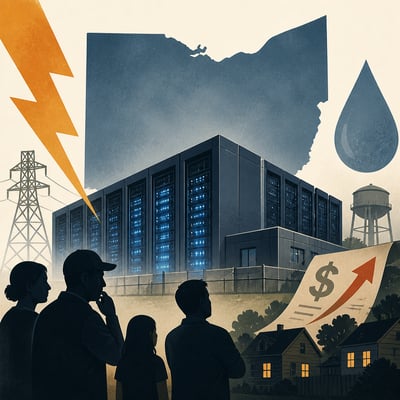
Ohio's rapid hyperscale data center buildout is driving a broad regulatory response involving electricity cost allocation, grid planning, water and wastewater permits, tax incentives, zoning, ballot measures, and demands for greater local control.
The debate has moved beyond proposed restrictions toward concrete regulatory decisions, notably Ohio EPA’s case-by-case wastewater permitting and the failure of House Bill 646. Grid planning has also become more central as PJM, utilities, and developers consider dedicated generation to accommodate hyperscale demand.
The debate now includes a concrete state response: Ohio paused new data-center tax-break requests after exemptions reportedly reached $1.57 billion in one year. The scale of existing development is also clearer, with more than 200 operating facilities statewide and over 100 near Columbus.
Ohio’s debate has become more concrete and politically urgent, with a new voter-approval proposal, at least 18 local moratoriums or pauses, and the issue entering the 2026 election cycle. Governor Mike DeWine has also paused new data-center sales-tax exemption requests while broader regulation is considered.
The biggest update is that Ohio's wastewater fight has advanced from debate to a concrete regulatory setback: the EPA rejected a statewide permit after heavy public opposition. The framing has also broadened from mostly state legislation and local rules to a more explicit statewide contest over permits, utility costs, and land-use constraints.
The story has sharpened from a broad fight over data-center growth into a more concrete regulatory showdown, centered on proposed ballot restrictions, unfinished state legislation, and utility tariff enforcement. The latest version adds specific operational constraints on power use and clarifies that water, tax, and permitting rules are now moving through multiple channels at once.
- Proposed ballot measure targets data centers above 25 megawatts.
- AEP Ohio tariff requires 85% minimum electricity payment and long-term contracts.
- Court challenge has been filed against the AEP Ohio tariff.
- Ohio EPA rejected a statewide wastewater permit.
- House Bill 646 now explicitly includes wastewater oversight and tax exemptions.
The story has shifted from mainly local opposition to a broader statewide regulatory push, with Ohio agencies and lawmakers now moving to tighten permitting, utility cost allocation, water reporting, and tax rules for data centers. The biggest new development is Ohio EPA abandoning a statewide wastewater permit in favor of project-by-project approvals, signaling a more restrictive and individualized regulatory approach.
- Ohio EPA abandoned a proposed statewide wastewater permit.
- Project-by-project NPDES approvals replaced the statewide permit approach.
- Proposals now target data-center electricity and grid upgrade cost responsibility.
- Columbus is developing new large-facility water and sewer requirements.
- House Bill 646 would tighten statewide data-center reporting and tax rules.
The story now emphasizes a broader, more coordinated push in Ohio to curb large data centers, with Conserve Ohio’s statewide effort delayed to 2027 and local charter campaigns still advancing. The framing also shifts slightly toward negotiated tradeoffs, highlighting industry and labor arguments for jobs, investment, and workforce protections alongside local restrictions.
The story has widened from local Ohio moratoriums and ballot measures to a broader statewide constitutional campaign, with ConserveOhio now claiming substantial signature momentum. Springfield’s status also shifted from a possible pause to an active redevelopment example, showing that some data-center-related projects are moving ahead under local incentives.
- ConserveOhio reported more than 105,000 signatures for a 2027 ballot effort.
- Springfield is converting a former LexisNexis facility into a commercial colocation site.
- The Springfield project is supported by tax abatements and projected jobs.
- The statewide effort is now framed as an Ohio constitutional amendment.
The story has shifted from broad Ohio pushback to concrete local ballot fights and moratorium efforts that could directly block or delay specific large data center projects. Sunbury’s certified ballot measure and similar actions in Pataskala and Springfield make the conflict more immediate and procedural.
- Sunbury certified a November ballot measure restricting data centers above 25 megawatts.
- Conserve Ohio is organizing a 2027 statewide restriction campaign.
- Springfield is considering a six-month moratorium on large data centers.
- An Amazon-linked campus in Sunbury could be affected by the measure.
- 5C Group is converting a former LexisNexis facility into colocation in Springfield.
Ohio's data center debate has broadened from a general push for oversight into a more concrete policy fight centered on utility tariffs, formal state study bodies, and a citizen-backed statewide ban proposal for very large facilities. The new version also frames local resistance as more active and litigation-backed, not just moratorium-driven.
- Citizen petition would ban new large data centers above 25 MW.
- Joint Data Center Committee and Data Center Study Commission are now identified.
- Local resistance now includes litigation in multiple Ohio communities.
- AEP Ohio tariff rules are newly highlighted in power-cost disputes.
The story has shifted from a general Ohio data-center growth dispute to a more defined statewide policy fight centered on concrete legislative and local-government mechanisms. Oversight efforts now appear more organized and immediate, with House Bill 646, a joint committee, moratoriums, and ballot initiatives framing the next phase.
- House Bill 646 is now the main legislative vehicle.
- Ohio Joint Data Center Committee is a new oversight body.
- Multiple local moratoriums and ballot initiatives are advancing.
- Central Ohio, especially New Albany and Columbus, is the primary buildout hub.
- Water reporting and tax accountability are now recurring policy concerns.
Ohio is facing a fast-growing data center buildout that is triggering disputes over electricity demand, ratepayer costs, water use, permitting speed, and community transparency. State regulators, lawmakers, and local governments are responding with tariffs, tax breaks, moratorium proposals, and tighter siting rules. The debate is increasingly about how to accommodate new investment without shifting infrastructure and environmental costs onto residents.