
 AI Governance
 Data Centers
 Drones
 Climate
 Privacy
 2026 Maine Senate
 Bob Dylan
Michigan Proposes Data Center Guardrails
Coverage from Planet Detroit, The Detroit News, and others
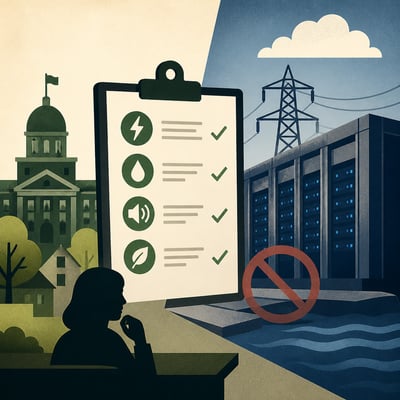
Michigan lawmakers and local governments are proposing new limits and approval conditions for large data centers, with measures addressing electricity costs, water use, noise, transparency, labor standards, and community benefits.
The debate is tied to hyperscale projects in Saline and Van Buren townships and includes competing proposals for stricter permitting, temporary moratoriums, and voluntary commitments from developers. The outcome could determine whether residents and utilities bear project-related costs and how quickly major campuses can secure approvals and power.
If you read one thing
Michigan House Democrats Propose Data Center RegulationsIt provides the broadest overview of Michigan’s proposed data-center safeguards, including developer costs, water limits, transparency, and community benefits.
Latest development
Detroit Groups Seek Data Center Moratorium During Ordinance ProcessIt materially updates the topic through Detroit’s emerging ordinance, transmission constraints, water concerns, and demands for stronger public safeguards.
The evidence
Detroit Council Seeks Limits on AI Data Center Water UseIt adds concrete evidence about large facilities’ cooling-water demand and Detroit’s proposed monitoring and mitigation requirements.
The local angle
Metro Detroit Towns Rewrite Zoning Rules for Data CentersIt shows how multiple Michigan communities are using moratoriums, zoning changes, buffers, and incentive conditions to manage data-center development.
Local governments are tightening siting controls
Michigan municipalities are using moratoriums, zoning revisions, residential buffers, and incentive conditions to slow or constrain data-center approvals while they update rules. Detroit has effectively paused new permitting, and several townships and cities are pursuing similar measures amid legal limits on outright bans.
Policy is shifting project costs toward developers
State proposals and the governor’s plan seek to prevent residents and other utility customers from subsidizing data-center electricity, water, and infrastructure demands through full-cost payment, distinct utility treatment, collateral, and disclosure requirements. The central unresolved divide is whether protections will be enforceable legislation or a voluntary developer pledge.
Water and grid capacity are binding constraints
Large facilities are being evaluated against substantial electricity and cooling-water demands, with Detroit citing inadequate transmission for hyperscale projects and opposing unmitigated city-water use. Proposed safeguards include water permits, caps, monitoring, wastewater reporting, and requirements to address grid and environmental impacts.
Community accountability and participation are contested
The emerging framework increasingly links approvals to community-benefit agreements, disclosure, limits on nondisclosure agreements, labor and noise protections, and decommissioning plans. At the local level, residents and environmental groups argue that approval and ordinance processes have not provided meaningful or timely public input.
345-kilovolt
voltage of transmission lines needed for hyperscale data center service
“DTE Energy indicated that Detroit lacks the 345-kilovolt transmission lines needed to serve hyperscale data centers, which can require more than 1 gigawatt—roughly the electricity demand of a large city.”
more than 1 gigawatt
electricity demand of hyperscale data centers
“DTE Energy indicated that Detroit lacks the 345-kilovolt transmission lines needed to serve hyperscale data centers, which can require more than 1 gigawatt—roughly the electricity demand of a large city.”
38-acre acres
size of the former Packard Plant site
“Data center developer Panattoni also evaluated the 38-acre former Packard Plant for a 1-gigawatt Google data center.”
More than 400 people
attendance at a community meeting
“More than 400 people attended a community meeting at a local high school.”
1.8-million-square-foot square feet
planned hyperscale data center size
“In late 2025, a 1.8-million-square-foot hyperscale data center and a DTE substation were conditionally approved for a site in Lyon Township, three miles from her home and less than a mile from an elementary school, two daycare centers, and an assisted-living facility. The township Planning Commission approved the project without input from residents whose homes bordered the property.”
Detroit moves toward formal data-center controls amid power and water constraints
Detroit, which lacks a data-center-specific ordinance, has effectively paused permitting for new principal-use facilities while developing regulations. The process is being driven by major transmission and water-access constraints, alongside disputes over projected tax benefits and the adequacy of public participation.
Previously
Michigan lawmakers, state agencies, and local governments are developing new rules for large data center projects as proposed campuses in Saline Township and Van Buren Township increase scrutiny of electricity costs, water use, grid reliability, noise, and public disclosure. Proposals include separate utility rates, water permits and caps, community benefits agreements, labor standards, decommissioning plans, and temporary approval pauses, while Gov. Gretchen Whitmer has promoted a voluntary cost-protection pledge alongside legislation. The measures remain proposals or local planning actions, so their final requirements and effect on projects are unresolved.
The policy debate remains largely unchanged, but major projects are now presented as more concrete: Google has signed Whitmer’s pledge for a planned Van Buren campus, while the Saline project is under construction and faces a DTE-related contract challenge.
The story now emphasizes a broader statewide regulatory push, with more explicit attention to utility rate treatment, community-benefit requirements, and local moratoriums alongside the original water and grid disputes. Whitmer’s position is also reframed as supporting both enforceable consumer protections and a voluntary developer pledge.