
 AI Governance
 Data Centers
 Drones
 Climate
 Privacy
 2026 Maine Senate
 Bob Dylan
Data Centers Meet Local Resistance
Coverage from Mondaq, Arnold & Porter, and others
U.
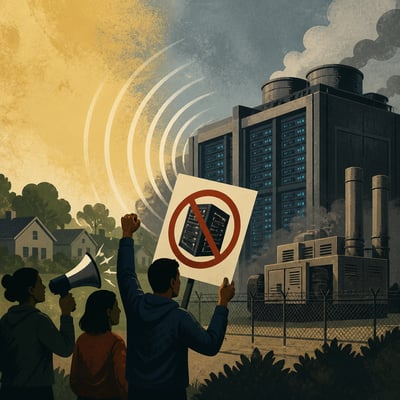
S. data center projects are facing growing resistance from residents, local governments, and advocacy groups over noise, construction disruption, water use, air quality, electricity demand, and who bears the costs. Opposition is increasingly affecting site selection through lawsuits, referenda, moratoriums, zoning disputes, and project cancellations or delays, while developers and utilities face pressure to provide clearer information and secure local support. The conflict is most visible in established data center regions such as Northern Virginia, but similar disputes are emerging across the country.
The story now shows clearer evidence that opposition is producing concrete outcomes, including a canceled major campus, a voter-approved local ban, and new state-level oversight of utility contracts and costs.
The story shifts from broad opposition to a clearer execution bottleneck, with Chesterfield tightening approvals and Alabama proposals highlighting the potentially exceptional scale of power demand and ratepayer risk.
The story now places utility cost allocation and ratepayer protection alongside environmental concerns, with Alabama regulators and Alabama Power becoming active participants. This shifts the issue from primarily local permitting resistance toward broader scrutiny of how large data-center power demands affect utilities and customers.
The story has expanded from general local resistance to a broader, more organized nationwide push that now includes referenda, proposed bans, and explicit local prohibitions. The framing also tightens around developers needing earlier political and community buy-in because approval risk is becoming more complex.
The story now centers more explicitly on a widening local political backlash, with broader regulatory tightening and outright project cancellations or pauses becoming more visible outcomes. It also expands the set of implicated states and actors, while emphasizing that political support, permitting, water approvals, and grid access are increasingly decisive for project viability.
- Some proposals have been canceled, stalled, paused, or restricted.
- Litigation now includes air permits, groundwater impacts, and rezoning disputes.
- The story broadens to additional states including California, Michigan, Utah, Maine, Mississippi, and Oregon.
- Developers are increasingly factoring political support and grid access into site selection.
- Opposition and regulatory activity are described as accelerating in 2026.
The story has broadened from mostly Virginia-centered opposition to a wider, more concrete account of how large AI and cloud campuses are moving through rezoning, permitting, utility planning, and construction while triggering organized resistance. It now emphasizes grid-infrastructure constraints, rural land conversion, and litigation as central bottlenecks, not just local backlash.
- Projects are now described as moving through construction, rezoning, permitting, and utility planning.
- Grid infrastructure approvals have become a major siting constraint.
- Rural counties are increasingly targeted for new large campuses.
- Lawsuits now challenge notice, rezoning, and water contamination claims.
- The story now includes facilities in England.
The story is now more explicitly framed as a broad policy and local-governance fight, not just a wave of resident resistance. The new version adds that moratorium and oversight proposals have spread across state legislatures, but few had actually been enacted.
The story has moved from general resistance to a more quantified, nationwide escalation, with newly reported project delays and a much larger organized opposition network. Virginia remains central, but the update adds sharper evidence that backlash is now affecting approvals and generator policy at scale.
- 75 U.S. projects worth about $130 billion were blocked or delayed in Q1 2026.
- Grassroots opposition groups reportedly reached 833 across 49 states.
- PJM authorized data centers to run backup generators during grid strain.
- Transparency of approval negotiations became a specific concern in Chesterfield and Culpeper.
The story has shifted from broad U.S. opposition to a more specific, more procedural fight centered on Virginia and a wider set of legal and regulatory challenges. What stands out now is that resistance is not just about complaints over impacts, but increasingly about moratoriums, lawsuits, rezoning, and utility-planning disputes.
- Virginia is identified as the clearest battleground.
- Court challenges and rezoning disputes are now part of the fight.
- Ballot efforts and moratoriums are appearing in both blue and red states.
- Utilities and grid actors are now central to the story.
Data center projects across the United States are facing stronger community resistance, project delays, moratorium proposals, and demands for clearer information about electricity, water, pollution, noise, and local benefits. A Data Center Watch analysis cited at least 75 blocked or delayed projects worth about $130 billion in the first quarter of 2026, while opposition groups more than doubled to 833 across 49 states. The disputes are also reshaping politics and permitting debates as officials promote data centers for jobs and tax revenue while residents and environmental groups challenge their local costs, particularly where diesel or gas generators support operations.