Data Centers Meet Local ResistanceData Centers Meet Local ResistanceCoverage from The New York Times, WIRED, and others
00/00/0000
DailyWeekly
AI data center proposals are becoming a bipartisan U.
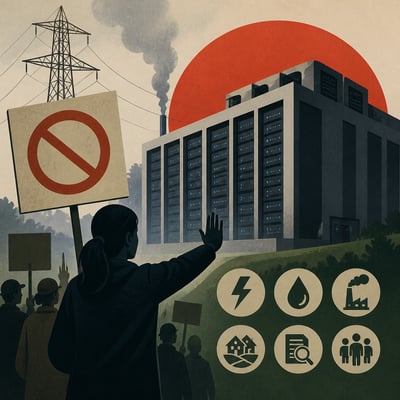
S. political flashpoint as residents and elected officials challenge their effects on electricity prices, water supplies, grid capacity, land use, noise, and pollution. States including New York, Texas, and Pennsylvania have adopted moratoriums, audits, or new developer requirements, while local campaigns and zoning disputes have delayed or threatened projects. The central tension is between the economic and tax benefits promised by developers and the infrastructure, environmental, and quality-of-life costs communities may bear.
It adds concrete evidence about rural siting, the spread of restrictions, and how grid policy can redirect development.
GPB / Julia Tilton
Key Issues
01
Local resource and consent conflict
Opposition centers on expected pressure on electricity costs, water, land, and local quality of life, alongside demands for transparency and meaningful community input. The conflict spans urban and rural settings and crosses party lines.
Stable
Drawn from 4 articles
02
Permitting and local-control tightening
Moratoriums, grid reviews, approval pauses, and stronger disclosure or local-consent requirements are established responses to siting concerns. Proposed development is increasingly conditioned on resource use, consumer costs, and community approval.
Stable
Drawn from 4 articles
03
Bipartisan political mainstreaming
Data-center siting has become an electoral and broader policy issue, with politicians across parties addressing local approval, utility costs, and community impacts. This political pressure coexists with continued arguments for rapid construction and economic competitiveness.
Stable
Drawn from 4 articles
04
Expansion friction and benefit bargaining
AI demand continues to support a large development pipeline, while moratoriums, stalled projects, and community resistance create material friction. Developers and supporters emphasize tax revenue and community commitments, amid persistent disputes over who receives benefits and who bears infrastructure costs.
Stable
Drawn from 4 articles
Key Numbers
More than 1,500 projects
data-center projects underway across the United States
reportedly
“The buildout nevertheless continues. More than 1,500 projects are reportedly underway across the country, with thousands more in planning, and only a small share have been delayed or canceled.”
The New York Times
thousands projects
additional data-center projects in planning
“The buildout nevertheless continues. More than 1,500 projects are reportedly underway across the country, with thousands more in planning, and only a small share have been delayed or canceled.”
The New York Times
$130 billion USD
data-center projects delayed or canceled in the first quarter
about
“About $130 billion in projects were delayed or canceled in the first quarter of the year, according to the article, while The Information reported that 500 jurisdictions had enacted bans or moratoriums.”
The New York Times
500 jurisdictions
jurisdictions enacting data-center bans or moratoriums
“About $130 billion in projects were delayed or canceled in the first quarter of the year, according to the article, while The Information reported that 500 jurisdictions had enacted bans or moratoriums.”
The New York Times
roughly three-quarters
Maryland population covered by data-center laws
“Maryland laws now cover roughly three-quarters of the state’s population, and New York enacted the first statewide pause. Texas Gov. Greg Abbott paused approvals pending an audit of data centers seeking connections to the state’s electric grid. Pennsylvania Gov. Josh Shapiro imposed new guardrails after previously promoting rapid development.”
The New York Times
Looking Back
132 Day Timeline
Articles published over time. Hover any bar for the period and its article count.
May 13
Jun 3
Jun 24
Jul 18
Aug 8
Aug 29
Sep 19
The Story So Far
Escalation
Local resistance begins terminating projects and tightening approvals
Opposition is producing more concrete political and project consequences: Virginia and Maryland are pausing or tightening approvals, secrecy around negotiations is fueling electoral backlash, and community resistance helped end a proposed $12 billion Wisconsin hyperscale campus.
Previously
AI data center proposals are becoming a bipartisan U.S. political flashpoint as residents and elected officials challenge their effects on electricity prices, water supplies, grid capacity, land use, noise, and pollution. States including New York, Texas, and Pennsylvania have adopted moratoriums, audits, or new developer requirements, while local campaigns and zoning disputes have delayed or threatened projects. The central tension is between the economic and tax benefits promised by developers and the infrastructure, environmental, and quality-of-life costs communities may bear.
History
09/17/2026
The story is materially stable. The current version slightly emphasizes local zoning disputes, project delays, and developer standards, but adds no clearly new event or policy beyond the previously reported opposition and restrictions.
09/15/2026
The story has moved from broad resistance and proposed controls toward measurable public opposition, implemented restrictions, and project delays. New polling and reported cancellation figures suggest the conflict is becoming a more consequential constraint on AI infrastructure expansion.
U.S. residents and officials are delaying or restricting data-center projects nationwide as communities debate electricity, water, environmental costs and local tax benefits.
8/31/2026 • Community & Local Opposition • General
American voters and local communities are increasingly opposing data centers, while Graphika and China experts found limited evidence of substantial Chinese influence in the United States.
Residents across the United States are organizing against expanding AI data centers in 2025 over water use, electricity strain, emissions, noise, and local political influence.
Heatmap News polling found sharply higher American opposition to data centers over the past year, prompting political repositioning across Michigan, Pennsylvania, Louisiana, and Washington.
8/31/2026 • Community & Local Opposition • General
Residents, activists, and conservative politicians opposed expanding AI data centers across the United States over power, water, pollution, land use, and local control concerns.
8/4/2026 • Community & Local Opposition • General
Tech Policy Press / Vignesh Ramachandran and Inayat Sabhikhi66
Communities in the United States, India, Brazil, and South Africa challenge data center projects over land disputes, environmental disclosures, and alleged intimidation.
Rural residents and officials across the United States are challenging proposed AI data centers through opposition groups, moratoriums, and restrictions in 2026.
Technology companies and political groups are intensifying the U.S. data center debate in 2026 as AI expansion drives power demand, water concerns and election spending nationwide.
Republican officials including Greg Abbott, JD Vance, and John Thune responded in 2020s Texas and South Dakota to data center opposition over electricity, water, and local power impacts.
U.S. candidates and governors are imposing or proposing data center restrictions ahead of the midterm elections across Florida, Ohio, Pennsylvania, Texas, and New York.
8/20/2026 • Community & Local Opposition • General
Minnesota Star Tribune / Jana Hollingsworth and Jp Lawrence65
Minnesota residents and local officials debate proposed data centers in multiple cities and counties, using moratoriums, lawsuits, and elections amid concerns over disclosure, electricity, and water.
7/24/2026 • Community & Local Opposition • General
Residents and local officials across the United States are challenging data-center projects over noise, land use, resource demand and secrecy, while governments reconsider approvals and incentives.
9/21/2026 • Community & Local Opposition • General
Residents and local officials in Texas, Pennsylvania, and other US communities are tightening data-center requirements in 2025 as opposition grows over water, electricity, land use, and permanent jobs.
9/2/2026 • Community & Local Opposition • General
Fortune / The Associated Press, Valerie Gonzalez and Jamie Stengle65
Gina Hinojosa and rural opponents in Texas campaign against rapidly expanding AI data centers, citing water stress, pollution fears, and limits on local zoning control.
7/24/2026 • Community & Local Opposition • General
In the U.S., growing community opposition to AI data centers is driving state-level actions by governors and local governments, including New Jersey reporting rules and New York moratorium proposals.
5/28/2026 • Community & Local Opposition • General
U.S. voters and state politicians are challenging data-center expansion over electricity, water, land use, and jobs, increasing pressure for stricter project rules.
8/19/2026 • Community & Local Opposition • General
In 2026, U.S. politicians and local communities challenged hyperscale data-center projects nationwide over land use, power demand, water needs, and limited permanent jobs.
Maine Gov. Janet Mills vetoed a proposal for a state data center moratorium in Jay after residents voiced concerns about power, water, pollution, and incentives.
5/25/2026 • Community & Local Opposition • General
Tech Policy Press / Evan Selinger and Divya Ramjee60
Communities across the United States are challenging AI data centers and Flock Safety cameras through protests, lawsuits, contract reviews, and policy efforts as local infrastructure and surveillance harms become more visible.
9/17/2026 • Community & Local Opposition • General
The Santa Barbara Independent / Lisa H. Sideris and David N. Pellow60
Gallup reported in 2026 that 71 percent of Americans oppose AI data centers in the United States, citing energy, water, pollution, noise, and land-use impacts.
9/15/2026 • Community & Local Opposition • General
Residents and state lawmakers in the United States are challenging data center development over water, power, community disruption, tax incentives, and distrust of technology billionaires.
The Trump administration directed the Environmental Protection Agency to limit public information and input on United States data center projects amid bipartisan local opposition.
8/30/2026 • Community & Local Opposition • General
California community organizations discussed opposition to proposed generative AI data centers on August 27 during an online webinar, citing power demand, water use, environmental effects, and limited transparency.
8/29/2026 • Community & Local Opposition • General
Public opposition to AI data centers is dividing labor groups and prompting governors in New York, Texas, and Pennsylvania to impose or consider tighter controls in 2025.
8/27/2026 • Community & Local Opposition • General
Residents, organizers, and political candidates across the United States are challenging AI data center projects through protests, ordinances, moratoriums, and election campaigns.
8/11/2026 • Community & Local Opposition • General
State and local officials and residents are challenging data-center projects across the United States during the 2020s AI expansion over resource demands, tax incentives, and technological anxiety.
Donald Trump urged governors and local officials to support data centers while religious and labor leaders increased opposition in New York and nationwide.
7/25/2026 • Community & Local Opposition • General
National Catholic Reporter / Michael Sean Winters60
Sherrod Brown and other community opponents in Ohio and multiple US states cite water and electricity impacts as AI data center siting sparks hearings and resistance.
7/23/2026 • Community & Local Opposition • General
Cedar Rapids and Linn County enacted data center-related moratorium actions amid misinformation-driven public concern about water, power, and land use impacts.
7/14/2026 • Community & Local Opposition • General
Nancy Mace and St. Charles, Missouri officials promote limits on new data centers as host-fee and dividend proposals gain support for local community benefits.
5/22/2026 • Community & Local Opposition • General
HumansFirst will protest data-center buildouts across at least 125 U.S. locations on Saturday, citing power cost, water, and environmental concerns tied to AI-driven expansion.
7/18/2026 • Community & Local Opposition • General
HumansFirst plans nationwide protests on Saturday in at least 125 U.S. locations against rapid data center expansion, citing power bills and water impacts.
7/18/2026 • Community & Local Opposition • General
Data Center Watch and POLITICO report local opposition and streamlined water pollution permitting after a 2023 Clean Water Act narrowing, alongside Meta's $10 billion Canada data center plan.
A bipartisan voter backlash against data centers is expanding across the United States as Alexandria Ocasio-Cortez, Bernie Sanders, and Greg Abbott criticize development while Donald Trump promotes facilities.
8/24/2026 • Community & Local Opposition • General
Arthur Herman says community opposition is delaying proposed data center projects and prompting restrictions in states including Texas and New York ahead of the 2026 midterms.
A Harvard researcher says U.S. local governments increasingly use moratoriums, zoning changes, and utility service limits as AI accelerates data-center proposals.
6/21/2026 • Community & Local Opposition • General
U.S. candidates and state officials are challenging proposed AI data centers nationwide ahead of November midterm elections because of land, water, electricity, and grid concerns.
U.S. communities are increasingly challenging data-center expansion in the 2020s as construction accelerates nationwide, citing opaque planning, local impacts, and rising electricity demand.
ABC News reported that residents and politicians across the United States are challenging rapid AI data-center expansion over resource use, costs, and local control.
8/23/2026 • Community & Local Opposition • General
Residents and local officials in Independence, Missouri, and Vineland, New Jersey, are challenging rapidly developed AI data centers over grid demand, noise, permitting, and community control.
President Donald Trump defended data center expansion as U.S. communities, state governments, and voters raised concerns about costs, water, power demand, and local impacts.
8/31/2026 • Community & Local Opposition • General
U.S. residents and governors are challenging AI data center expansion in 2026 through protests, zoning actions, lawsuits, and stricter oversight across multiple states.
8/21/2026 • Community & Local Opposition • General
Voters and policymakers in the United States and Europe are challenging rapid AI data center expansion over electricity costs, grid strain, jobs, and land use.
HumansFirst will coordinate Saturday protests in at least 125 US locations against AI-driven data center expansion amid concerns over power bills and water impacts.
7/18/2026 • Community & Local Opposition • General
Candidates and elected officials across the United States made opposition to data center construction and support for moratoria a bipartisan political issue during 2024 and 2025 campaigns.
Residents and political candidates opposed proposed AI and hyperscale data centers during 2025 campaign activity across Michigan, Tennessee, Colorado, and other U.S. states.
7/31/2026 • Community & Local Opposition • General
U.S. communities and policymakers are challenging rapid AI data center expansion over electricity costs, water use, environmental impacts, and limited local participation nationwide.
8/31/2026 • Community & Local Opposition • General
U.S. residents and local organizers delayed or opposed dozens of data center projects and surveillance deployments across multiple jurisdictions during 2026 over infrastructure, land-use and privacy concerns.
8/30/2026 • Community & Local Opposition • General
American communities are increasingly opposing data center projects because AI, Big Tech, infrastructure impacts, and limited local benefits have eroded trust across the United States.
8/24/2026 • Community & Local Opposition • General
During the 2026 midterm campaign, US voters and candidates challenged data-center expansion over utility costs, water use, and siting in communities nationwide, while Meta Platforms continued construction in El Paso, Texas.
8/14/2026 • Community & Local Opposition • General
During Democratic primary contests, Francesca Hong lost narrowly in Wisconsin while data-center moratorium candidates gained victories and visibility across Michigan, Kansas, and Colorado.
8/12/2026 • Community & Local Opposition • General
California lawmakers and local communities are scrutinizing DataBank's expanding data center operations over electricity demand, backup-generator impacts, and potential consumer costs.
7/31/2026 • Community & Local Opposition • General
New York Governor Kathy Hochul imposed a one-year moratorium on new data center construction as public opposition spreads over land, water, and electricity impacts.
7/24/2026 • Community & Local Opposition • General
Reggie James argues that state moratoriums and local organizing against proposed data centers reflect rising public distrust tied to AI-linked impacts.
7/23/2026 • Community & Local Opposition • General
Andy Revkin reports a panel discussion linking data center moratoriums across 38 U.S. states to community trust concerns and proposed bill-credit and distributed energy solutions.
7/21/2026 • Community & Local Opposition • General
E&E News by POLITICO / Katherine Long, Jessie Blaeser54
POLITICO Poll results by Public First show rising, polarized voter opposition to sprawling data centers in the United States over six months, accelerating among Democrats.
7/17/2026 • Community & Local Opposition • General
In Utah and New Jersey, local organizers and environmental researchers oppose hyperscale AI data center projects over electricity demand, water use, and approval process constraints.
6/12/2026 • Community & Local Opposition • General
Candidates in Michigan and Wisconsin are campaigning against proposed AI data centers as local opposition grows over electricity, land use, environmental effects, and community control.
U.S. residents, policymakers, and energy experts are debating expanding AI data centers' effects on power, water, health, land, and jobs across communities including Northern Virginia and Genesee County, New York, in 2025.
8/30/2026 • Community & Local Opposition • General
Communities, advocacy groups, utilities, and political candidates are challenging AI data-center projects across the United States over power, water, land-use, and economic concerns.
8/29/2026 • Community & Local Opposition • General
Jeff Hanneman and other residents opposed a 220-acre data center proposal in Wisconsin Rapids, Wisconsin, as Francesca Hong backed a one-year construction moratorium during a gubernatorial campaign.
Karen Hao discusses 2025 U.S. data center protests and claims more than $100 billion in facilities faced delays as opposition centered on energy and freshwater impacts.
5/22/2026 • Community & Local Opposition • General
Technology executives promoted expanded AI infrastructure in Chapel Hill, North Carolina, while protesters and local governments challenged data centers over resource use, pollution, jobs, and land use.
Community organizations and political campaigns are challenging data center projects during 2020s election contests across Texas, Ohio, Michigan and Pennsylvania over power, water and land-use concerns.
National labor unions are divided over AI data center development as construction unions support projects and other labor groups back restrictions amid public opposition across the United States.
8/31/2026 • Community & Local Opposition • General
US community groups delayed or canceled 75 data-center projects worth about $130 billion during the first quarter of 2026 through protests and local opposition.
8/30/2026 • Community & Local Opposition • General
OpenAI CEO Sam Altman acknowledged growing US opposition to data center development in recent months as officials in Pennsylvania and Texas reconsidered expansion controls.
8/27/2026 • Community & Local Opposition • General
U.S. residents, officials, and technology leaders are contesting AI data center expansion in recent weeks across local communities and Washington, D.C.
8/22/2026 • Community & Local Opposition • General
Candidates in Michigan, Ohio, and Wisconsin are campaigning for data center restrictions after residents raised concerns about electricity costs, noise, pollution, and local control.
Americans are increasingly opposing AI data-center development across the United States amid local concerns and unproven claims of Chinese social-media influence.
8/21/2026 • Community & Local Opposition • General
U.S. communities, governors, environmental groups, and labor unions are contesting rapidly expanding AI data-center projects over water, power, land, taxes, and local approvals across the United States.
8/27/2026 • Community & Local Opposition • General
U.S. data center developers and technology companies are expanding AI infrastructure nationwide, prompting communities and policymakers to demand greater transparency, shared economic benefits, and cleaner electricity.
U.S. communities are increasingly challenging data center expansion as technology companies build AI infrastructure, with concerns focused on local impacts, electricity demand, and economic benefits.
Residents and elected officials across the United States are challenging AI data-center construction during the election year over electricity, water, noise, pollution, and local land-use impacts.
A New York Times/Siena poll conducted nationally from September 8 to 13 found broad voter opposition to new data centers, with resistance strongest among Democrats and younger voters.
9/15/2026 • Community & Local Opposition • General
Humans First, led by Cindy Kremer, staged data center protests across 37 states on Saturday, amid New York's data center moratorium and Republican calls for added guardrails.
7/15/2026 • Community & Local Opposition • General
Gallup surveys released in 2026 report 70% of U.S. adults oppose AI data center construction locally, largely due to environmental and community concerns.
5/13/2026 • Community & Local Opposition • General
U.S. voters and officials are increasingly challenging AI data center projects nationwide over electricity, water, subsidies and local development impacts.
Democratic candidates in Wisconsin, Kansas, and Michigan elevated data center moratoriums and AI regulation during 2026 primary campaigns as communities opposed large facilities.
Milltown Partners polling shared with Axios finds nearly half of US voters support a temporary data center construction ban, with opposition not primarily from neighbors.
6/22/2026 • Community & Local Opposition • General
U.S. voters and local communities increasingly oppose nearby AI data centers, prompting Republican distancing and Democratic calls for development moratoriums across several states.
Donald Trump defended U.S. data center development this week as communities and politicians, including Texas officials, faced backlash over energy, water, environmental, and economic concerns.
American residents and policymakers are challenging data center expansion across the United States as polling and local backlash highlight concerns about costs, jobs, power use, and public participation.
8/27/2026 • Community & Local Opposition • General
Andy Masley argues that during recent US data center permitting debates, residents have primarily opposed projects over local power, water, environmental, and land-use concerns.
8/26/2026 • Community & Local Opposition • General
House Democrats, including Hakeem Jeffries and Alexandria Ocasio-Cortez, are debating a national data center construction pause as communities across the United States oppose rising utility costs and development impacts.
New York lawmakers recently enacted a moratorium on new data center construction amid national opposition, foreign influence allegations, and debates over AI infrastructure.
The AP-NORC and University of Chicago poll found in July 2026 that Americans increasingly worried about data centers' electricity, water, and environmental effects nationwide.
9/16/2026 • Community & Local Opposition • General

 AI Governance
 Data Centers
 Drones
 Climate
 Privacy
 2026 Maine Senate
 Bob Dylan