
 AI Governance
 Data Centers
 Drones
 Climate
 Privacy
 2026 Maine Senate
 Bob Dylan
Data Centers Meet Local Resistance
Coverage from The New York Times, WIRED, and others
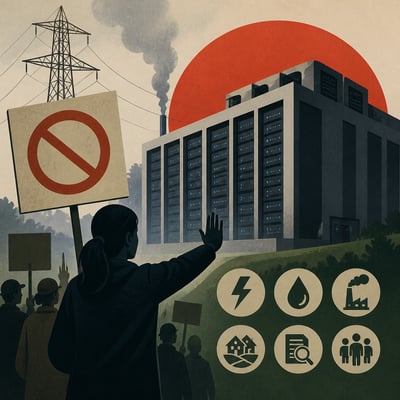
AI data center proposals are becoming a bipartisan U.
S. political flashpoint as residents and elected officials challenge their effects on electricity prices, water supplies, grid capacity, land use, noise, and pollution. States including New York, Texas, and Pennsylvania have adopted moratoriums, audits, or new developer requirements, while local campaigns and zoning disputes have delayed or threatened projects. The central tension is between the economic and tax benefits promised by developers and the infrastructure, environmental, and quality-of-life costs communities may bear.
The story is materially stable. The current version slightly emphasizes local zoning disputes, project delays, and developer standards, but adds no clearly new event or policy beyond the previously reported opposition and restrictions.
The story has moved from broad resistance and proposed controls toward measurable public opposition, implemented restrictions, and project delays. New polling and reported cancellation figures suggest the conflict is becoming a more consequential constraint on AI infrastructure expansion.
The story remains broadly stable, but now includes a contested claim that foreign influence may be shaping the backlash; cited analysis instead attributes most opposition to domestic concerns.
The story is largely stable, but it now includes more explicit mitigation efforts by major technology companies and broader detail on infrastructure-cost and approval conditions. These commitments have not yet reduced opposition or altered the central conflict.
The update largely confirms the existing picture of bipartisan opposition, regulatory scrutiny, and continued industry and national political support for rapid expansion. It adds limited detail on project-level lawsuits, public hearings, transparency, and land impacts but does not materially change the story.
The story now more explicitly links data center opposition to national competitiveness and electoral politics, including gubernatorial races and the 2026 midterm debate. Federal support for rapid construction, particularly from Donald Trump, adds a higher-level political dimension to the existing state and local conflict.
Pennsylvania has moved from considering stronger safeguards to imposing additional oversight and local approval requirements, reinforcing the shift toward implemented state-level constraints. The update also highlights more organized forms of opposition, including lawsuits, zoning disputes, and campaign pressure.
The story is increasingly framed as a national political and strategic dispute, not only a local environmental backlash. New emphasis falls on bipartisan opposition, federal pressure to accelerate construction, and concerns that delays could weaken U.S. competitiveness with China.
The update mainly confirms the existing trajectory, while making Texas’s response more concrete by describing an actual pause in approvals for grid-impact and standards reviews.
New York has moved from considering restrictions to imposing a statewide construction moratorium, while conditional military-base proposals show expansion continuing through federally controlled sites. The story therefore now includes concrete regulatory implementation and a new federal siting pathway with environmental, power, and water conditions.
The story is now more concretely quantified and framed as an investment-risk problem: local opposition has reportedly disrupted at least 75 U.S. projects worth about $130 billion. The update also emphasizes uneven local benefits and growing tension between construction-labor support and resident opposition.
The story is increasingly framed as a permitting and local-consent constraint on AI infrastructure, not merely a protest movement. New emphasis on audits, accountability, and uneven community benefits modestly strengthens the case that safeguards are moving into implementation.
Resistance has produced concrete outcomes rather than remaining primarily a political and community challenge: New York enacted a statewide moratorium and QTS terminated a major Virginia project. The story also broadens internationally and shows that opposition is increasing project risk without stopping major capacity expansion.
- New York enacted a one-year statewide data-center construction moratorium.
- QTS terminated its Prince William Digital Gateway proposal in Virginia.
- Planned demonstrations are coordinated across more than 125 U.S. locations.
- Related siting conflicts are now documented in Japan, India, Brazil, and South Africa.
- Meta is pursuing a planned one-gigawatt campus in El Paso despite opposition.
Texas has emerged as a concrete policy battleground, with Governor Greg Abbott pausing or reviewing new AI data center projects amid concerns about drought, electricity costs, and limited local control. This strengthens evidence that opposition is producing governmental delays and scrutiny, not merely protests or proposals.
The story now places more emphasis on political fightback and active project advancement: opposition is increasingly tied to elections and ballot activity, while developers and federal agencies continue moving projects forward under scrutiny. It also adds stronger focus on commitments around grid, resource, and infrastructure support as a key condition in current disputes.
The story now shows the anti-data-center backlash becoming more explicitly political and operational, with added emphasis on project delays, permitting constraints, and grid planning rather than just local opposition. It also broadens the cast of active players, especially developers and federal military-site projects moving forward under conditions.
- Project timelines and permitting conditions are now directly affected.
- Developers are emphasizing jobs, investment, and tax revenue.
- Opposition now includes Georgia, North Carolina, Oregon, and Pennsylvania.
- Federal projects require independent power plans and water requirements.
- Limited disclosure now includes related transmission projects.
The story has shifted from general backlash and policy friction to a more quantified, nationalized political fight: widespread public opposition is now documented by polling, and organized protest activity appears far broader than before. At the same time, federal military-land projects remain moving forward conditionally, showing that the buildout is still advancing despite the backlash.
- Gallup found 70% of U.S. adults oppose a local AI data center.
- HumansFirst organized protests at at least 125 U.S. locations.
- Data center siting is becoming an election issue in multiple states.
- The Army conditionally selected Fort Bliss and Dugway Proving Ground sites.
- Polling supporting the story was conducted in March, April, and June 2026.
The story has shifted from broad opposition and policy debate to a more concrete account of how that resistance is affecting specific projects, with cancellations, delays, litigation, and new cost-sharing or transparency requirements now central. It also broadens materially into military-land leasing and shows continued buildout in major growth markets despite the pushback.
- At least one major Virginia campus was abandoned.
- Opposition has contributed to project cancellations, delays, and litigation.
- States are testing disclosure requirements and direct infrastructure cost sharing.
- Federal military-land leases for AI facilities are advancing conditionally.
- Wisconsin land acquisitions and hyperscale projects continue despite pushback.
The story now centers more explicitly on a coordinated nationwide protest campaign and adds President Trump as a visible pro-development counterweight. It also sharpens the policy picture with specific state responses, including New York’s proposed moratorium and Maine’s vetoed bill.
The story now includes a broader set of political and stakeholder responses, with governors, lawmakers, unions, religious leaders, and even national figures weighing in on data center expansion. It also adds a stronger regulatory angle, as permitting, moratoriums, and developer commitments are becoming more central to the dispute.
- Governors and lawmakers are debating moratoriums and other limits.
- Texas officials are calling for restraint on rapid development.
- Developers and utilities face pressure for transparency and bill protections.
- Labor unions and religious leaders have joined the backlash.
- Threat researchers say foreign actors are amplifying genuine grievances.
The story has shifted from general local resistance to a more organized, politically salient backlash, with coordinated protests, bipartisan election implications, and added concern about foreign amplification. The issue is now framed less as isolated permitting fights and more as a national campaign shaping state policy and 2026 electoral politics.
- HumansFirst organized protests across at least 125 U.S. locations.
- The backlash is becoming a 2026 election issue.
- Foreign-linked media and fake accounts are amplifying the controversy.
- Polling distinguishes nearby-facility opposition from national moratorium support.
The story has broadened from a mostly U.S.-focused opposition wave into a more structural backlash centered on resource use, with new polling, policy responses, and host-community bargaining now shaping the narrative. It is less about isolated project fights and more about a durable, politically visible constraint on data center expansion.
- Polling now shows most Americans oppose nearby data centers.
- Developers are proposing community-benefit terms like host fees and profit sharing.
- Land prices are rising around major hyperscaler buildouts.
- Japan has joined the list of affected countries.
- State responses are moving toward formal reporting and siting standards.
Opposition to new U.S. data centers is spreading from individual local disputes into coordinated protests, state-level policy debates, and project delays. Residents and officials are focused on electricity costs, water use, pollution, land acquisition, transparency, and whether communities receive durable benefits. The trend is creating new pressure for moratoriums, stricter approvals, environmental review, and developer accountability, while similar conflicts are emerging internationally.