
 AI Governance
 Data Centers
 Drones
 Climate
 Privacy
 2026 Maine Senate
 Bob Dylan
Data Centers Meet Growing Resistance
Coverage from Fox News, Stand.earth, and others
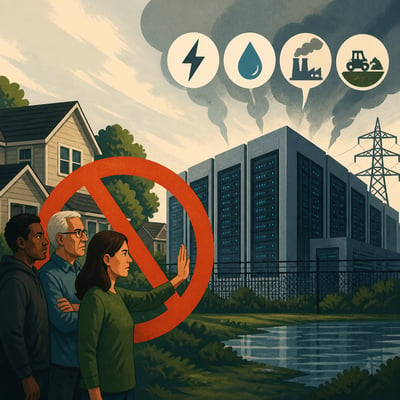
Data center projects are facing stronger public resistance across the United States, with multiple surveys showing roughly seven in ten respondents oppose facilities near their communities or favor slower construction.
Concerns focus on electricity prices, grid strain, water use, pollution, land conversion, noise, and whether local jobs and tax revenue offset those costs. The resistance is translating into moratoriums, tighter state and local rules, zoning challenges, project delays, and greater scrutiny from lenders and regulators.
The story has shifted from rising opposition and project delays toward a more consequential risk for development: legal and zoning challenges are blocking projects, reported affected investment has increased substantially, and the issue is becoming politically salient.
The story has moved from growing opposition and anticipated scrutiny to documented project disruption, with an estimated $64 billion in projects delayed or threatened. Resistance is also spreading into additional state-level arenas, while skepticism about lasting employment benefits sharpens the challenge to developers’ economic case.
The story has become more specific and more geographically broadened: opposition is now quantified in multiple polls, and new state examples such as Minnesota and Texas show the backlash is not confined to Virginia. The framing also shifts from general resistance to concrete pressure on approvals, utility cost allocation, and environmental safeguards.
The story has broadened from general opposition to data centers into a more specific policy and cost-allocation fight over AI data-center expansion. The current version emphasizes concrete government responses—moratoriums, zoning limits, transparency rules, and protections against shifting infrastructure costs onto residents.
- Resistance is now specifically directed at nearby AI data-center construction.
- Governments are adopting transparency requirements and utility-cost protections.
- Grid capacity and responsibility for network upgrades are now explicit concerns.
- Support for public subsidies is limited in some states.
- The geographic focus now includes Texas, Wisconsin, Minnesota, and Florida.
Public resistance to new data centers is increasing across the United States, with national and Virginia polling showing opposition outweighing support for facilities near homes and communities. Residents most often cite electricity prices, water demand, pollution, land use, and uncertainty about long-term local benefits, while developers and supporters point to jobs, tax revenue, and economic growth. The shift is contributing to moratoriums, tougher public hearings, and pressure for projects to fund grid upgrades, use cleaner power, and provide clearer local benefits.