
 AI Governance
 Data Centers
 Drones
 Climate
 Privacy
 2026 Maine Senate
 Bob Dylan
AI Data Center Buildout Meets Power Constraints
Coverage from Yahoo, AOL, and others
AI infrastructure expansion is shifting from chip demand toward the ability to finance, power, permit, and build very large campuses.
The PORTS-Pike project in Ohio dominates the current state, while broader Nvidia demand remains strong but faces equipment shortages, grid constraints, environmental concerns, and local scrutiny.
The story is increasingly framed as an execution and financing problem rather than primarily a chip-demand story. It also broadens beyond hyperscalers to sovereign, government, enterprise, regional-cloud, and specialized AI customers, while emphasizing new power and cooling approaches.
The story now emphasizes execution risk and local acceptance more strongly, while adding a separate South Korean policy development showing governments are adapting approval processes for AI data centers. Nvidia’s support is also specified more concretely through a $1.5 billion SB Energy investment.
The update adds sharper financial and technical specificity to the Ohio project, especially the planned natural-gas generation and at least $4.2 billion in regional grid infrastructure. The core story otherwise remains a confirmation of the previously described campus scale, timeline, and execution risks.
The story broadens from a single Ohio campus and chip-supply commitments to a wider demand-and-delivery problem, with AWS GPU expansion and Nvidia revenue underscoring market momentum while power validation and equipment bottlenecks threaten timelines.
The Ohio project is now framed as a defined approximately 8-gigawatt buildout, with 800 megawatts targeted by 2028 and completion extending to 2032, rather than primarily a potential expansion. New details also make federal remediation, permitting, water, housing, emissions, and transparency conditions central to feasibility.
The Ohio project has become more concretely structured around SB Energy’s long-term development and operating role, but its expected campus scale and Nvidia-backed financing appear lower than previously reported. The story also broadens with major dedicated-generation and utility investments, plus a separate South Korean policy change streamlining AI data-center approvals.
The Ohio AI data center story is now framed more concretely around an OpenAI lease negotiation and a large Nvidia backstop, with the site’s land status and power access details newly specified. The update also sharpens the financing-risk angle by emphasizing unresolved tenant, debt, and approval questions.
The story now frames the Ohio and South Korea projects as a broader Nvidia-led push to assemble huge AI data centers through financing, chips, and partnerships, rather than mainly an OpenAI-hosted Ohio deal. It also adds a clearer sense of scale and execution risk, with the Ohio buildout now described as far costlier and longer to complete.
- Ohio project cost is reported above $500 billion.
- Nvidia is helping assemble multiple large AI data center projects.
- South Korean plans now include a first 2-gigawatt facility.
- SK Hynix is tied to next-generation memory for Nvidia AI systems.
- Full Ohio buildout is described as needing much longer construction and funding.
The Ohio story has become more concrete and more politically entangled: OpenAI is now framed as the prospective tenant in an advanced lease discussion, with SoftBank as developer and U.S.-Japan power access arrangements now explicitly part of the deal. The current version also adds broader competitive interest in the site and clarifies that execution, approvals, and financing are still unresolved.
- OpenAI is in advanced talks to lease the Ohio site.
- SoftBank’s energy subsidiary is developing the southern Ohio project.
- Power access is controlled by the U.S. government and linked to Japanese funding.
- Anthropic, Microsoft, and Google have shown interest in the Ohio site.
- Nvidia is discussing up to $350 billion in chip financing.
The story now extends beyond South Korea to include a much larger Nvidia-linked financing push for OpenAI’s proposed Ohio AI campus, making capital structure and execution risk more central. Korea’s plans remain in place, but the key new wrinkle is that Nvidia is now tied to funding, not just chips and memory.
- Nvidia may backstop up to $250 billion in debt and lease financing for OpenAI.
- OpenAI’s proposed Ohio campus could exceed $500 billion with equipment.
- An initial 800-megawatt Ohio phase is targeted for 2028.
- SoftBank’s energy subsidiary is now identified as the Ohio site developer.
- Brookfield is newly named as a partner in the Korea expansion.
The story is more concrete: the 2GW AI facility now has a 2027 target, and the broader rollout has been tightened into a clearer staged plan with a 5GW domestic milestone beginning in 2029. The government-industry side also expanded the long-range target to 10GW by 2035, reinforcing that this is becoming a larger national infrastructure push.
- 2GW AI facility now targeted for 2027
- 5GW domestic capacity begins in 2029
- Separate 10GW target extends to 2035
- Power, siting, financing, and tenant commitments remain unresolved
The story has become more concrete: SK Telecom’s broad 15GW ambition now includes a specific 2GW-class AI factory timeline, while national planning has also crystallized into an 8.4GW-by-2029 benchmark. The framing also broadens the partnership stack by tying Nvidia, SK Hynix, Naver and Brookfield to implementation and financing.
- 2GW-class facility targeted to begin operating in 2027
- Nvidia Vera Rubin chips and SK Hynix HBM4 memory named
- Government-linked roadmap targets 8.4GW by 2029
- Brookfield joins Naver AI data center expansion plans
- 1GW facility estimated to cost about KRW 70 trillion
The story has shifted from a broad national push for AI data centers to a more concrete SK Telecom-led execution plan with dedicated corporate structure and phased gigawatt-scale buildout. The new emphasis is on implementation details—sites, financing, and regional rollout—rather than just policy and investment intent.
- SK Telecom launched wholly owned subsidiary SK Hyper.
- Ulsan is the anchor site for the first phase.
- Additional gigawatt-scale sites are being mapped across multiple regions.
- Funding will combine company capital, project finance, partners, and customer contracts.
- Targets now include 15GW by 2035.
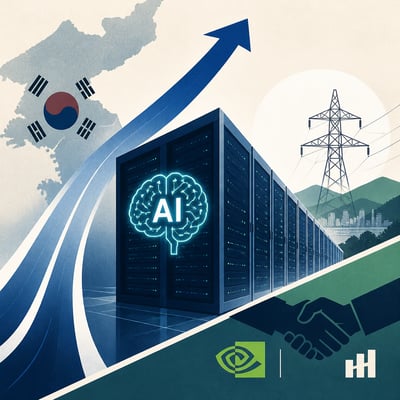
South Korea is moving to speed up AI data center construction through a new special law, major private investment plans, and partnerships with Nvidia and domestic tech firms. The topic centers on expanding capacity outside the Seoul area while balancing approval streamlining with concerns about power supply and electricity market stability. The result is a coordinated push to make AI infrastructure a national growth priority, but with timelines and energy constraints still shaping how fast projects can advance.