Power Delays Put AI Campuses to the TestPower Delays Put AI Campuses to the TestCoverage from Deutsche Welle, Springer Nature, and others
00/00/0000
DailyWeekly
U.
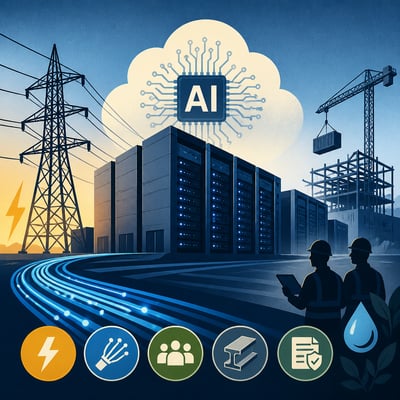
S. data center construction and investment are accelerating as hyperscalers and technology companies add capacity for AI workloads. The expansion is increasingly shaped by long power-delivery timelines, transmission and generation limits, permitting disputes, cooling requirements, and a shift toward rural or secondary markets with available land and electricity. Developers are responding through phased construction, powered-land acquisitions, private generation, site conversions, and long-term leases, but forecasts indicate that announced capacity may exceed what the grid can support on current timelines.
Its permitting, electricity-use, rural-siting, utility-cost, and private-generation evidence grounds the expansion and infrastructure constraints in observed projects.
It shows how data-center impacts cross county boundaries and create local policy questions over revenue, power, and environmental responsibility.
Conduit Street / Dominic Butchko
Key Issues
01
AI-driven capacity expansion
Hyperscaler capex, long-term leases, GPU deployment plans, and gigawatt-scale campuses continue to support an exceptionally large data-center pipeline. Construction and infrastructure backlogs are expanding, but much of the announced capacity remains phased, conditional, or scheduled for delivery after 2028.
Strengthening
Drawn from 5 articles
02
Power and grid delivery are the binding constraint
Interconnection queues, transmission and substation requirements, equipment lead times, and large-load delivery schedules increasingly determine whether announced capacity can come online and when. A potential 63 GW U.S. energy shortfall, multi-year delivery timelines, and growing reliance on private or behind-the-meter generation show that power availability is separating planned capacity from deliverable capacity.
Strengthening
Drawn from 6 articles
03
Siting follows infrastructure while campuses spread outward
Access to deliverable power, existing generation, connectivity, and land is driving site selection toward rural, secondary, and energy-rich markets. This is a redistribution rather than a wholesale departure from established hubs: most facilities still cluster around metropolitan or existing infrastructure systems.
Mixed
Drawn from 5 articles
04
Local environmental and political license is tightening
Communities and policymakers are weighing investment and tax revenue against electricity costs, water use, emissions, waste heat, land conversion, and cross-jurisdictional infrastructure burdens. Moratoriums, political delays, and disputes over cost allocation are increasing approval risk, while cooling improvements and revenue-sharing proposals offer only partial mitigation.
Strengthening
Drawn from 6 articles
05
Skilled labor is limiting delivery capacity
Major campuses require unusually large construction, commissioning, and operations workforces, while employers report acute shortages, high turnover, and recruitment competition for electricians, engineers, and other specialized roles. Staffing remains an execution constraint alongside power, equipment, and permitting.
Drawn from 3 articles
Key Numbers
125-micron microns
diameter specification of the MCF optical-fiber strand
single optical-fiber strand
“Corning developed Multicore Fiber, or MCF, which packs four cores into a single 125-micron optical-fiber strand. The design can provide the performance of a single-core solution with 75% fewer cables.”
AOL
130,000 GPUs
GPU-cluster threshold for requiring an additional optical layer
clusters exceeding this size
“Corning says GPU clusters exceeding 130,000 GPUs will require an additional optical layer, increasing fiber content by roughly 50%, making higher-density connectivity increasingly important.”
AOL
four cores
cores packed into one MCF optical-fiber strand
single 125-micron optical-fiber strand
“Corning developed Multicore Fiber, or MCF, which packs four cores into a single 125-micron optical-fiber strand. The design can provide the performance of a single-core solution with 75% fewer cables.”
AOL
almost 2 billion gallons of water
collective water use by Northern Virginia data centers
2023
“In Northern Virginia, where nearly 300 data centers handle about one-third of the world's online traffic, facilities collectively used almost 2 billion gallons of water in 2023.”
Deutsche Welle
nearly 300 data centers
facilities in Northern Virginia
nearly · 2023
“Large facilities can use up to 5 million gallons per day for cooling—roughly the consumption of a town of 10,000 to 50,000 people. About 80% of water withdrawn for cooling evaporates, while the remainder becomes wastewater. Northern Virginia’s nearly 300 data centers used almost 2 billion gallons of water in 2023.”
Deutsche Welle
Contested Issue
1 open dispute
Will the scale of announced and forecast AI data-center demand translate into physical capacity on current or near-term timelines?
Some evidence treats hyperscaler spending, customer commitments, backlog, and market absorption as evidence of sustained expansion. Other evidence argues that power delivery, interconnection, permitting, labor, equipment, and financing constraints mean much of the announced pipeline is conditional or delayed, with only a minority converting soon.
Demand-backed expansion
3 articles · across 2 publications
Large hyperscaler spending forecasts, strong customer commitments, and continued market absorption indicate that AI infrastructure demand can support substantial ongoing data-center expansion.
Constraint-limited realization
3 articles · across 3 publications
The announced pipeline substantially overstates near-term deliverable capacity because energy constraints, interconnection queues, permitting, labor, equipment, and financing bottlenecks will delay or prevent many projects.
Looking Back
134 Day Timeline
Articles published over time. Hover any bar for the period and its article count.
May 7
May 28
Jun 21
Jul 12
Aug 2
Aug 26
Sep 16
The Story So Far
No material change
The newly supplied articles reinforce existing expectations of sustained AI infrastructure spending and power and environmental constraints but do not establish a material new development beyond the prior state.
Previously
AI demand is driving a sharp increase in data center construction, investment, and leasing across the United States and other major markets. Developers are increasingly moving toward rural and secondary locations, powered land, private generation, and existing energy sites as grid-delivery timelines lengthen and projected electricity needs rise. Power availability, cooling requirements, skilled-labor shortages, permitting, and local opposition are becoming central constraints on whether announced capacity can be delivered on schedule.
History
09/18/2026
The update mainly confirms the existing constraint-driven narrative, while adding a quantified estimate that permitted projects could require 224–359 TWh of annual electricity.
09/17/2026
The story now has sharper quantitative evidence of an impending power constraint: large-load grid connections can take over four years, with a projected 63 GW U.S. energy shortfall by 2033. This strengthens the urgency around rural siting, private generation, and the risk that announced capacity will not commission on schedule.
Data centers are driving higher power, water, emissions, and land-use demands, with grid constraints emerging in Frankfurt, Dublin, and Northern Virginia.
Data centers are expanding worldwide, increasing electricity, water and land demands and intensifying grid, emissions and environmental pressures in major hubs including Frankfurt, Dublin, Northern Virginia and Phoenix.
NYU researchers found in a Nature Cities study that 4,283 U.S. data centers cluster near urban power infrastructure, particularly in metropolitan areas.
U.S. data centers are projected to generate $27 billion in tax revenue nationwide over the next decade while increasing local infrastructure and resource pressures.
Across the United States, residents and officials are challenging hyperscale data center projects as electricity, water, land, and noise impacts intensify.
Corning is expanding optical-connectivity capacity in response to AI data-center demand, with agreements involving Meta Platforms and Amazon and manufacturing growth planned during 2026.
In Ireland, the Commission for Regulation of Utilities replaced a 2021 de facto grid-connection moratorium with the Large Energy Users Connection Policy for new data centers above 10 MVA.
Fingrid grid-connection prioritization and renewable power attract AI-driven data center investment in Finland, but permitting and grid capacity timelines threaten buildout speed.
Hyperscalers are funding most 2026 AI datacenter construction from operating cash flow, while moratoriums in New York, Pennsylvania, and Texas slow projects.
BloombergNEF raised its US data center capacity forecast on July 21, 2026, citing AI demand but warning that power constraints and execution risks could limit construction through 2035.
Vantage Data Centers broke ground in December 2025 on the Lighthouse campus in Port Washington, Wisconsin, as Stargate pursues gigawatt-scale AI compute tied to dedicated power strategies.
Goldman Sachs analysts Ronald Keung and Timothy Zhao forecast 20% China data center demand CAGR for 2025-2028, citing power bottlenecks and green-power rules across Asia.
DataX Connect released its 2026 Data Center Salary Survey on September 15, finding labor shortages and job switching across the United Kingdom, Europe, and United States.
Technology companies and public officials are weighing data center investment, infrastructure costs, electricity demand, and water use as generative AI expands in communities worldwide.
Kelly Services reported on August 25 that skilled-worker shortages are constraining U.S. data center expansion, with employment projected to reach 650,000 positions by 2026.
The AI-driven data-center construction boom is increasing electricity and water demand across the United States while intensifying local concerns about emissions, incentives, noise, and infrastructure costs.
State and local officials across the United States are using tax incentives to attract data centers, which can produce substantial property-tax revenue with fewer public-service demands than large manufacturing projects.
Agri-Pulse webinar panelists urged rural communities to scrutinize data center developers' power, water, land and infrastructure impacts before granting approvals.
8/27/2026 • Community & Local Opposition • General
U.S. data center developers are expanding AI and cloud facilities in states including Virginia and Texas, increasing power, water, permitting, and community pressures nationwide.
Microsoft and other hyperscalers frame AI training campuses around power and cooling rather than TOP500 HPL scores as multiple multi-hundred-MW sites progress in 2026.
DataBank warns in 2025 that skilled labor shortages could limit staffing for large data center capacity activation in 2026-2027, citing construction crew growth.
U.S. counties are confronting expanding data center development as electricity, water, environmental, and land-use impacts cross local boundaries and require state coordination.
Carbon Direct experts and Microsoft sustainability executive Sara Neff discussed AI data center power, water, emissions, and community impacts during a 2025 roadmap webinar.
Business Insider mapped 1,416 US data centers using air permits through end-2025, with Meta and Amazon disputing methodology-based counts and electricity estimates.
6/8/2026 • Infrastructure & Site Development • General
Ian Curry of Principal Asset Management says U.S. AI growth is increasing data center construction, with power access and facility execution shaping yields.
Switch construction progress and multiple market reports in 2025-2026 show tighter data-center availability and multi-year power delivery timelines amid AI-driven demand.
HUMAIN, backed by Saudi Arabia's Public Investment Fund, signed AI infrastructure deals and a $10 billion AMD 500 MW joint venture while planning 1.9 GW by 2030.
SoftBank, Stratos, and Meta are planning multi-gigawatt AI data center campuses across Ohio, Utah, and Louisiana with scaled cooling and on-site natural gas generation.
Epoch Frontier Data Centers estimates fastest AI compute growth at the largest single data center sites since August 2024, with hyperscalers dominating through likely 2028.
Eaton, Vertiv, and Quanta Services reported in the second quarter of 2026 that AI data center demand was increasing orders for power, cooling, transmission, and substation infrastructure.
Hut 8 Corp. joined Russell growth and small-cap benchmarks on 27 June 2026 as analysts weighed execution risk for River Bend and a second U.S. AI campus.
Nvidia executives said the company expects substantial fiscal 2028 growth as hyperscalers expand AI data-center infrastructure, but deployment remains constrained by land, power, components, and capacity worldwide.
Business Insider reports 176 U.S. data center permits issued in 2025 across 34 states, projecting 224.3 to 358.8 TWh annual electricity demand and increasing local water and grid opposition.
In 2026, U.S. hyperscalers are accelerating data-center construction nationwide, intensifying competition for land, equipment, electricity and water while provoking political delays and local opposition.
John Norris discusses how United States communities should weigh data center economic benefits against land, energy, water and quality-of-life costs before rejecting projects.
Microsoft disclosed during its earnings call that revised asset lives and operating lease treatment will change how fiscal 2027 AI data center spending appears in financial reports.
Power grid capacity, permitting, and cooling limits increasingly constrain AI data center buildouts as electricity demand rises rapidly in the U.S., Dublin, and Frankfurt.
Christopher Johnson and Mark Bednar said at a Daily Caller Live event in Washington that reliable domestic power is essential for expanding U.S. data centers and AI infrastructure.
New York University researchers found that 97.5% of US data centers are located in metropolitan or micropolitan areas, primarily near regions with greater power-generation capacity.
7/31/2026 • Infrastructure & Site Development • General
Data center developers are expanding AI-oriented facilities globally, increasing rack density, cooling requirements, and electricity demand as construction accelerates through 2024 and beyond.
Residents, protesters, and politicians are challenging expanding U.S. data centers over electricity, water, emissions, and community impacts ahead of the 2026 elections.
8/19/2026 • Community & Local Opposition • General
China, through the National Development and Reform Commission, prepares a five-year data center hubs blueprint largely financed by ultra-long-term special government bonds.
Citi links a reported NDRC-led 2 trillion yuan China data center network plan to projected 10 gigawatts of new AI capacity and near-term operator gains.
Goldman Sachs Research projects accelerating US data center power demand through 2027, increasing regional grid reliability risk based on generation capacity and delivery timing.
Ireland CSO reported datacenter metered electricity consumption rose to 7,663 GWh in 2025 despite a CRU Dublin-area grid-connection moratorium lifted in December 2025.
McKinsey projects $7 trillion of global data center investment over three years as AI companies and infrastructure developers address energy constraints and compute demand.
U.S. communities and policymakers are challenging rapid data-center development during the current election cycle, particularly in Michigan, over costs, resource demands, uncertain returns, and proposed moratoriums.
Dell’Oro Group projected in 2026 that worldwide data center capital spending will exceed $3 trillion by 2030 as hyperscalers and AI cloud providers expand infrastructure globally.
A 2026 Resources Policy study models mineral demand from AI data centers through 2035, finding copper-dominated demand driven mainly by power and grid transmission needs.
Morgan Stanley and Goldman Sachs forecasts link AI data center growth through 2026-2029 to rising construction, cooling, and power needs for hyperscalers and converted mining sites.
Hut 8 Corp. secured 3.25B non-recourse financing for River Bend and advanced Beacon Point with a first 352 MW phase under a 15-year AI data center lease.
Thailand approved 958 billion baht of data infrastructure projects while JC4 hyperscale campus development advanced in Greater Jakarta and Malaysia and Vietnam gained new data center investment approvals.
Synergy Research Group reported in July 2026 that U.S. data center capacity could triple within three years despite power constraints and community opposition.
Alphabet, Amazon, Meta Platforms, Caterpillar, Eaton, and Vertiv are expanding or supplying AI data-center infrastructure as hyperscale investment accelerates globally.
PricewaterhouseCoopers LLP forecasts $31.6 trillion in global data center spending through 2050, with investment potentially reaching $50 trillion if AI adoption accelerates worldwide.
Peter Berezin and Calum Williams estimated that global AI data-center investment could require $2.5 trillion to $10 trillion in annual revenue during the 2020s.
Microsoft, Alphabet, and other hyperscalers faced investor scrutiny in Q2 2026 as escalating AI data-center spending outpaced visible revenue growth, while lawmakers in Washington and Loudoun County, Virginia, pursued new restrictions.
Alphabet raised 2026 AI infrastructure capex to $190 billion-$205 billion as investors await evidence that expanded cloud capacity will produce monetization and cash flow.
Kevin O'Leary says AI demand outpaces data center capacity and points to Alberta and Utah industrial park and buildout projects amid projected power growth.
CBRE says AI-driven hyperscale demand is increasing data center construction and leasing growth, prompting CBRE to expand critical infrastructure services and training in 2025 and 2026.
AMD signed 15-year agreements to lease 530MW of AI datacenter capacity from Core Scientific across Texas, Georgia, Oklahoma, and Alabama, with deliveries through 2028 and scaling potential to 2.5GW.
Hut 8 signed a second 15-year $9.8 billion lease on July 20 for the Beacon Point AI data center campus in Texas, expanding contracted capacity to 704 MW.
SemiAnalysis projects Meta Platforms will accelerate AI compute procurement through 2027, driving RPO growth for CoreWeave and Nebius after a July 1 stock reaction to reported monetization plans.
Anthropic is hiring data center and compute roles in Australia and Japan to expand AI capacity, while grid capacity limits and copyright law risks constrain large-scale buildouts.
Nomura, via analyst Aaron Jeng, says AI infrastructure investment likely has not peaked, citing hyperscaler spending and greenfield data center capacity constraints into 2027.
U.S. communities and policymakers are confronting expanding data center construction nationwide as residents debate electricity use, water consumption, environmental effects, and local economic benefits.
8/19/2026 • Community & Local Opposition • General
Bloomberg reports Z.ai partially operates a completed 1GW data center in China using Chinese-made chips, with compute capacity and chip suppliers still unclear.
Amazon and Corning Incorporated announced a multibillion-dollar fiber supply and training agreement in North Carolina to support expanding U.S. data center connectivity.
Meta and Nvidia-backed Corning fiber manufacturing expansions in North Carolina and Texas target capacity for AI data center optical fiber demand expected to remain constrained into 2027.
During the 2020s, data center developers expanded phased hyperscale campuses across the United States as AI and cloud workloads increased land, power, and cooling requirements.
8/6/2026 • Infrastructure & Site Development • General
Liberty Energy and PowerBridge plan first power in late 2027 for a 2-gigawatt West Texas data center campus amid growing financing partnerships and siting friction in New York and Jersey City.
7/28/2026 • Project Finance & Incentives • General
Tennessee, Pennsylvania, Michigan, and other states are assessed for AI data center readiness based on power delivery capability, water supply, and certified shovel-ready sites.
Nexus Data Centers is pursuing $15 billion in financing for an Anthropic-linked campus in Hubbard, Texas, with Google guarantees and a 1.6-gigawatt gas-fired power plant.
7/30/2026 • Project Finance & Incentives • General
NVIDIA CEO Jensen Huang links hyperscale AI data-center demand to physical infrastructure limits as utilities in Virginia and Arizona report grid-capacity and interconnection constraints.
China is planning a five-year, 2 trillion-yuan data center buildout to support AI compute, with National Development and Reform Commission drafting an inter-connected hub blueprint.
Amazon and Corning announced a multiyear fiber supply agreement in North Carolina on job creation and training, amid growing scrutiny and Senate Bill 730 restrictions on data-center incentives and noise control.
Citi initiated coverage of TeraWulf, citing forecast data center demand growth and describing grid constraints and local opposition as limiting supply.
Mathpix deployed Nvidia B300 GPU systems at DataVerge's Industry City Brooklyn facility, targeting lower-cost, faster inference for document processing.
Meta, Amazon, Google, and Microsoft are expanding U.S. data centers in 2025, drawing skilled construction workers from housing projects across Texas, Virginia, and other markets.
Corning reported strong Optical Communications growth tied to AI data center fiber demand, while shares fell in response to broader AI-stock rotation and guidance.
Google and Amazon reported higher emissions in annual sustainability reports in 2025-2026 disclosures as AI datacenter investment increased electricity demand.
Vertiv completed the ThermoKey acquisition in Italy, raising 2026 and long-term targets based on strong backlog driven by AI data center cooling demand.
Census Bureau data show U.S. data center construction spending surpassed $50 billion in April as AI-driven hyperscale demand outpaces power and permitting capacity.
Google raised AI and data center buildout spending projections as investors anticipate capex surprises, financing strain, and potential overbuild risks from other hyperscalers.
Core Scientific and AMD announced a 15-year infrastructure agreement on July 28, 2026, expanding leased AI data center capacity to about 1.1 GW beginning in 2027.
CBRE reported 2025 Asia Pacific datacenter investment at US$11.6 billion, citing power access as the main driver for new high-density campus demand in India and Malaysia.
Skilled-trades shortages, amplified by AI-driven data center and grid investment, are slowing construction and prompting proposals for licensing and national apprenticeship funding.
Wood Mackenzie and McKinsey forecast rising copper and aluminum demand for data center expansion, driven by grid reinforcement and integrated power systems, through 2030.
As AI adoption expands, Google, Meta, Microsoft, and Amazon are increasing data center investment across the United States, raising demand for chips, power, cooling, and facilities.
Nexus Data Centers plans a $15 billion-financed Hubbard, Texas campus for Anthropic, while Microsoft and Meta expand AI-related data-center capacity and commitments.
7/31/2026 • Project Finance & Incentives • General
Meta Platforms said Thursday in a regulatory filing that agreements commit almost $700 billion to future AI data-center, cloud, server, and network spending.
7/30/2026 • Project Finance & Incentives • General
International Data Center Authority reports AI-driven load growth raises US data center electricity use to 29.2 gigawatts while triggering permitting and water concerns in multiple regions.
OpenAI is drawing hundreds of electricians to its Saline Township, Michigan, data center project, intensifying skilled-trade competition during construction.
7/29/2026 • Infrastructure & Site Development • General
Jensen Huang and utility warnings highlight that hyperscale AI data-center power growth is constrained by grid interconnection and transformer timelines in the United States.
McKinsey estimates AI drives most new colocation capacity as HBM and DDR5 supply constraints and CoWoS bottlenecks extend server delivery timelines for data center projects.
On Thursday, Morgan Stanley was reportedly negotiating a $15 billion loan to Nexus Data Centers for an Anthropic AI campus in Hubbard, Texas, with Google providing credit support.
7/30/2026 • Project Finance & Incentives • General
China Mobile, China Telecom, and the National Development and Reform Commission draft a five-year national data center blueprint with domestic AI chip requirements.
Nvidia, hyperscalers, and financial investors are expanding AI data-center financing through global bond and leasing markets during the 2020s, heightening scrutiny of leverage and returns.
8/14/2026 • Project Finance & Incentives • General
Turner & Townsend reported tightening data center contractor capacity and MEP labor shortages across 112 markets in 2026, increasing cost and schedule risk.
7/22/2026 • Infrastructure & Site Development • General
Amentum executives John Heller and Steve Arnette said AI workload retrofits at hyperscale data centers are increasing electrical grid stress while telecom capacity work expands through 5G and early 6G.
Corning is expanding optical connectivity supply for Amazon, Meta Platforms, Nvidia, and other data-center operators as AI infrastructure grows and potential U.S. import restrictions support domestic manufacturing.
Morgan Stanley-led banks are discussing a $15 billion loan to build an Anthropic data center in Texas, backed by Google, amid accelerating AI infrastructure spending.
Microsoft and Meta reported expanding AI data center investment and capacity constraints on Thursday in company earnings updates from the United States.
Cushman & Wakefield estimates 44 percent year-over-year growth in data-center-linked industrial leasing in 2025 across six US metros, tied to large planned capacity.
Hut 8 fully commercialized the 1-gigawatt Beacon Point data center in Texas on a 15-year $9.8 billion lease deal, while Microsoft and Iren reported AI infrastructure momentum.
JPMorgan and Goldman economists link 2024 AI data center investment to sharply higher memory chip and electricity costs, while Federal Reserve officials monitor inflation persistence.
NVIDIA, Meta, Google, Blue Owl, and Ares announced AI data-center capacity, financing, and dark-fiber initiatives across Alberta, Wyoming, Florida, and Indonesia.
Meta and Microsoft increased future AI data-center lease commitments in recent quarters, pushing total large-cloud obligations above 850 billion dollars.
Hut 8 reported Q1 2026 revenue growth and expanded contracted AI campus capacity through triple-net, take-or-pay leases tied to power-first development.
Nexus Data Centers is negotiating $15 billion to develop a Google-backed Anthropic data center campus in Hubbard, Texas, while DeepSeek plans another major facility in Inner Mongolia.
Corning and Eaton earnings coverage focuses on hyperscaler AI infrastructure buildout signals, including a fiber transition timeline around 2028 and liquid-cooling backlog growth.
Hut 8 and IREN announced major AI compute and cloud services contracts in Texas and corporate updates in 2020s market conditions, driving datacenter demand sentiment.
Bank of America and other firms initiated buy-equivalent coverage of Innio N.V. in mid-2024, citing AI-driven data center power demand and modular onsite gas-engine solutions.
China plans to invest 2 trillion yuan over five years in data centers as NDRC drafts a nationwide computing hub blueprint supporting AI deployment and domestic AI chip sourcing.
Microsoft increased quarterly capital spending to $41 billion on June 30, 2026, as cloud demand exceeded available data-center capacity and Fitch Ratings warned of AI investment risks.
Economists including Duke economist Connel Fullenkamp tied data center and AI infrastructure demand to higher construction and semiconductor prices as June inflation eased in the U.S.
Google and Amazon sustainability reports linked AI datacenter buildouts to higher emissions, while gas-generated electricity contracts expanded power supply across Texas, Indiana, and Louisiana.
AMD at Advancing AI event projected inference-driven datacenter accelerator demand, with accelerator-to-CPU spending remaining several times higher through 2030.
O'Keefe Stevens Advisory cited Corning as benefiting from Nvidia, Amazon, and Meta optical-connectivity deals and U.S. manufacturing expansions for fiber-connected data centers in 2026.
Indeed reports U.S. data center job postings more than doubled over two years, with hiring concentrated in construction, installation, and maintenance roles across major metro markets.
Arista Networks cites AI data-center networking demand as justification for strong growth and higher forward valuation, supported by 29% R&D spending growth to 343 million dollars.
SIA reported May 2026 US staffing gains driven by data center construction demand for electricians and controls engineers, while transportation and warehousing staffing stayed subdued.
Data center-support tenants increased their industrial leasing share from 2021 through 2025 across Atlanta, Chicago, Northern Virginia, Charlotte, Austin, and Nashville.
Link Logistics research estimates data center construction will produce 200 million square feet of durable warehouse demand over five years, led by supplier operations needs.
Meta Platforms plans an AI cloud offering to sell excess computing and models externally, with Bloomberg reporting evaluations of bare-metal and full-platform options.
Mark Douglas said investors underestimate the difficulty of building third-party AI compute capacity, citing Saudi-backed Gulf supply and challenging U.S. data-center economics.
Jefferies research note ranks AWS, Microsoft, and Google as dominant North American data-center power capacity leaders, exceeding half of the top-15 total.
DataBank construction executive Tony Qorri described intensifying skilled-trades competition from AI data center construction in Dallas, Northern Virginia, and other markets.
7/29/2026 • Infrastructure & Site Development • General
Meta, Google, and BlackRock are funding more than $265 million in U.S. skilled-trades training as data center construction strains labor markets in Texas, Virginia, and other regions.
7/29/2026 • Infrastructure & Site Development • General
Alphabet, Amazon, Meta, Microsoft, and Oracle increased US AI data center spending using higher debt over five years as bond investors evaluate return timing.
7/10/2026 • Project Finance & Incentives • General
TRG Datacenters ranked 24 states by readiness for large-scale data centers, placing Virginia first and Texas in the middle based on power capacity and environmental indicators.
Credit spreads widened for AI hyperscalers and neoclouds in 2026 as analysts warned late-year expansion could stress highly leveraged data-center financiers.
7/26/2026 • Project Finance & Incentives • General
Alphabet and market estimates project major AI infrastructure spending as rural data-center expansions increase load growth and spur demand for substations and fiber upgrades.
7/26/2026 • Infrastructure & Site Development • General
United States construction firms are expanding hiring for data-center and supporting infrastructure projects as AI demand drives projected industrial construction growth through 2031.
8/28/2026 • Infrastructure & Site Development • General
22V Research and partner Analyst Hub Securities linked stronger investor interest in Shenzhen-listed component suppliers to AI data center demand for optics and power-related parts.
Meta and Microsoft added tens of billions in future data center lease commitments in recent quarters, pushing total large-cloud obligations above $850 billion.
Fujikura expects to beat targets as US hyperscaler orders for fiber-optic cables supporting AI data-center buildouts tighten supply and enable pricing increases, according to Naoki Okada.
Vertiv raised its 2026 financial guidance in July 2026 after reporting stronger profit and cash flow but lower-than-expected second-quarter sales caused by project timing and supply constraints.

 AI Governance
 Data Centers
 Drones
 Climate
 Privacy
 2026 Maine Senate
 Bob Dylan
 About Amazon