
 AI Governance
 Data Centers
 Drones
 Climate
 Privacy
 2026 Maine Senate
 Bob Dylan
Power Delays Put AI Campuses to the Test
Coverage from Deutsche Welle, Springer Nature, and others
U.
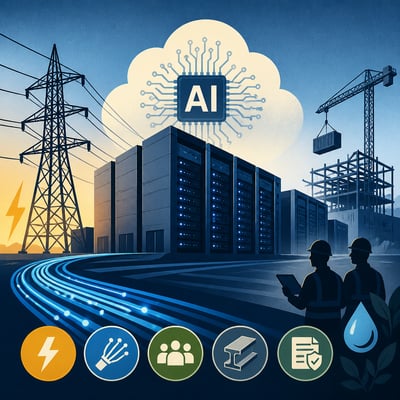
S. data center construction and investment are accelerating as hyperscalers and technology companies add capacity for AI workloads. The expansion is increasingly shaped by long power-delivery timelines, transmission and generation limits, permitting disputes, cooling requirements, and a shift toward rural or secondary markets with available land and electricity. Developers are responding through phased construction, powered-land acquisitions, private generation, site conversions, and long-term leases, but forecasts indicate that announced capacity may exceed what the grid can support on current timelines.
The update mainly confirms the existing constraint-driven narrative, while adding a quantified estimate that permitted projects could require 224–359 TWh of annual electricity.
The story now has sharper quantitative evidence of an impending power constraint: large-load grid connections can take over four years, with a projected 63 GW U.S. energy shortfall by 2033. This strengthens the urgency around rural siting, private generation, and the risk that announced capacity will not commission on schedule.
The story has broadened from a primarily U.S.-focused construction surge into a global infrastructure race, with deployment increasingly constrained by equipment, labor, financing, and community acceptance in addition to power. New detail also emphasizes larger, denser campuses and greater execution risk for projects already backed by capital.
The story is largely confirmed, with one meaningful clarification: 2025 permitting data now quantifies the breadth of planned U.S. expansion at 176 projects across 34 states. The central constraints and development trends remain unchanged.
The story now quantifies the potential electricity burden of permitted U.S. projects, strengthening the conclusion that power availability—not demand—is the central execution constraint. Construction momentum is also shown to be accelerating, with spending up more than 28% year over year.
The story now places greater emphasis on execution pathways and regulatory friction: former cryptocurrency-mining sites and non-hyperscaler operators are becoming part of AI capacity expansion, while proposed restrictions add a more concrete policy risk.
The story now has a more quantified and urgent energy constraint, with a projected 63 GW U.S. shortfall by 2033 and average large-load power-delivery timelines of 4.4 years. It also emphasizes execution risk: substantial announced capacity lacks firm commissioning dates and remains dependent on difficult infrastructure delivery.
The story broadens from predominantly U.S.-focused construction constraints into a more explicitly global and geopolitical infrastructure race. China’s reported state-led expansion and growing scrutiny from host communities add new dimensions beyond power, land, and cooling availability.
The story now extends beyond construction and grid constraints to include measurable year-over-year spending growth, industrial supply-chain leasing, and consolidation in liquid-cooling services. New actors such as Hut 8 and Ecolab indicate more active implementation strategies and commercial responses.
The story now emphasizes a broader investment and execution bottleneck: not just power and cooling constraints, but also tenant commitments, labor, and local review factors that may determine which AI data centers actually get built. It also adds a clearer market signal that hyperscalers and investors are still pouring in hundreds of billions despite the expanding project pipeline.
The story broadens from a mostly U.S.-focused power-and-labor constraint narrative into a wider market and infrastructure bottleneck story, with more emphasis on rural siting, cooling, water, and financing strain. It also adds a clearer warning that many announced projects may not secure power or commissioning dates on time.
- Large-load power delivery can take about 4.4 years.
- Permitted projects could require 224.3 to 358.8 TWh annually.
- Private AI infrastructure funding reportedly fell in Q2.
- Liquid and closed-loop cooling are gaining importance.
- Developers are shifting toward rural and secondary markets.
The story has tightened from a broad, multi-region AI data center buildout to a more U.S.-centric picture centered on rapid capital deployment and hard infrastructure bottlenecks. The new version adds concrete scale indicators and highlights emerging fixes such as on-site gas generation, structured financing, and workforce training.
- U.S. data center construction spending exceeded $50 billion in April.
- Nearly 97.5% of studied U.S. facilities are in metropolitan or micropolitan areas.
- On-site gas generation and former coal-plant sites are being considered.
- Large workforce-training programs are being launched for skilled trades.
- Investor and local-government concerns are rising over overbuilding and financing exposure.
The story has broadened materially from a general AI data center buildout constraint narrative into a larger, more explicitly infrastructure-driven expansion across the U.S., Southeast Asia, and China. The current version also adds more concrete actors and emphasizes state-directed Chinese planning alongside tightening fiber and grid-linked supply chains.
The story broadens from a general AI data center buildout constraint narrative into a more specific 2026 picture of where bottlenecks are biting: power, interconnection, permitting, and physical supply chains across the U.S. and Asia. The current version also adds new actors and sharper evidence that the buildout is still accelerating rather than simply growing in scale.
The story has broadened from a general AI data center buildout constraint narrative into a more specific, higher-confidence view of larger hyperscale campuses, tighter power planning, and a wider regional footprint. It now emphasizes execution pressure across the US and Asia, including Southeast Asia and a state-directed China buildout, rather than mainly describing bottlenecks.
- Hyperscale campuses and multi-gigawatt projects are becoming more common.
- Southeast Asia is adding major data center capacity.
- China is preparing a state-directed nationwide buildout with domestic technology requirements.
- Data centers are increasingly treated as integrated power-and-infrastructure projects.
- Permitting and construction spending remain strong in the US.
AI is driving a large-scale buildout of data centers that is increasingly constrained by power availability, fiber supply, workforce capacity, and upstream materials. Major cloud and technology firms are locking in long-term contracts, new manufacturing capacity, and local training programs to secure the infrastructure needed for AI growth. The topic also includes rising scrutiny over electricity demand, land use, water use, and permitting as projects spread across the U.S. and abroad.