Data Center Power Costs And RatesData Center Power Costs And RatesCoverage from Houston Public Media, MinnPost, and others
00/00/0000
DailyWeekly
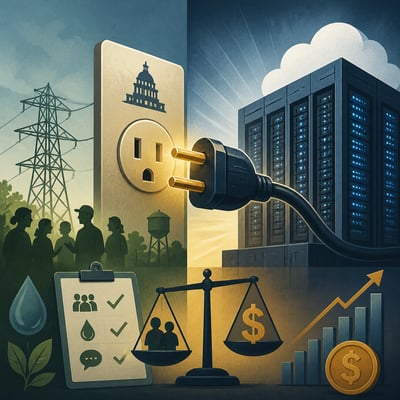
Data center growth is pushing utilities and regulators to redesign rates, contracts, and grid funding so large customers pay for new infrastructure without shifting costs to households.
Missouri and Montana proceedings, plus multi-state utility filings, show a strong current focus on cost allocation, long-term service commitments, and load uncertainty. The signal is coherent and fairly dense, with most material pointing to an ongoing structural utility-planning issue rather than a short-lived local dispute.
Looking Back
71 Day Timeline
Articles published over time. Hover any bar for the period and its article count.
May 8
May 20
Jun 1
Jun 13
Jun 23
Jul 5
Jul 17
History
07/02/2026
The story has broadened from general utility planning around data-center load growth into more specific state-level rate design and contract fights, with Missouri and Montana emerging as the clearest active battlegrounds. The new material also adds more concrete implementation details such as rate freezes, minimum contract terms, and direct connection-cost requirements aimed at shielding households.
06/29/2026
The story has broadened from a general utility-cost conflict into a more specific regulatory and operational push: FERC is now explicitly pressing ISOs and RTOs to accelerate large-load interconnections and improve cost transparency. The current version also adds a stronger emphasis on regional divergence and on power availability, not just cost allocation, as a binding constraint on data center growth.
Missouri City, Texas, adopted zoning rules in May requiring energy and water disclosures and public hearings for new data center permits as Houston-area growth accelerates.
6/8/2026 • Permitting & Regulation • Permitting & Regulation: Zoning & Land Use
Missouri City, Texas required energy and water usage disclosure and public hearings for proposed data centers after fast regional expansion raised grid and water concerns.
6/8/2026 • Permitting & Regulation • Permitting & Regulation: Zoning & Land Use
St. Charles, Missouri adopted a permanent ban on data-center construction after resident concerns, as Missouri lawmakers stalled on permitting and tax-incentive bills and local elections escalated project disputes.
6/12/2026 • Community & Local Opposition • NIMBY Opposition
Missouri Rural Crisis Center and No MO Dirty Data Center Coalition will rally in Jefferson City on Wednesday ahead of a closed Local Government Data Center Summit.
6/16/2026 • Community & Local Opposition • NIMBY Opposition
In Jefferson City, Missouri on Wednesday, a protest and Gov. Mike Kehoe summit highlighted local disputes over AI data center expansion, water concerns, and public input.
6/17/2026 • Community & Local Opposition • Public Engagement
The White House plans a voluntary pledge with utilities and data center developers to limit household electricity bill increases from AI-driven load growth.
NV Energy announced an end to Liberty Utilities electricity supply after May 2027, amid Northern Nevada data-center load growth and policy proposals on grid-upgrade cost allocation.
Morningstar equity analysts Travis Miller and Andrew Bischof recommend selected U.S. utilities in response to data-center-driven electricity demand and related grid investment.
CGEP studies and U.S. utility filings show electricity bill changes track grid upgrade incentives and congestion constraints as data center demand rises during 2025.
Missouri lawmakers asked Gov. Mike Kehoe for a special session and Jackson County for a moratorium to address data center infrastructure and land use concerns.
6/23/2026 • Permitting & Regulation • Local Approvals & Hearings
FERC issued show cause orders to US RTOs and ISOs to revise transmission service, interconnection, and cost allocation rules for large loads starting under Federal Power Act jurisdiction.
FERC issued June 18, 2026 section 206 show cause orders to six RTOs and ISOs, directing tariff changes for large-load integration, including data centers, within 60 days.
7/15/2026 • Power Procurement & Grid • Grid Interconnection
Missouri state lawmakers and local cities address hyperscale data-center growth with failed bills and moratoriums focused on water permits, electricity use, and cooling requirements.
6/7/2026 • Permitting & Regulation • Permitting & Regulation: Zoning & Land Use
EPRI and Emerald AI-backed flexibility testing links data-center operating actions to utility grid signals as AI load growth strains interconnection speed and reliability.
6/26/2026 • Power Procurement & Grid • Substation & Transmission
Independence City Council schedules discussion and a public hearing on new zoning and special-use permit limits for future data centers, including closed-loop water and setback requirements.
7/16/2026 • Permitting & Regulation • Permitting & Regulation: Zoning & Land Use
Henrico County, Virginia asked public schools and county facilities to reduce electricity use during a heat wave as electricity rates increased July 1.
Scotland and UK planning discussions, along with US gas capacity forecasts, raise regulatory concerns as data center power demand and water use increase.
Entergy CEO Drew Marsh told CNBC that Fair Share Plus would require data centers to cover incremental grid and overhead costs, protecting residential customers across Louisiana, Arkansas, Mississippi, and Texas.
FERC issued June 18, 2026 show cause orders to six ISOs and RTOs to accelerate large load interconnections, including data center demand, and require resource adequacy reporting.
6/26/2026 • Power Procurement & Grid • Grid Interconnection
S&P Global Ratings webinar explains Shade of Green criteria for data-center financings, focusing on decarbonized electricity procurement and water-aware cooling amid power and permitting constraints.
6/23/2026 • Power Procurement & Grid • Power Procurement & Grid: Power Purchase Agreements
FERC directed six U.S. regional grid operators within months to accelerate interconnection for large tech loads while limiting ratepayer cost shifting for grid upgrades.
6/18/2026 • Power Procurement & Grid • Grid Interconnection
PJM and other U.S. grid operators face large data center load growth, shifting planning toward interconnection timing and reliability as time-to-power becomes a development constraint.
FERC approved orders in Washington to speed large data-center grid connections to 90 days, with tradeoffs for curtailment and upgrade costs as utilities face rising bill pressures.
6/20/2026 • Power Procurement & Grid • Grid Interconnection
FERC issued June 18 directives requiring six U.S. regional grid operators to reform or justify data center interconnection practices amid long connection queues.
6/24/2026 • Power Procurement & Grid • Grid Interconnection
Gov. Greg Abbott directed ERCOT and the Texas Public Utility Commission on interconnection costs for data centers, alongside a July 17 joint-report requirement.
FERC chair Laura Swett announced orders in 2024 requiring grids to report and process hyperscaler data center connections faster, citing insufficient US grid capacity.
6/20/2026 • Power Procurement & Grid • Grid Interconnection
National Taxpayers Union and Pelican Institute promote Consumer Regulated Electricity in the US to enable islanded private power contracting for data-center and industrial load.
7/10/2026 • Power Procurement & Grid • Backup Power & Generation
Oracle operations use millisecond-scale GPU heartbeat triggered secondary workloads to smooth AI data-center power fluctuations caused by bulk-synchronous training pauses.
Nvidia, AWS, and other vendors in June 2026 emphasized system-level AI data center design, focusing on networking latency, orchestration, memory, and utilization.
FERC ordered PJM, MISO, and ERCOT to submit interconnection reform proposals and adequacy reports for data center large loads within set 30- and 60-day deadlines.
6/22/2026 • Power Procurement & Grid • Grid Interconnection
Senator Bernie Sanders and other state policymakers propose data-center construction moratoria and off-grid power exemptions amid grid interconnection constraints and local opposition.
NextEra Energy proposed acquiring Dominion Energy in a $66.8 billion deal as U.S. utilities increase contracted large-load capacity for data center demand.
E3 study examined E3 data for four Amazon data centers and found required grid expansions were financed by Amazon, affecting electricity bill allocations in Mississippi.
Texas Gov. Greg Abbott ordered PUCT and ERCOT to act by late July to keep data-center interconnection costs from increasing residential transmission charges in Texas.
On June 18, 2026, FERC issued show cause orders to RTOs and ISOs seeking tariff and planning reforms for expedited interconnection of large loads such as data centers.
Southwire expanded a North Carolina cable plant and modernized facilities in response to rising AI data center power demand and Georgia permitting limits.
7/5/2026 • Market Demand & Investment • AI Infrastructure Demand
FERC fast-tracked show-cause orders for ISO-NE, NYISO, PJM, MISO, SPP, and CAISO to revise large-load tariffs and accelerate grid access for data centers.
In the United States, utilities and datacenter operators face long grid interconnection timelines as electricity demand drives batteries, solar, and some fossil generation.
6/19/2026 • Market Demand & Investment • AI Infrastructure Demand
State regulators and PJM analysts described how coincident peak demand pricing and grid upgrade cost allocation tied to data center load can increase electricity rates for U.S. consumers through 2028.
Abbey O'Brien at Ulteig recommends grid-interconnection reforms for utilities facing AI and hyperscale data center demand, building on FERC Order 2023 cluster study methods.
Columbia University researchers reported grid-enhancing technologies and data center demand response could mitigate electricity price pressures from growing computing loads.
Utility executives in PJM and other U.S. regions cited constraints and process uncertainty as data center load growth drives new planning, contracts, and spending.
EPRI and Columbia University studies published in the 2020s examine how US data-center load interacts with power-system planning and incentives to affect electricity rates.
Henrico County manager John Vithoulkas issued a June 26 electricity reduction request after a 25% utility rate increase took effect July 1 for county and school facilities.
California data center projects face constraints in electricity pricing, grid connection timelines, and 100 MW backup-generator certification rules, limiting planned facility scale.
Multiple US states approve large-load tariffs with collateral and minimum charges to transfer data-center stranded-cost and capacity risk from ratepayers to large customers.
S&P Global Ratings assessed how data center lease expiry during debt terms increases reletting exposure, using hypothetical 500 MW Atlanta projects to show DSCR sensitivity to rollover timing.
7/1/2026 • Market Demand & Investment • AI Infrastructure Demand
FERC issued six Section 206 show-cause orders in 2026 directing six RTOs and ISOs to justify or revise large-load grid interconnection tariffs for data centers and other 20 MW-plus facilities.
Henrico County, Virginia, under County Manager John Vithoulkas, issued electricity-use reduction guidance after a new municipal contract raised power rates nearly 25% starting July 1.
Virginia, especially Northern Virginia around Loudoun and Henrico near Richmond, is highlighted as a major Northeast data center cluster near substations and gas infrastructure.
Elea Data Centers and AXIA Energia advance BEL1 in Belém, Brazil, while Milan ML5 heat recovery and Portugal SINES ocean-water cooling expand broader data center siting approaches.
7/4/2026 • Market Demand & Investment • AI Infrastructure Demand
Columbia Threadneedle is monitoring credit impact from hyperscaler data center construction, emphasizing supplier revenue visibility alongside customer-concentration and stranded-asset risks.
7/17/2026 • Market Demand & Investment • AI Infrastructure Demand
Texas Gov. Greg Abbott directed ERCOT and the Public Utility Commission in 2027-focused data center regulation proposals while OpenAI pursued a 10 GW Ohio campus lease in Piketon.
6/13/2026 • Market Demand & Investment • AI Infrastructure Demand
ERCOT approved tougher interconnection requirements for Texas data center projects as AI-driven demand increases and local governments begin adding oversight.
6/3/2026 • Policy & Utility Planning • State Energy Policy
City Utilities of Springfield is reviewing large-load data center proposals with system impact studies, extra-large user rates, and water evaluations to protect grid reliability and existing customer bills.
City Utilities of Springfield launched a large-load review process and system impact studies for proposed data centers, including an extra-large energy user rate.
Utilities and regulators in the United States respond to increased large-load data center interconnection requests that strain grid planning and raise capacity costs.
Barclays analyst Julian Mitchell links upcoming 800VDC AI data center designs starting in 2027 to potential upside for Vertiv, GE Vernova, and nVent Electric.
6/26/2026 • Market Demand & Investment • AI Infrastructure Demand
Hawley and Blumenthal advance the GRID Act in Washington as EPA proposes permitting changes and Congress debates moratoriums over data-center electricity impacts.
5/22/2026 • Policy & Utility Planning • State Energy Policy
During a Montana Public Service Commission hearing, NorthWestern Energy and Black Hills Corp. faced questions about data center load discussions and residential rate impacts ahead of expected 2026 approval.
State legislatures across the U.S. are revising data-center incentives in 2025-2026 with ratepayer cost protections, tighter electricity rules, and more water and permitting requirements.
Henrico County, Virginia, directed government and school employees to conserve electricity after Dominion Energy multi-year contract rate increases of nearly 25 percent begin July 1.
The White House will host a forthcoming voluntary pledge aligning utilities and data center developers to limit ratepayer-funded grid upgrade costs driven by AI power demand growth in the United States.
Entergy Louisiana announced $2 billion in additional customer savings from a Meta Louisiana campus power agreement, citing improved grid resilience under Public Service Commission oversight.
Entergy CEO Drew Marsh described a Fair Share Plus framework for large data center customers in Louisiana, Arkansas, Mississippi, and Texas to reduce residential bill impacts amid public backlash.
Utilities and regulators across multiple U.S. states expand rate freezes and large load tariffs tied to data center demand growth, aiming to avoid residential cost impacts.
City Utilities of Springfield created a large-load task force in Springfield to review data center proposals using system studies, extra-large user rates, and water assessments.
Georgia Power says revised contract and upfront infrastructure cost rules for data centers aim to protect residential and small-business customers while funding grid upgrades in Georgia.
FERC issued six Section 206 show-cause orders to PJM and five other ISOs on June 18, 2026, seeking tariff revisions for large co-located loads such as data centers.
The White House plans a voluntary pledge meeting with utilities, data center operators, and state governors to keep AI-driven grid upgrade costs off ratepayers in the United States.
Dominion Energy Virginia GS-5 large-load tariff modeling uses a hypothetical 100 MW data center to assess stranded cost risk and ratepayer protections.
The White House planned a July event to coordinate utilities and data center developers on a voluntary pledge limiting ratepayer costs from AI electricity demand growth.
Idaho HB 911, effective July 2026, requires PUC-approved contracts for new AI data center loads above 50 MW and allocates generation and transmission cost responsibility.
Montana Public Service Commission held a four-day hearing in Helena on a proposed NorthWestern Energy and Black Hills Energy merger as data center load and rate impacts became central issues.
Evans and Dean asked FERC to explain how grid reliability and transmission planning will address data-center load growth and related consumer affordability concerns in 2026.
Analysts and local residents in Virginia and West Virginia describe Northern Virginia data center demand and coal-centric utility planning as key factors behind rising electricity costs.
Wayne Christian backed Gov. Greg Abbott's directive to PUC Texas and ERCOT on requiring data centers to pay full electricity infrastructure costs in Texas.
6/11/2026 • Policy & Utility Planning • State Energy Policy
FERC issued Section 206 show cause orders in 2020s to RTOs and ISOs requiring tariff fixes for data center cost allocation and speed-to-power interconnection.
Mark MacCarthy links the March 4, 2026 Ratepayer Protection Pledge to state tariff rules ensuring data centers pay grid costs in full across USA states including Virginia and Ohio.
FERC ordered six regional grid operators on June 18 to justify or revise transmission planning and tariff rules for rapidly growing data-center demand.
SMUD in Sacramento is studying transmission needs for a 50-MW data center inquiry, with a targeted fall 2026 study completion amid limited hyperscale expectations.
7/14/2026 • Infrastructure & Site Development • Construction & Buildout
Noah and Kate Gordon say Virginia and Lake Tahoe should require data centers to help fund transmission upgrades, substations, and resilience as utility and local costs rise.
Ohio and Virginia regulators approved large-load tariffs for new data center load while Minnesota evaluates Clean Transition Tariff structures to procure cleaner resources.
MISO, Minnesota utilities, and the Minnesota PUC address whether data centers drive peak summer power demand and approve safeguards for future very large customer costs.
In Montana, NorthWestern Energy deals with data centers drew Public Service Commission and community scrutiny over ratepayer funding for grid and power upgrades.
NorthWestern Energy filed large-load electric rate proposals with the Montana Public Service Commission, drawing nine intervention requests tied to data-center power planning.
NorthWestern Energy filed a Large New Load Tariff proposal with the Montana Public Service Commission in Missoula to charge 5 MW-or-more data center loads for infrastructure upgrades.
United States research using an instrumental-variables approach estimates data centers lowered average retail electricity rates from 2015 to 2024, with possible reversal under future supply constraints.
Castor and Evans introduced the Ratepayer Protection Act on June 19, 2026, to require state regulators to prevent ratepayer-funded grid upgrades for 100 MW+ data-center loads.
NorthWestern Energy CEO Brian Bird testified at a Montana Public Service Commission hearing on a proposed $15.4 billion merger with Black Hills, linking data center discussions to growth and potential rate issues in 2026.
NorthWestern Energy filed a Montana PSC tariff case for data center large loads in March 2026, prompting intervention petitions from state DEQ, cities, consumer advocates, industry, and conservation groups.
6/22/2026 • Policy & Utility Planning • State Energy Policy
NorthWestern Energy seeks PSC approval for data center serving terms in Montana, while an Earthjustice-led coalition requests a dedicated data center customer class.
Henrico County, Virginia, expects a 25% rise in electricity costs next year and ordered government power conservation after residents raised concerns tied to expanding data-center operations.
MultiState reports that Alabama, Tennessee, South Dakota, Nebraska, and Florida enacted data-center energy bills requiring ratepayer protection cost recovery tied to grid expansion.
6/4/2026 • Policy & Utility Planning • State Energy Policy
The Trump administration reportedly plans to expand the Ratepayer Protection Pledge by promoting Consumer-Regulated Electricity for private data center power networks.
7/16/2026 • Policy & Utility Planning • State Energy Policy
IDCA reported May 13 that power scarcity and grid constraints are driving growing resistance to data center builds in major markets, including Northern Virginia.
In February 2025, Indiana regulators approved an Indiana Michigan Power hyperscale settlement with stranded-cost protections while other utilities cited data center load as a potential driver of lower or stabilized customer bills.
ERCOT and FERC guidance in Texas targets milestone and evidence thresholds for AI data center load assumptions that influence transmission planning and interconnection approvals.
Montana Public Service Commission review of a NorthWestern Energy-Black Hills Corp merger coincides with anticipated electricity demand from large data centers exceeding current customer load.
FERC directed six RTOs to justify or revise large-load tariff rules for data center grid interconnection under section 206, with a 60-day compliance timeline.
Missouri lawmakers on the House Utilities Committee discussed Ameren Missouri generation expansion, data center electricity contracts, and possible ratepayer cost exposure during an informational hearing.
FERC ordered six regional grid operators to justify or revise large-load facility rules for data-center demand and submit generation adequacy reports within 30 days.
FERC issued June 18, 2026 show cause orders requiring RTOs and ISOs to justify large-load interconnection tariff adequacy amid data-center electricity demand growth.
Mississippi policy SB2001 is criticized for weakened Public Service Commission oversight of large data-center contracts, potentially shifting grid costs onto residential customers.
Synapse Energy released a Mississippi-focused report for Environmental Advocates Mississippi and Earthjustice on Entergy Mississippi data-center grid costs and residential bill increases in 2025-2026.
Earthjustice filed an intervention petition with the Montana Public Service Commission in NorthWestern Energy's data center tariff proceeding, seeking public transparency and stronger protections for residential ratepayers.
FERC issued orders requiring six major US interstate grid operators to revise data center transmission rules within 60 days to speed capacity approval.
Tony O'Donnell filed to intervene in a NorthWestern Energy tariff case in Montana on June 19, targeting cost allocation rules for 5+ megawatt data centers.
Entergy in Arkansas, Louisiana, and Mississippi describes data center cost-sharing agreements signed 2024 to 2025 to fund grid upgrades and reduce residential bills.
FERC ordered regional grid operators to submit 60-day plans for data center demand cost transparency and faster transmission upgrades in the United States.
Missouri Senate Bill 4 sets large-load tariffs and long-term contract requirements for hyperscale data centers, while environmental groups question residential cost pass-through and regulatory coverage.
6/5/2026 • Policy & Utility Planning • State Energy Policy
FERC ordered six U.S. RTOs and ISOs to revise large-load interconnection rules for data centers after grid interconnection processes appeared inadequate.
Entergy Mississippi CEO Haley Fisackerly said Amazon data center expansion in Madison County, Clinton, and Vicksburg supports grid upgrades and projected savings for customers.
PJM market monitoring projected $23 billion in customer electricity price increases through at least 2028, driven by expected data-center power demand.
Georgia PSC, Entergy, and Indiana Michigan Power describe data center agreements as enabling new generation and grid investments that lower residential rates.
Henrico County asked schools and government offices to cut electricity use as the local grid strained by 37 data centers faces power demand from 17 proposed sites.

 AI Governance
 Data Centers
 Drones
 Climate
 Privacy
 2026 Maine Senate
 Bob Dylan

 Turner Report / Randy Turner