
 AI Governance
 Data Centers
 Drones
 Climate
 Privacy
 2026 Maine Senate
 Bob Dylan

Data Center Power Costs And Rates
Coverage from Houston Public Media, MinnPost, and others
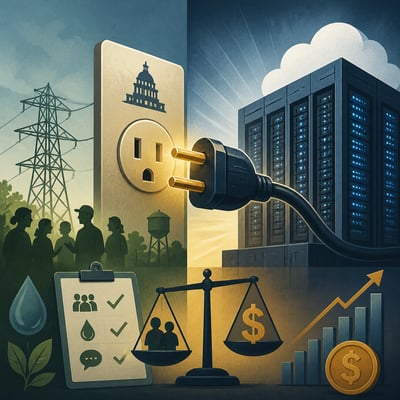
Data center growth is pushing utilities and regulators to redesign rates, contracts, and grid funding so large customers pay for new infrastructure without shifting costs to households.
Missouri and Montana proceedings, plus multi-state utility filings, show a strong current focus on cost allocation, long-term service commitments, and load uncertainty. The signal is coherent and fairly dense, with most material pointing to an ongoing structural utility-planning issue rather than a short-lived local dispute.
The story has broadened from general utility planning around data-center load growth into more specific state-level rate design and contract fights, with Missouri and Montana emerging as the clearest active battlegrounds. The new material also adds more concrete implementation details such as rate freezes, minimum contract terms, and direct connection-cost requirements aimed at shielding households.
The story has broadened from a general utility-cost conflict into a more specific regulatory and operational push: FERC is now explicitly pressing ISOs and RTOs to accelerate large-load interconnections and improve cost transparency. The current version also adds a stronger emphasis on regional divergence and on power availability, not just cost allocation, as a binding constraint on data center growth.
- FERC is pressing ISOs and RTOs to speed large-load interconnections.
- Regulators are being urged to improve transmission-cost and study-timeline transparency.
- Regional policy responses are described as sharply different across states and utilities.
- Water and cooling are now identified as secondary constraints.
The story has broadened from general disputes over who pays for data-center-driven grid upgrades into a more concrete utility-planning and execution story, with utilities now actively securing contracts, tariff proposals, and rate protections. The newest emphasis is on operational flexibility and multi-state planning responses, while Montana remains the clearest active regulatory battleground.
- Utilities are booking multi-gigawatt data-center demand in planning.
- Rate-freeze filings are being used to protect household bills.
- Workload flexibility is emerging as an operational response.
- Montana debates now include merger-related growth assumptions.
- The story now spans more states and utilities.
The story broadens from a general utility-ratepayer conflict into a more specific operational and policy picture, adding California’s harder siting constraints and S&P’s financing/sustainability lens. It also surfaces more concrete state-level scrutiny in Missouri and Montana and highlights PJM queue uncertainty as a live implementation risk.
- California faces high power prices, slow interconnection, backup-generation rules, and local moratoria.
- Missouri lawmakers are actively hearing data center load-growth and ratepayer-exposure disputes.
- PJM queues now include projects that may be delayed, downsized, or never built.
- Power sourcing and water use are becoming central evaluation criteria for data centers.
- S&P Global Ratings and PG&E are newly named actors.
The story has broadened from a state-by-state utility pricing and cost-allocation dispute into a more explicit regulatory regime, with FERC now directly pushing large-load interconnection reforms and protection rules. It also adds a new practical response: utilities are increasingly using rate freezes and customer-protection filings to ease approval of data center-driven investments.
- FERC ordered grid operators to revisit large-load interconnection rules.
- Utilities are filing rate freezes alongside data center deals.
- Some developers are pursuing off-grid or behind-the-meter power arrangements.
- Montana merger review now ties directly to data center growth concerns.
- Residential customers may face costs for assets built before demand materializes.
The story has shifted from broad regulatory debate to a more concrete utility-planning and cost-recovery phase, with utilities now openly building major capacity around data center demand. The biggest new element is the stronger emphasis on long-term contracts, large-load tariffs, and dedicated customer-funded upgrades as the preferred way to protect other ratepayers.
- Several utilities report large new data center load pipelines and multi-year buildouts.
- Long contracts and large-load tariffs are now a dominant response.
- Montana and Missouri are now central venues for hearings and rate-design disputes.
- Industry groups are presenting dedicated cost recovery as consumer-protective.
- Some regions are actively courting large-load demand with specialized pricing.
Utilities, state regulators, and federal policymakers are adjusting rules as data centers create unusually large new electricity loads. The main issues are who pays for new generation and transmission, how quickly facilities can connect, and how to protect existing customers from stranded costs and rate increases. Local debates are also intensifying as communities weigh economic benefits against water, land, and infrastructure impacts.