
 AI Governance
 Data Centers
 Drones
 Climate
 Privacy
 2026 Maine Senate
 Bob Dylan
Sustainable Desalination Cuts Energy and Waste
Coverage from NBC 5 DFW, Boston Globe, and others
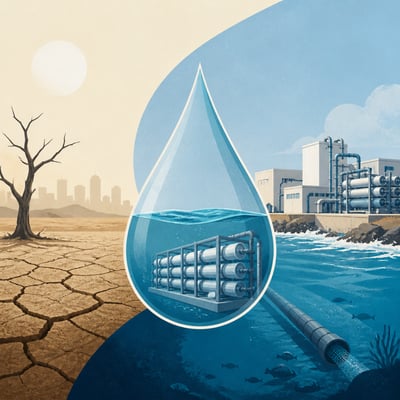
Desalination is expanding as drought, disrupted rainfall, and rising demand increase pressure on freshwater supplies, but conventional systems remain energy-intensive and can harm marine environments through brine discharge and intake impacts.
Research and pilot projects are targeting these drawbacks with solar-driven systems, improved membranes, deep-sea reverse osmosis, hybrid energy designs, and real-time monitoring. Several approaches show promising laboratory or prototype results, although their cost, durability, and performance at commercial scale remain uncertain.
The story now frames desalination more concretely around deployment-stage pilots and operating realities, not just research concepts. It also adds a clearer industry context: reverse osmosis remains dominant, while the key uncertainty is whether these approaches can deliver commercially at scale.
The story has shifted from a general discussion of desalination’s tradeoffs to a more specific account of active technical approaches and named projects aiming to reduce energy use, brine, and biofouling. It now emphasizes that many of these ideas are still unproven beyond lab or prototype settings.
The story now puts more emphasis on specific new desalination approaches, especially University of Rochester solar-thermal salt-recovery work and OceanWell’s subsea pods, rather than just broad efficiency improvements. It also frames desalination more clearly as a practical near-term supply tool alongside longer-term experimentation.
The story broadens from general desalination growth to a more specific operational and policy frame: current coverage now emphasizes concrete efficiency pathways and the constraints slowing deployment. It also adds new actors and a clearer evidence base around subsea pilot activity and research efforts.
Desalination is gaining attention as drought, rainfall disruption, and water scarcity push more regions toward seawater-based drinking water. Reverse osmosis remains the dominant approach, while newer subsea designs aim to lower energy use and environmental impacts.