
 AI Governance
 Data Centers
 Drones
 Climate
 Privacy
 2026 Maine Senate
 Bob Dylan
Floating Solar Expands Across Water
Coverage from AutoNotcion, kiowacountypress, and others
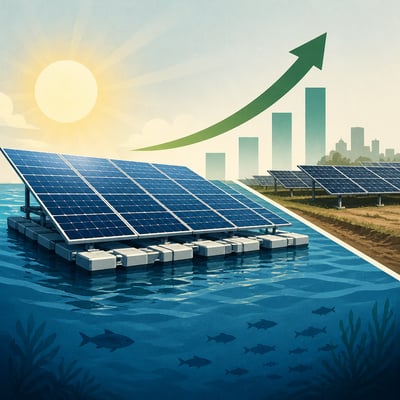
Floating solar is being considered for reservoirs, industrial waterways, and selected offshore sites where land is scarce, water conservation is valuable, or existing grid connections can support new generation.
Evidence from Taiwan suggests water-based cooling can improve output, while U.S. assessments identify substantial theoretical potential on federally regulated reservoirs. Expansion remains constrained by permitting, environmental review, transmission from water to shore, marine durability, maintenance, and possible effects on aquatic ecosystems.
The story has broadened from a general assessment of floating solar’s promise and constraints to a more specific view of where it may be viable: offshore selected sites and U.S. federally regulated reservoirs with existing grid access. The new version also sharpens the central bottlenecks, especially permitting and environmental review, while reframing large resource estimates as technical ceilings rather than deployment forecasts.
The story has broadened from a Taiwan-centric performance comparison into a wider assessment of floating solar as a deployable option on reservoirs and coastal waters, especially in the U.S. The new emphasis is on practical scaling constraints: permitting, federal licensing, grid connection, and environmental review.