
 AI Governance
 Data Centers
 Drones
 Climate
 Privacy
 2026 Maine Senate
 Bob Dylan
Sea-Level Rise Raises Coastal Flood Risk
Coverage from USA TODAY, New Security Beat, and others
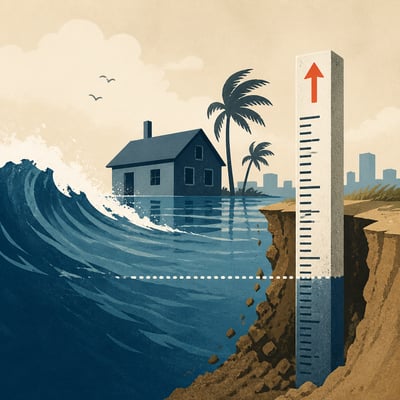
Research indicates that global sea-level rise is accelerating, with warming oceans, glacier loss, and increasing Greenland and Antarctic ice loss contributing to the trend.
Human-caused rise is already making extreme coastal water levels and flooding more frequent, while some global assessments may understate present exposure because of limitations in baseline sea-level modelling. The findings have implications for coastal protection, adaptation planning, population-risk estimates, and assessments of ecosystem resilience.
The update mainly sharpens the scientific framing: it adds a more precise acceleration figure and broadens the attribution from warming oceans and ice-sheet loss to explicitly include mountain glaciers. It also reframes the exposure concern as a baseline-model problem that may understate current risk.
The story now shifts from broad evidence that sea-level risk was underestimated to more specific quantified findings on acceleration, attribution, and exposure. It adds stronger empirical support that warming is already driving more frequent extreme coastal water levels and that some global exposure models start from sea levels that are too low.
- Sea level rose faster in 2005–2023 than its average since 1960.
- Human-caused sea-level rise was detectable at 97% of assessed tide-gauge sites.
- Climate change caused 58% of extreme-water-level days from 2000 to 2018.
- A review of 385 studies found many models start from sea levels that are too low.
- Changing seasonal sea-level ranges may stress intertidal ecosystems.
The updated version sharpens the science rather than changing the overall story: sea-level rise is now more explicitly tied to warming oceans plus Greenland and Antarctic ice loss, and the methodological critique is framed as having broader consequences for exposure estimates. The main new emphasis is that undercounted coastal risk may be more widespread, strengthening the case for adaptation and policy use.
The story has broadened from a measurement-baseline dispute into a stronger attribution-and-impact narrative: sea-level rise is now more explicitly tied to human-caused warming, with more frequent extreme flooding and higher exposure estimates. The baseline-method critique remains central, but it is now framed as a planning and standardization problem affecting adaptation decisions in specific vulnerable regions.
- Human-caused climate change is linked to more extreme coastal flooding days.
- Ocean warming and ice loss are now cited more directly as drivers of rise.
- Flood defenses and adaptation funding are newly framed as affected decisions.
- Standardized, decision-ready coastal risk models are now a stated research goal.
- Specific hotspots like New Orleans, Miami, Jakarta, and Lagos are newly highlighted.
The story has sharpened from a broad upward revision of coastal sea-level risk into a more explicit methodological critique: the latest version emphasizes that baseline errors, datum handling, and coastal-model assumptions are the main drivers of underestimated exposure. It also adds a smaller new strand on ecosystem impacts from seasonal sea-level variability.
Recent coverage shows sea-level risk is being recalibrated upward as researchers and agencies compare modeled baselines with direct coastal measurements. The strongest pattern is methodological: many assessments appear to underestimate present coastal water levels, especially in the Global South and Indo-Pacific, which expands estimated land and population exposure. At the same time, longer-running climate records still show accelerating global sea-level rise driven by ice melt, thermal expansion, and local subsidence. The topic is coherent and structurally important, with moderate-to-dense signal and a strong current emphasis on adaptation planning, hazard maps, and measurement standards.