
 AI Governance
 Data Centers
 Drones
 Climate
 Privacy
 2026 Maine Senate
 Bob Dylan
North Carolina Weighs Gas Against Solar
Coverage from Inside Climate News, Canary Media, and others
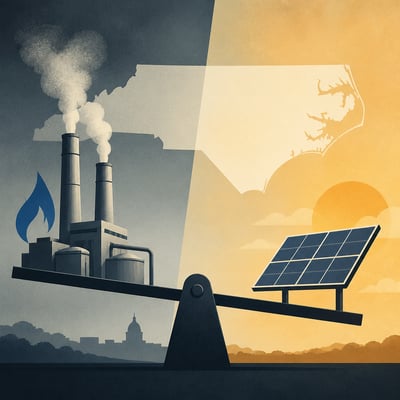
North Carolina is debating whether rising electricity demand should be met with new natural-gas and nuclear generation or with faster solar, battery storage, and efficiency measures.
Duke Energy’s proposed expansion has drawn regulatory scrutiny over demand forecasts, construction and fuel costs, emissions, and the risk of overbuilding, while lawmakers are considering measures affecting fossil-fuel permitting, data centers, coal retirement, and solar taxation. The outcome will shape ratepayer exposure, the pace of coal replacement, and the state’s ability to maintain its long-term emissions goals.
The story now frames Duke’s expansion debate more explicitly around ratepayer risk and overbuilding concerns, while the clean-energy response has sharpened into a stronger push for local solar, batteries, and efficiency as alternatives to both gas and new nuclear. The legislative side also became more concrete, with Senate Bill 730 and House Bill 1213 now tied to data centers, fossil-fuel permitting, coal retirements, and solar taxation.
The story now has sharper regulatory and legislative specifics: Duke’s gas plans face a formal delay recommendation, while two bills would reshape both data-center growth and solar taxation. The framing has also tightened around a policy choice between dispatchable fossil/nuclear capacity and faster clean-resource deployment.
- Public Staff recommended delaying Duke’s CC4 and CC5 gas plants.
- Senate Bill 730 would restrict large data center development.
- House Bill 1213 would end the 80% solar property-tax exclusion.
- Demand projections now include life sciences as a major load driver.
- Current framing centers on fossil/nuclear versus clean-resource prioritization.
The story now centers more sharply on two new fault lines: a legal fight over Duke’s halted 2026 solar and storage procurement, and a broader legislative push that could reshape fossil, solar, and tax policy in North Carolina. At the same time, the gas-buildout debate is more explicit about modeling risk, overbuilding, and whether large-load growth justifies the proposed investments.
- Legal challenge filed to restore Duke’s 2026 solar and storage procurement.
- Utilities Commission halted procurement without, filing says, a hearing or public comment.
- Lawmakers are considering changes to fossil-fuel permitting and coal retirements.
- Solar property-tax changes could affect systems installed after July 1, 2027.
- Critics are targeting Duke’s CC4 and CC5 gas projects specifically.
The story now extends beyond utility planning disputes into a more explicit legislative and rate-design fight over data centers, with new actors joining the debate and nuclear approval becoming more central to coal retirement policy. The addition of court challenges and state-level intervention makes the conflict look broader and more procedurally fragmented than before.
The story has broadened from a general dispute over Duke's gas-heavy planning and delayed clean-energy procurement to a more specific 2026 regulatory fight that now includes coal retirement being linked to nuclear approval. The framing also puts greater emphasis on contested load-growth forecasts and the role of transmission and storage in meeting demand.
- Coal retirement is being tied to nuclear permitting.
- EDF is now named as a participant in the dispute.
- The active regulatory period is January to June 2026.
- Critics are challenging Duke's load-growth forecasts as insufficiently tested.
- Transmission and nuclear are now part of the resource-plan debate.
The story now centers more explicitly on a broader regulatory fight over Duke Energy's next resource plan, with heavier scrutiny of gas buildout and clearer emphasis on how delayed solar and storage procurement interacts with load growth and affordability. The framing has shifted from a general gas-versus-clean-energy dispute to a more specific contest over planning assumptions, climate-target weakening, and customer cost exposure.
North Carolina utility planning is tilting toward new gas and delayed solar after climate-target rollbacks, while regulators and advocates dispute Duke Energy's cost, reliability, and modeling assumptions.