
 AI Governance
 Data Centers
 Drones
 Climate
 Privacy
 2026 Maine Senate
 Bob Dylan
Nebraska Wildfires Disrupt Ranching
Coverage from WOWT, KOLN, and others
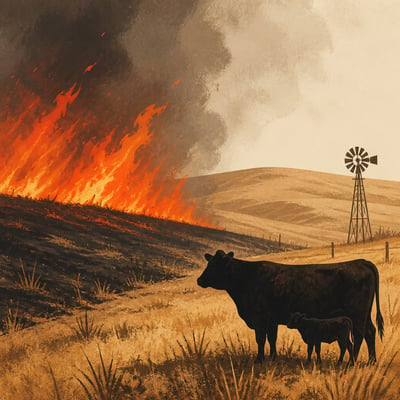
Large wildfires across central and western Nebraska have burned record areas, destroyed grazing land and hay, and disrupted cattle operations during calving season.
The damage is compounded by drought, warm and dry conditions, invasive vegetation, and limited pasture availability, raising costs and in some cases threatening herd sizes and ranch viability. The fires have also renewed debate over prescribed burning, fire-resilient infrastructure, and how Nebraska can reduce fuel loads without increasing the risk of escaped burns.
The story now emphasizes that the wildfire damage is not just large but is directly threatening ranch viability through higher costs, possible herd reductions, and longer recovery. It also adds a stronger policy angle: prescribed burning remains controversial, but regulatory pauses and opposition have become more prominent.
The story has become more concrete and severe: Nebraska’s wildfire crisis is now framed as a record-setting 2026 outbreak that has already burned unprecedented acreage and caused large-scale ranching disruption. The debate over prescribed fire remains, but it is now set against clearer evidence of statewide damage, longer recovery, and limited fire-response capacity.
- 945,381 acres burned statewide by March 30, 2026
- Morrill Fire became Nebraska’s largest documented wildfire
- Calving-season losses included calf deaths and injuries
- Volunteer firefighters and neighboring ranchers played central roles
- Herd reductions may continue for several years
The story now places greater emphasis on a specific, escalating wildfire crisis centered on the Morrill Fire and on ranchers’ immediate coping measures, not just long-term adaptation. It also adds that an escaped prescribed burn has sharpened concern over fire-management risk and state burn restrictions.
- Morrill Fire identified as Nebraska’s largest documented wildfire
- Escaped prescribed burn heightened concern over fire management
- Ranchers are using donated hay and leased pasture
- Cattle culling and herd reductions are part of the response
- State burn restrictions now factor into the debate
The story has shifted from a general account of wildfire damage and climate pressure to a more specific policy and management debate over how Nebraska ranchers should adapt. Prescribed burning is now framed as the central contested tool, alongside operational response measures like back burns and fire breaks.
- Prescribed burning is now a central management dispute.
- Opponents stress escape risk under windy, low-humidity conditions.
- Volunteer firefighters and land managers are part of the response.
- Back burns and fire breaks are being used in active response.
- Fire during calving season has intensified losses.
Nebraska ranching is facing repeated wildfire damage as warm, dry winters, drought, and high winds increase fire risk across the Sandhills and surrounding rangeland. Ranchers are dealing with hay loss, pasture loss, calf deaths, and longer recovery timelines while experts point to prescribed burning and fuel management as partial adaptation tools.