
 AI Governance
 Data Centers
 Drones
 Climate
 Privacy
 2026 Maine Senate
 Bob Dylan
Heat Stress Threatens Wild Bees
Coverage from ScienceDaily, Nature, and others
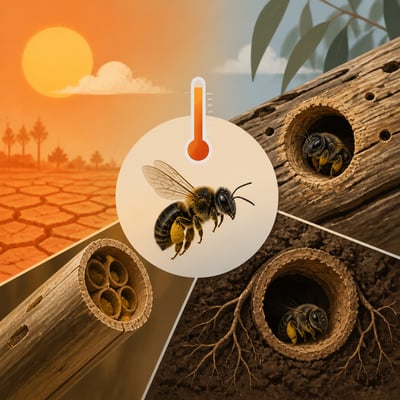
Research indicates that rising heat and climate-driven changes in flowering can undermine bee reproduction, survival and access to adequate nutrition.
Vulnerability varies substantially by species, nesting strategy, foraging range and social structure, with solitary bees and species exposed to hot nest environments facing particular risks. These pressures may reduce pollination capacity, especially when combined with pesticides, habitat loss and mismatches between bee activity and plant flowering.
The story broadens from heat-driven bee stress to a more specific climate-risk framework that also includes altered flowering schedules and compounding pressures from pesticides and habitat loss. It also adds a clearer downstream implication: reduced bee performance can weaken pollination services for wild plants and crops.
The updated story sharpens the mechanism of bee vulnerability by emphasizing nest temperatures and social buffering, while downgrading certainty about overall population and crop impacts. It also slightly reframes the risk as more context-dependent across species and landscapes rather than broadly predictive.
The story now has stronger physiological evidence showing climate heat can directly impair bee fertility, not just shift exposure or nutrition. It also sharpens the warning that using ambient air temperature alone can mis-rank which bee species are most at risk.
- Simulated heatwaves reduced red mason bee sperm activity by 50%.
- Female egg development also declined after three days of heat exposure.
- Nest microclimates reshuffled heat-vulnerability rankings across 95+ Australian bee species.
- Ambient air temperatures alone may misidentify the most at-risk bee species.
- Climate stress may reduce bee fertility, survival, and colony performance.
The story has broadened from Australian nesting-based heat vulnerability to a wider bee decline frame that adds food-quality degradation and multiple compounding stressors. It now emphasizes not just climate exposure, but how warming interacts with pesticides, habitat loss, and timing mismatches across wild bees in Australia, Europe, and England.
- Bee nutrition is now a distinct climate-risk pathway.
- Pollen and nectar quantity, timing, and nutrient composition are being altered by warming.
- Pesticides and habitat loss are newly cited as compounding stressors.
- England and Europe are now included in the bee decline context.
- Solitary and range-limited bees are singled out as more vulnerable.
Recent research on Australian native bees links climate vulnerability closely to nesting behavior and nest microclimates. Bees that nest in stems, wood cavities, or underground experience different thermal conditions, which changes how heat tolerance and risk are assessed. The work matters because it improves predictions of which bee species are most exposed to warming and which pollination systems may be most at risk.