
 AI Governance
 Data Centers
 Drones
 Climate
 Privacy
 2026 Maine Senate
 Bob Dylan
Heat Drives Inactivity and Deaths
Coverage from Penn State News, News-Medical, and others
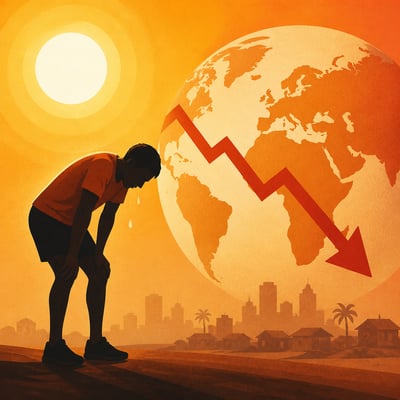
Rising temperatures are projected to reduce physical activity and increase heat-related illness and deaths, with the largest effects in hotter, lower-income regions.
A Lancet Global Health modeling study covering 156 countries estimates that each additional month above 27.8°C could raise global physical inactivity by roughly 1.5 percentage points and contribute to hundreds of thousands of premature deaths annually by 2050. Other evidence highlights Europe’s preparedness gaps, limited cooling access, and the disproportionate mortality burden facing countries with fewer adaptation resources.
The story now puts more weight on quantified future mortality from heat, adding a specific global estimate and emphasizing scenario dependence. It also shifts the geographic emphasis toward Europe’s preparedness gaps alongside the broader inequality in adaptation capacity.
The story has shifted from broad evidence that heat constrains health and activity to a more detailed picture of structural adaptation gaps and policy response. The new version adds concrete U.S. county-level risk projections, WHO year-round planning guidance, and stronger emphasis on unequal cooling, housing, and healthcare capacity as the main determinant of outcomes.
- WHO issued updated year-round heat-health planning guidance.
- U.S. models project more than a threefold cardiovascular burden increase by 2050.
- Heat risk perception is lower than assessed danger in most U.S. counties.
- Humidity and warmer nights are expanding unsafe exposure beyond hot regions.
- Cooling dependence creates affordability, power-demand, and outage vulnerabilities.
The story has shifted from a broad climate-health pattern to a more specific adaptation and infrastructure framing, with Europe now singled out as a cooling-gap case. The latest version also adds clearer institutional sources and a stronger emphasis on measurable mortality and infrastructure constraints.
The story now emphasizes a broader, more explicit heat-stress trend: warming is making dangerous heat exposure more frequent, intense, and longer-lasting, not just limiting outdoor activity. It also adds stronger emphasis on humid heat constraints and productivity losses alongside health impacts.
The story has broadened from a general heat-health pattern into a more quantified and operationalized risk picture, with new global modeling and regional case studies showing where heat most sharply constrains activity and livability. It now emphasizes mortality, unsafe outdoor exposure, and adaptation measures more explicitly than before.
The story has shifted from broad heat-health projections into more specific evidence and policy action: new material emphasizes physical inactivity, stroke risk, human heat-tolerance limits, and official adaptation guidance. The WHO and stroke experts now appear as active actors, making the adaptation response more operational than before.
- WHO issued updated Heat-Health Action Plan guidance.
- Stroke risk is now explicitly tied to climate warming.
- Human heat-tolerance thresholds are a new focus.
- Physical activity losses are projected through 2050.
- World Stroke Organization experts reviewed the evidence.
The story has broadened from a general heat-health warning into a more explicitly quantified projection story, with sharper emphasis on mid-century mortality and cardiovascular burdens under higher-emissions warming. It also adds a new mitigation angle: short-term forecasting is now presented as a potentially meaningful way to reduce heat deaths.
The story has sharpened from a broad climate-health pattern into a more specific evidence base, with newer studies adding cardiovascular-risk framing, county-level perception gaps in the U.S., and greater emphasis on within-country inequality. Adaptation remains central, but the current version is more explicit that the evidence is still largely model-based and uncertain on local magnitudes.
Recent coverage repeatedly points to the same climate-health pattern: rising heat is projected to reduce outdoor physical activity, increase premature deaths, and deepen inequality between hotter lower-income regions and wealthier areas with more cooling and adaptation capacity. The strongest signal comes from Lancet Global Health modeling and Climate Impact Lab mortality projections, which are being echoed by public-facing explainers and adaptation-oriented reports. A second, related thread is that practical responses matter: shaded streets, cooled indoor exercise options, heat advisories, and broader urban design changes are presented as ways to reduce risk. The cluster is coherent and fairly dense, with limited fragmentation; most material is current and research-driven rather than historical. The topic appears structural and ongoing, not short-lived, because it links climate warming to durable health-system, urban, and inequality pressures.